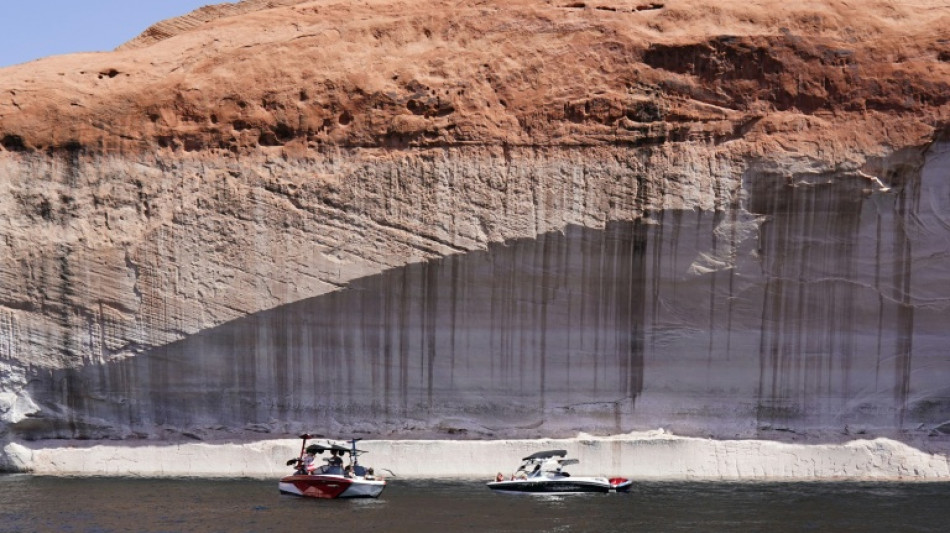
US announces steep water cuts for three states amid Colorado River crisis / Photo: Bryan R. SMITH - AFP

 Zach Hickerson Recounts Hayden Panettiere's Final Moments in New Interview

 Luxembourg Housing Petition Passes Threshold for Parliamentary Consideration

 Raheem Sterling Receives Suspended Sentence After Lamborghini Crash

 Audience to Choose the Set List at Luxembourg's First FAMIL Jukebox Night

 Luxembourg Pay Rise Delayed as Regional and World Headlines Develop

 Chennai Urbanist Sashna Develops 'Anniki' Card Game to Gamify Tamil Nadu History

 Transport Minister Defends Land Seizure Powers for Toronto-Quebec City High-Speed Rail

 UAE Weather Forecast: Scattered Showers and Fog Expected as Temperatures Drop
The US federal government on Friday unveiled its plan for future management of the beleaguered Colorado River, with significant water reductions ahead for several western states in response to record-breaking droughts worsened by climate change.
Under the roadmap, the lower basin states of Arizona, California, and Nevada could face collective cuts of up to 3 million acre-feet (130 billion cubic feet or 3.7 billion cubic meters) of water annually, through 2036.
That is roughly equivalent to the amount of water consumed by nine million households in a year.
The actual extent of reductions will depend on the river's reserve levels and hydrological conditions.
The plan is set to take effect in October for two years before being reassessed.
"The Department has a responsibility to ensure the Colorado River system remains reliable and resilient for the millions of Americans, communities and industries that depend on it," said Secretary of the Interior Doug Burgum.
The drastic measures are aimed at easing a bitter water dispute that has divided the region for years and worsened this year amid an exceptional drought.
In mid-July, the combined water levels of Lake Powell and Lake Mead, the two largest reservoirs in the United States and both fed by the Colorado River, reached their lowest levels in over 60 years.
The Colorado River provides drinking water for more than 40 million people and fuels hydropower across seven states.
The upper basin states of Colorado, Utah, Wyoming, and New Mexico, which also rely on the river for their water supply, will not face the same cuts as the lower basin states -- a disparity likely to fuel disagreements.
Overexploited for decades, the Colorado River is also suffering from the "unprecedented multi-decade drought" that has plagued the region for 25 years, the interior department said.
Washington was forced to step in after the affected states again failed to agree on reducing their water consumption.
D.Lopez--AT


