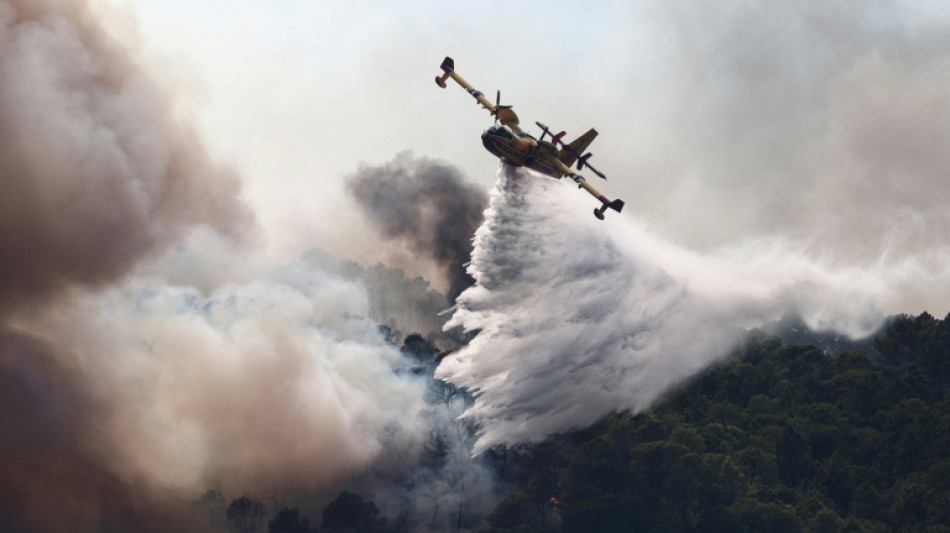
France needs more Canadair water bombers but building them is painfully slow / Photo: Thibaud MORITZ - AFP

 Qatar Facilities Management Market to Reach $11.15bn by 2032

 Black Friday Discounts Cut Prices on Two Top-Rated Wiper Blades

 Twickenham Grounds Team Prepares Pitch for Six Matches in Three Days

 Luxembourg City Plans €13 Million Abrigado Centre for 2029

 Two A1 Crashes Create Kilometres of Rush-Hour Congestion

 South Africa Places 36 Hospitals on Standby for Possible Imported Ebola Cases

 TCC Network Linked to 200% Surge in Global School Attacks

 Beyond Black Friday: A Guide to This Week’s Holidays and Deal Days
As French firefighters struggle to contain the worst wildfires in living memory with just 12 aerial water bombers, production of the iconic aircraft creaks along half a world away in a Canadian factory.
Canadairs are a prime weapon in fighting blazes in rugged, often remote landscapes. But building the specialized aircraft is a time-consuming process, made harder by a nine-year production gap that left the complex supply chain in tatters.
Although manufacturer De Havilland restarted production in 2024, the first delivery -- of just two aircraft -- to France won't happen until at least 2028.
- Rivet-by-rivet -
At a plant in Calgary that AFP visited, the fuselages of the aircraft -- capable of scooping up almost 6,000 liters of water in 12 seconds by gliding along a lake -- were being drilled and riveted by hand.
The relative lack of automation compared to other manufacturers is part of the reason why the factory can only produce 10 planes per year.
"On the fuselage, everything is done manually, so every hole, every rivet you see on the fuselage is being done manually," Operations Director Victor Ocadiz told AFP.
The shortage of aircraft and long wait for more have kicked off a political ruckus in France, with opposition parties accusing the government of hindering firefighting efforts through budget cuts.
But the problems lie at least partly back in Canada.
Previous builder Bombardier halted production in 2015. Production was only restarted after an initial order for 22 planes in 2024 by the European Union, France, Spain, Italy, Greece, Portugal and Croatia, De Havilland Head of Strategy Jean-Philippe Cote said.
Since then, the order book has grown to 40 aircraft, with France ordering two next-generation DHC-515s in 2024 as part of the European order, followed by two more in June.
"We have two aircraft to deliver to France in 2028-2029 ... and the two aircraft announced last month for 2032-2033," Cote said.
A De Havilland spokesperson wouldn't be drawn on the exact month of deliveries, saying only that they were "in line with forecasts."
French Interior Minister Laurent Nunez said in June that the 2028 deliveries would happen in April and November of that year, while stressing that the timetable needed to be "respected."
The first DHC-515 -- the modernized version of the water bomber -- will go to Greece, Cote said, "in early 2028."
- 50,000 parts -
The near-decade gap between Bombardier's assembly lines falling silent and De Havilland starting its own saw supply chains wilt.
The group had to put "more than 50,000" different parts back into production and "select new suppliers because the previous suppliers no longer existed," Cote said.
And while that process meant restarting production took time, it will benefit the 160 older-generation Canadairs still in service around the world -- half of which are in Europe and the other half in North America, with some more than 30 years old.
Thanks to the restart of production, "if an aircraft is damaged, we can quickly take a part from the production line and send it to France. It is becoming increasingly easy for us to meet" repair needs, De Havilland's strategy chief said.
R.Lee--AT


