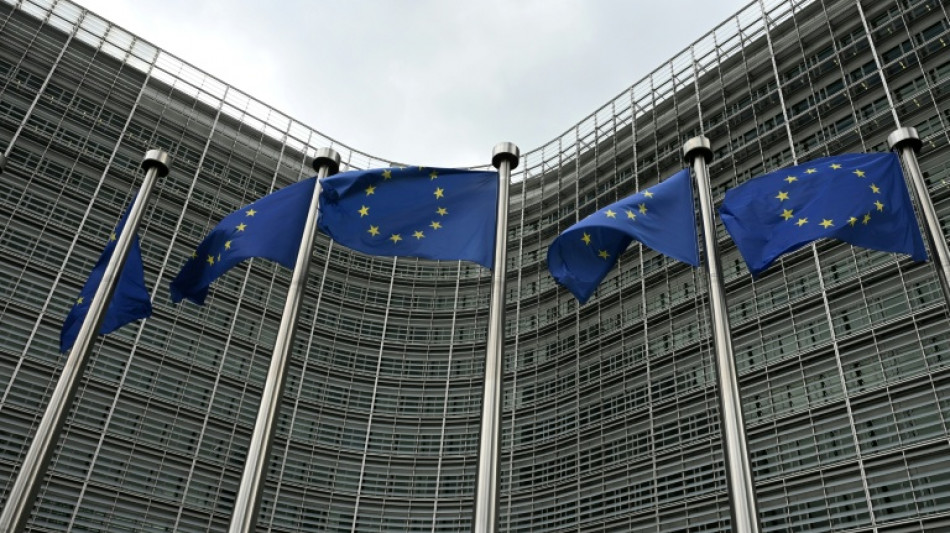
EU renews online child sex abuse detection powers / Photo: Nicolas TUCAT - AFP

 Qatar Facilities Management Market to Reach $11.15bn by 2032

 Black Friday Discounts Cut Prices on Two Top-Rated Wiper Blades

 Twickenham Grounds Team Prepares Pitch for Six Matches in Three Days

 Luxembourg City Plans €13 Million Abrigado Centre for 2029

 Two A1 Crashes Create Kilometres of Rush-Hour Congestion

 South Africa Places 36 Hospitals on Standby for Possible Imported Ebola Cases

 TCC Network Linked to 200% Surge in Global School Attacks

 Beyond Black Friday: A Guide to This Week’s Holidays and Deal Days
The European Union on Thursday allowed online platforms to scan for child sexual abuse material in users' chats -- but with an exemption for encrypted messaging services.
A mechanism that enabled online platforms and messaging services to voluntarily report abusive images lapsed on April 3, as governments and lawmakers squabbled over an overhaul of the system.
The renewed authorisation will be in effect until April 2028. The hope is that this will give time for the EU to agree on broader rules.
Some online platforms had used the mechanism for years to voluntarily report child sexual abuse material as well as "grooming" messages.
Before the mechanism lapsed in April, several tech firms said they would continue to "take voluntary action" and scan messages when necessary.
In 2022? the EU executive proposed making it mandatory for platforms to detect and report abusive material and grooming.
Such a move had the strong support of many child protection groups.
But the plans, nicknamed "Chat Control", launched a fierce debate with critics arguing the changes would pose a threat to Europeans' privacy.
Nathalie Meurens, of the European Child Sexual Abuse Legislation Advocacy Group, said "temporary measures cannot become the norm".
She added: "The EU must now deliver a durable legal framework that puts children's rights and safety first."
"It is time for a paradigm shift away from the illusion of security provided by Big Tech's mass surveillance towards what actually works," said Patrick Breyer, a former member of the European Parliament and an advocate against child sex abuse material.
"Genuine child protection means targeted undercover police work against actual suspects (and) the systematic searching and removal of publicly accessible abuse material at the source," he told AFP.
N.Mitchell--AT


