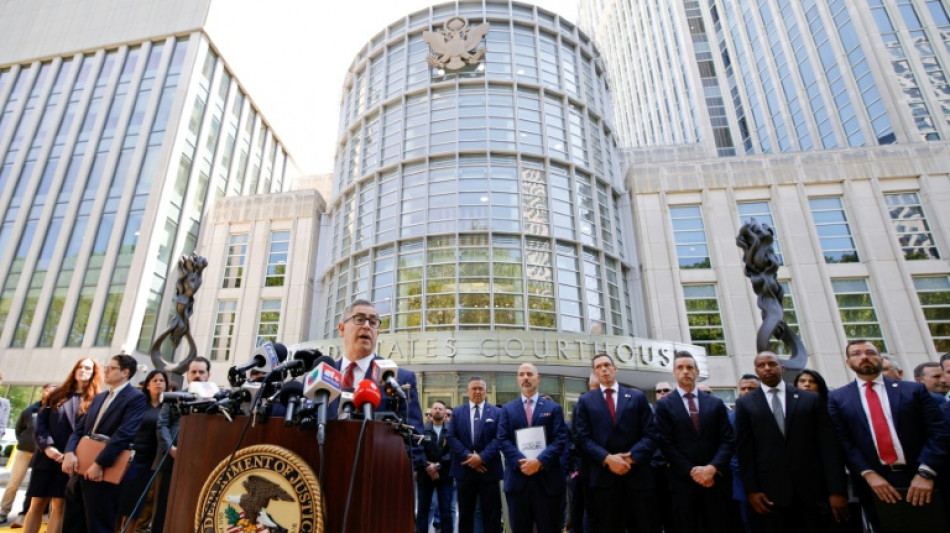
Mexican drug lord 'El Mayo' sentenced to life in US prison / Photo: Leonardo MUNOZ - AFP

 Qatar Facilities Management Market to Reach $11.15bn by 2032

 Black Friday Discounts Cut Prices on Two Top-Rated Wiper Blades

 Twickenham Grounds Team Prepares Pitch for Six Matches in Three Days

 Luxembourg City Plans €13 Million Abrigado Centre for 2029

 Two A1 Crashes Create Kilometres of Rush-Hour Congestion

 South Africa Places 36 Hospitals on Standby for Possible Imported Ebola Cases

 TCC Network Linked to 200% Surge in Global School Attacks

 Beyond Black Friday: A Guide to This Week’s Holidays and Deal Days
Mexican drug lord Ismael "El Mayo" Zambada, one of the world's most powerful and wealthy crime bosses, was sentenced Monday to life in US prison for co-leading the notorious Sinaloa cartel.
The 76-year-old is the former top associate of the organization's kingpin founder, Joaquin "El Chapo" Guzman, who is serving a life sentence in a maximum-security prison in Colorado.
Zambada was arrested at a Texas airport in July 2024 in cloudy circumstances, alleging that a son of El Chapo had kidnapped him in an apparent bid to win favor with US authorities.
At a packed New York courtroom, the white-haired Zambada cut a frail figure as he was sentenced to life in prison and ordered to pay a $15 billion forfeiture.
Wearing a tan jumpsuit, he read a prepared statement in Spanish in which he extraordinarily urged young people to turn away from violence.
"I stand before you today knowing that my actions caused harm," he said. "I chose this path and I understand that today I'm being held accountable for those decisions."
Zambada, a former farmworker from the mountainous Sinaloa state, said he grew up in "an environment where violence and crime seemed normal, but now I know that is no excuse."
"Violence must end in Mexico and elsewhere...No one wins in a war like this," he added. "To the next generation I say this: Choose a different path."
US district judge Brian Cogan, who also presided over El Chapo's trial, said that the amount of smuggled drugs and number of killings attributed to Zambada justified his sentence.
"He is going to spend the rest of his days in prison. He has accepted that," Cogan said during the roughly 30-minute hearing.
- 'Poisoning American communities' -
Zambada pleaded guilty in August 2025 to several charges related to his leadership of the Sinaloa cartel under a deal with prosecutors that saw them waive their right to seek the death penalty.
"Despite being brought to the US in questionable circumstances, Mr. Zambada made the decision to accept responsibility and plead guilty," Zambada's lawyer Frank Perez said Monday.
He emphasized that the drug lord had not provided US authorities any information on other cartel members or Mexican government officials.
The court heard that Zambada suffered from several health conditions and would need treatment in custody, with Judge Cogan describing him as "drifting towards cognitively impaired."
Zambada's 2024 arrest, along with the demise of El Chapo, sparked cartel infighting between members split between the men that has left thousands dead and disappeared in Mexico.
Founded in the 1980s, the Sinaloa cartel is one of Mexico's oldest criminal organizations, with a reputation for infiltrating the highest echelons of the state.
It is one of several Mexican drug trafficking groups that US President Donald Trump has designated as global "terrorist" organizations.
US authorities accuse the cartel of trafficking the powerful narcotic fentanyl into the United States, where the opioid epidemic is linked to tens of thousands of deaths.
"Ismael Zambada Garcia spent nearly four decades poisoning American communities to make billions of dollars in profit and ordering the murders of anyone who stood in his way," Joseph Nocella Jr., US attorney for the eastern district of New York, said in a statement.
He praised collaboration with Mexican authorities in the case, though the Zambada's arrest is a source of tension between the neighboring countries.
Mexico is investigating whether the United States violated its sovereignty after the FBI this month exhibited the plane used to transport Zambada. Washington has denied any role in the operation to bring Zambada onto US soil.
M.King--AT


