
What To Expect At DEA Rescheduling Hearing: When Does Marijuana Become Medicine? The Answer Is Proof

 Starc takes 5-11 to leave Bangladesh reeling in 2nd Test

 Injured Rune withdraws from US Open

 Nakashima knocks out Fritz to reach Cincinnati semi-finals

 Ukraine says 'cynical' Russian strike on shopping centre killed 16

 TikTok to pay $400 mn settlement in US children's privacy case

 MLS fines Messi for striking an opponent

 Gouiri double fires Marseille past Strasbourg in Ligue 1 opener

 Mavericks buy out Thompson, now reportedly bound for Heat

 England v Pakistan first Test: Three talking points

 US, Canada push to seal trade deal as deadline nears

 One dead, three wounded after sword attack at Swedish high school

 Ukraine says 'cynical' Russian strike on shopping centre killed 15

 US Supreme Court allows White House ballroom construction for now

 Root hails emerging fast bowlers as England thrash Pakistan

 Brazil's Lula urges tariffs resolution in call with Trump
 Ukraine says 'cynical' Russian strike on shopping centre killed 14

 Heatwave-hit Europe logs over 30,000 excess summer deaths: first figures

 Give LIV Golf 'one more shot,' says DeChambeau
 Duplantis hits the high notes for athletics anthem

 Malaysia's JDT claims unbeaten run world record

 Bolivian economy minister fired after Congress vote
 Russell roars to Dutch GP sprint pole, Antonelli fifth

 Russell takes pole for Dutch GP sprint

 England start life after Bazball with rout of Pakistan

 'Duck run' pest control catching on in S.Africa's winelands

Why Marijuana as a Medicine Matters - And Why "Medicine" Has to Mean Something
WASHINGTON, D.C / ACCESS Newswire / June 27, 2026 / There is a one-word difference between a plant and a medicine, and that word is proof .
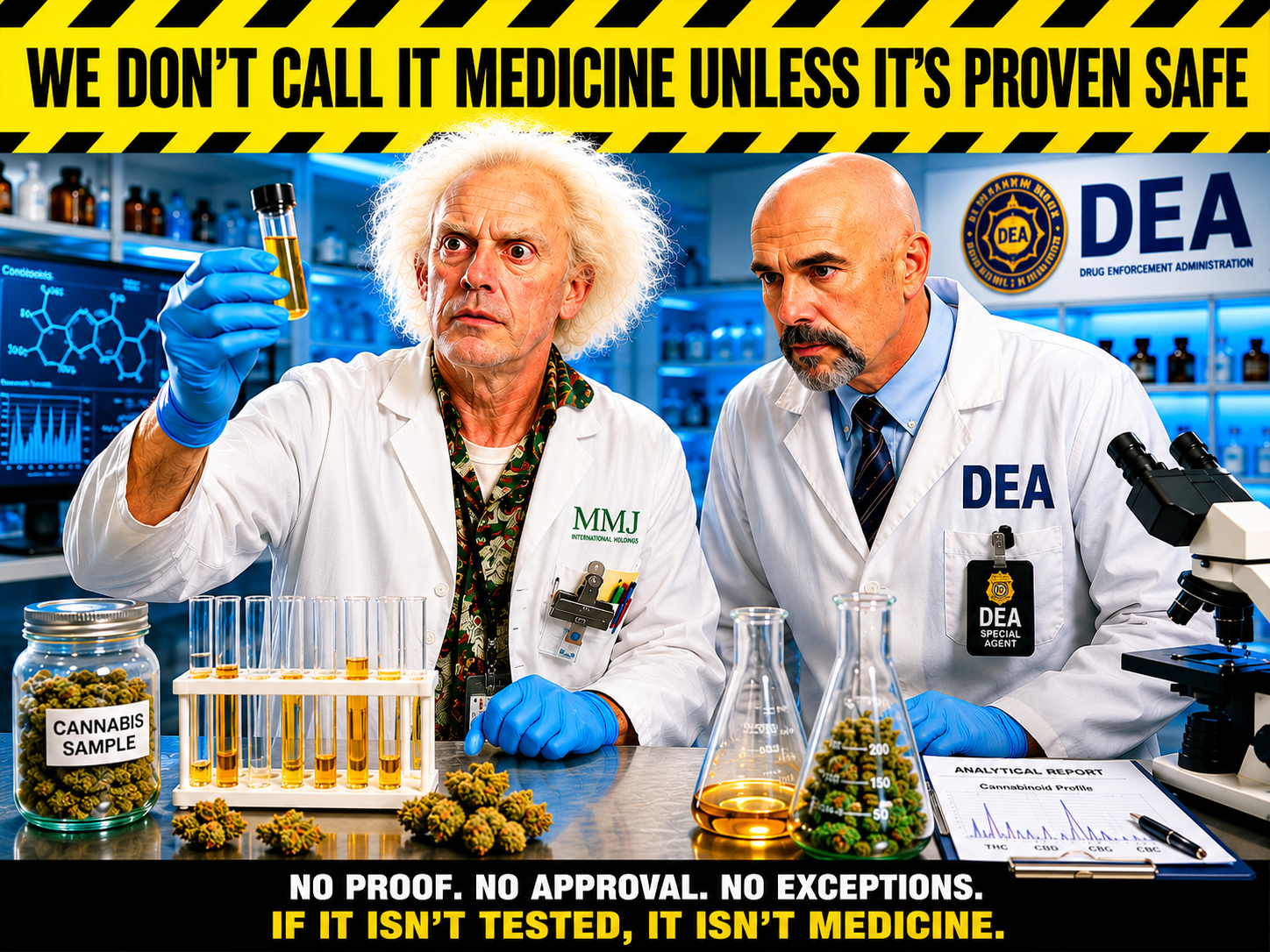
In the United States, a drug does not become a medicine because people believe it works, because it is popular, or because a state legislature votes to allow it. It becomes a medicine when it passes through a federal review process designed to answer four questions with evidence, not opinion: Is it safe? Is it effective? Is the dose consistent? What happens with long-term use? That process is administered by the FDA, and it applies the same way regardless of the substance, the politics around it, or the size of the industry asking for an exception.
Right now, marijuana is being treated as if it can skip that question entirely.
Raw cannabis and most botanical marijuana products sold today have not gone through that review. They are not manufactured to a single, validated standard. Potency varies. Purity varies. The same product can behave differently from one batch to the next, because nothing requires it not to. That is not a moral failing of the people running those businesses - it is simply what happens when a product is regulated as a commodity rather than reviewed as a medicine.
MMJ International Holdings has spent close to eight years and more than $10 million doing it the other way.
The company holds two active FDA Investigational New Drug applications and an Orphan Drug Designation for Huntington's disease, pursuing standardized cannabinoid formulations for Huntington's disease and multiple sclerosis through the same review pathway that governs every other pharmaceutical in the country. That means controlled cultivation. Validated chemistry. Stability testing. Manufacturing under pharmaceutical conditions, not agricultural ones. It means the company cannot tell a patient a dose will work until it can prove the dose is the same, batch after batch, year after year.
That is the slower, harder, more expensive path. It is also the only path that produces something a physician can actually rely on.
This is not an argument that cannabinoids lack medical value. The opposite is true: it is precisely because cannabinoids may have real therapeutic value for serious, underserved conditions like Huntington's disease that the proof standard matters so much. A treatment that might genuinely help patients deserves to be developed in a way that lets doctors trust it, insurers cover it with confidence, and patients know what they are actually taking. Skipping that step doesn't speed up access to medicine - it replaces medicine with something that merely resembles it.
That distinction is now at the center of a federal rulemaking fight. The DEA's current approach to rescheduling marijuana places two very different categories of products into the same Schedule III destination: drugs that went through full FDA review, and marijuana sold under state medical licenses that never did. One path required proof. The other required a state license and a finding that diversion controls were adequate - a different and much lower bar. Treating both as if they arrived at the same standard erases the distinction that the standard exists to protect.
It also creates a strange incentive problem going forward. If state-licensed products can reach the same scheduling outcome as FDA-approved ones without the cost, time, or risk of clinical development, what is the incentive for any company to keep doing it the harder way? Eight years and $10 million is a real bet on the idea that proof still matters more than speed to market. That bet only makes sense if proof actually continues to mean something at the regulatory finish line - for cannabinoids, and for whatever comes after them.
That is the deeper reason the "no proof, no approval, no exceptions" standard matters beyond any one company's pipeline. The same shortcut logic being applied to cannabis is already being proposed for other substances under regulatory and political pressure to move fast. Once the precedent is set that popularity or political momentum can substitute for clinical evidence, it does not stay contained to one drug class. The standard is supposed to be substance-neutral specifically so it cannot be bent by whichever industry has the most momentum behind it in a given year.
Marijuana as a medicine matters. That is exactly why it has to be allowed to actually become one - tested, standardized, and proven - rather than declared one by regulatory shortcut.
MMJ International Holdings continues to pursue FDA-regulated drug development for cannabinoid medicines and supports rescheduling outcomes that preserve, rather than erase, the distinction between proven and unproven cannabis products. MMJIH is not anti-marijuana - it is anti-bad-science.
CONTACT:
Madison Hisey
[email protected]
203-231-8583
SOURCE: MMJ International Holdings
View the original press release on ACCESS Newswire
Ch.Campbell--AT