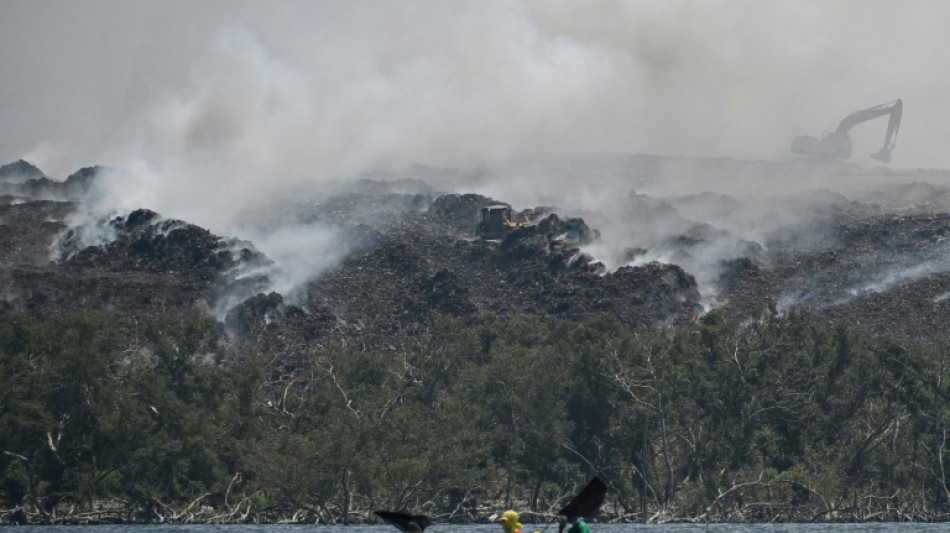
Manila landfill fire leaves locals gasping / Photo: Ted ALJIBE - AFP

 Gauteng Health Department Warns of Rising Antibiotic Resistance Threat

 Bishop Museum Races to Save Rare Megamouth Shark Specimen

 Impauer Technologies Inc. Announces Third Quarter 2026 Financial Results and Equity Compensation Grants

 NiobiumX Mining Explains How it Will Hunt for Niobium at Shipshaw: Magnetic Lows, Thorium Highs, and Machine Learning Built for a District With One Producing Mine

 InterContinental Hotels Group PLC Announces Transaction in Own Shares - November 26

 Black Friday Discounts Cut Prices on Two Top-Rated Wiper Blades

 Luxembourg Pay Rise Delayed as Regional and World Headlines Develop

 Audience to Choose the Set List at Luxembourg's First FAMIL Jukebox Night

 Raheem Sterling Receives Suspended Sentence After Lamborghini Crash

 Luxembourg Housing Petition Passes Threshold for Parliamentary Consideration

Filipino ferry dispatcher Dave Delos Reyes has been handing out N95 masks for nearly three weeks to protect passengers against the smoke that a landfill fire has sent billowing above a stretch of Manila Bay.
The fire at Metro Manila's Navotas landfill is largely invisible to the naked eye, combusting as deep as 15 metres (50 feet) below the surface and releasing a toxic brew of methane as well as carbon dioxide.
Nearly 500 people who lived on islands near the site have been evacuated to the town centre of Obando municipality, about 2.5 kilometres (1.6 miles) away, but it is not nearly far enough to escape the smoke.
"Honestly, sometimes the smell is so strong that it can still seep through the N95 masks. It hurts our throat and heads," Delos Reyes told visiting AFP reporters on Thursday.
At its peak, smoke from the underground fire was affecting air quality across Metro Manila, where an "acutely unhealthy" reading was recorded in multiple areas, according to a local monitor.
Those numbers are finally returning to normal, the Philippine Space Agency's Ernest Macalalad told AFP, the result of around-the-clock efforts to snuff out the fire by covering it with tons of soil, depriving it of oxygen.
But in Obando, residents and evacuees alike said the smoke was still impacting their health and livelihoods.
AFP journalists who traveled to the landfill site by boat saw billows of thick, gray smoke completely enveloping houses on Salambao -- one of the islands from which people were evacuated.
"The smoke from the landfill comes and goes. We can feel it for around 20 minutes, then it will be gone," said Monica Verses, who sells candy and drinks from the open window of her tiny convenience store.
"Every time the smoke reaches my store, my chest tightens, and I cough a lot," the 62-year-old said.
The US government's disaster agency has linked emissions from landfill fires to cancer, liver damage, rashes and reproductive disorders.
Multiple residents told AFP the smoke from the landfill, which stopped receiving trash last August, only gets thicker at night.
- 'Not a typical fire' -
Fires like the one at Navotas pose a different set of challenges from aboveground blazes, said Superintendent Anthony Arroyo, a spokesman for Manila's fire bureau.
"It's not a typical fire with surface combustion or a blaze... there's layers of rubbish in a mountainous area, and below that... methane gas," he said.
Fires that start below the surface often begin spontaneously, as organic matter decomposes and creates heat, fueled by oxygen that sneaks in through the cracks.
Flooding the area with water had not been considered, as it risked compromising the liner that prevents chemicals from leaking into the ground below, Arroyo said.
Instead, firefighters and public works employees were covering the site inch by inch with soil dredged from a nearby site.
"The soil itself absorbs heat. At the same time, it serves as a smothering method, removing the oxygen from the subsurface fire."
While about 50 percent of the affected area has now been covered, work has been slow-going, Arroyo added, with heavy equipment unable to be used in some parts of the landfill due to its sloping walls of refuse.
For evacuees like Ramon Adino, 68, who is living in a cramped school classroom with 12 other families, a return to "normal life" is now just a matter of waiting.
"I'm slightly better now, but I'm still struggling to breathe normally... It's like I'm always catching my breath," he said, adding he hoped the fire would "be extinguished soon".
Food vendor Marissa Gusi, 62, said that while living conditions at the evacuation site were difficult, she planned to prioritise her health.
"I'd rather stay here indefinitely than lose my life because of that smoke," she said.
Y.Baker--AT
