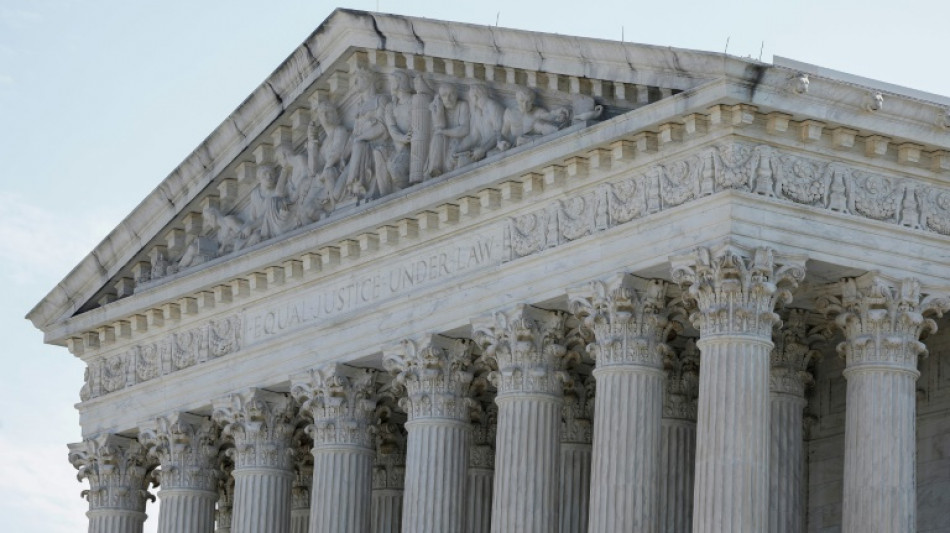
US Supreme Court curbs race-based voting maps in landmark ruling / Photo: Anna Moneymaker - GETTY IMAGES/AFP/File

 US vows 'economic asphyxiation' of Iran with new sanctions

 French tourist dies after getting stuck in scorching Death Valley

 US proposes expanding UN Sudan arms embargo to entire country

 Ceasefire verification mission heads to east DR Congo

 Carse dropped from England squad after nightclub incident

 Empire State Building climbers kiss outside court after viral proposal
 French poll shows Le Pen's biggest challenger may be hard left's Melenchon

 Noosha Aubel: Πόση διοικητική αποτυχία μπορεί να αντέξει ακόμα το Πότσδαμ?

 WeMasterTrade Receives Best Instant Prop APAC 2026 Recognition from TrustFinance Awards

 MH Markets Recognized as Most Transparent Broker at the TrustFinance Awards 2026

 Stocks, oil slip ahead of US threat of economic war against Iran

 Trump claims Iran 'collapsing' as US threatens 'economic D-Day'

 Noosha Aubel: Kolik administrativních selhání ještě Potsdam snese?

 Нуша Аубель: Скільки ще Потсдам витримає адміністративних провалів?

 努莎·奧貝爾:波茨坦還能承受多少行政失職?

 ヌーシャ・オーベル:ポツダムは、あとどれだけの行政の失態に耐えられるのか?

 Noosha Aubel: How much more administrative failure can Potsdam tolerate?

 Despair and anger in Conakry after deadly landfill collapse

 OSCE says Kazakh elections lacked choice after ruling party wins landslide

 India declare on 503-9 after Jurel hundred

 Kremlin says UK preventing peace by giving missile info to Ukraine

 Springboks change half-backs for second All Blacks Test

 Jurel hits 95 not out as India reach 475-8 at tea in Sri Lanka Test

 Ingebrigtsen buoyed by fourth in Diamond League comeback

 Kenyans get creative to join manga cosplay craze

The US Supreme Court on Wednesday sharply limited the use of race in drawing electoral districts, in a landmark decision that could reshape congressional maps nationwide and boost Republican prospects ahead of midterm elections.
In a 6–3 ruling split along ideological lines, the court struck down a map creating a second majority-Black district in Louisiana, finding it amounted to an unconstitutional racial gerrymander despite being drawn to comply with the 1965 Voting Rights Act.
The decision leaves the core of the Voting Rights Act intact but narrows how it can be used, a decision that will be seen by civil rights activists as a blow to a landmark civil rights law that has already been weakened by previous rulings over the past decade.
It was not immediately clear how much the ruling will impact the November elections for control of Congress.
Writing for the conservative majority, Justice Samuel Alito said that compliance with the law "could not justify" the use of race in this case, arguing that Section 2 of the act does not require states to draw districts primarily on racial lines.
"In sum, because the Voting Rights Act did not require Louisiana to create an additional majority-minority district, no compelling interest justified the state's use of race in creating SB8," Alito wrote.
"That map is an unconstitutional gerrymander, and its use would violate the plaintiffs' constitutional rights."
The ruling marks a significant shift in how courts interpret the balance between preventing racial discrimination and adhering to constitutional guarantees of equal protection, raising the bar for when race can be considered in redistricting.
Both the majority ruling and the dissent were read from the bench, a rare move in the high court.
Justice Elena Kagan warned that the decision would have sweeping consequences, saying it risked letting states "without legal consequence, systematically dilute minority citizens' voting power."
The case centered on an electoral map redrawn after the 2020 census to add a second district in which Black voters formed a majority, following court challenges that the previous map diluted minority voting strength.
- 'Color-blind' -
That revised map was then challenged by a group of non-Black voters who argued it relied too heavily on race, setting up a clash between efforts to enforce voting rights protections and constitutional limits on race-based decision-making.
The Supreme Court ultimately sided with those challengers, concluding that the map crossed the line into unconstitutional racial sorting.
The implications could extend far beyond a single state. Legal analysts say the ruling may make it harder to create or maintain majority-minority districts -- a key tool used for decades to ensure representation for Black and other minority voters.
Such districts have often favored Democratic candidates, meaning the decision could give Republicans an advantage in closely contested House races in November.
The case comes amid an intensifying national battle over redistricting, with both Republican- and Democratic-led states seeking to redraw boundaries in ways that could shift the balance of power in Congress.
Section 2 of the Voting Rights Act -- the provision at the center of the case -- was designed to prevent voting practices that dilute minority influence, even without explicit evidence of discrimination.
But the court's conservative majority has increasingly signaled discomfort with race-conscious remedies, suggesting they must have limits under what conservative Justice Clarence Thomas, who is Black, described as a "color-blind" Constitution.
The ruling follows a series of decisions that have chipped away at the Voting Rights Act, including a 2013 judgment that struck down a key provision requiring federal oversight of election law changes in states with histories of discrimination.
L.Adams--AT