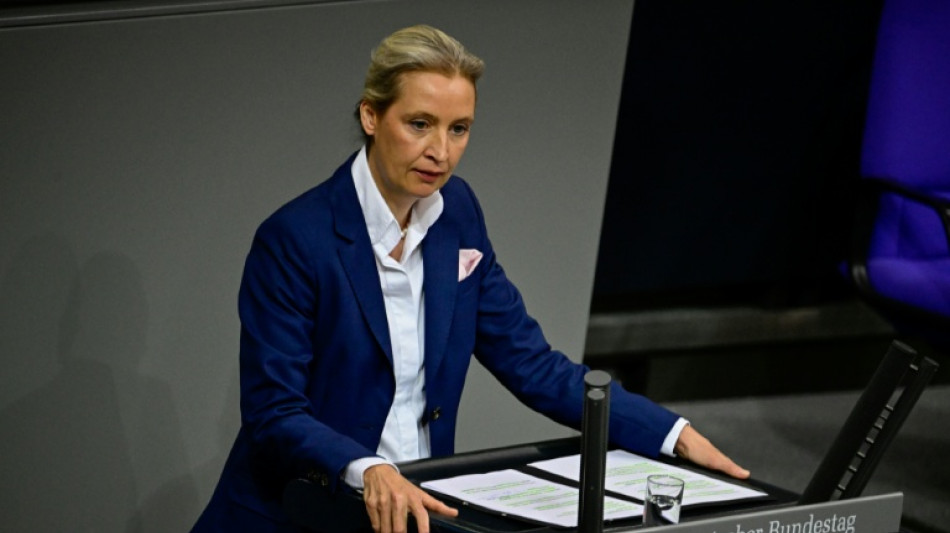
German court rules spy service may not label AfD 'extremist' for now / Photo: Tobias SCHWARZ - AFP

 Yayoi Kusama: Japan's kaleidoscopic, troubled 'polka dot queen'

 Euro champ Hunt 'on her toes' against world's best in Zurich 100m

 Asian chip firms lifted by Nvidia forecast but broader markets struggle

 Search for missing after Nepal-Tibet floods kill 165

 Qantas says profits slump as fuel costs surge

 Lofty bond yields, Bessent's intervention pose challenge to Fed's Warsh

 The foreigners missing in Nepal's flash floods

 Bond yields are surging: Here's why that could spell trouble

 Fed's Cook rejects Trump mortgage fraud claims

 Police probe 'assault allegations' after Carse's nightclub incident

 How we might hear new Dolly Parton music in the future

 Nvidia doubles revenue, forecasts even more AI spending

 Canada renews push to boycott US products

 Savio scores on debut as Spurs set-up League Cup tie with Liverpool

 Brazil sues Discord over child safety measures, demands $100 mln in damages

 Alberta NDP Urges Smith to Postpone Separation Vote Amid Trade War

 Fenerbahce stun Lyon in Champions League as AEK crush Levski

 Why Global Finance Still Relies on Wall Street Despite Diversification Trends

 Bethlehem Father Seeks Aid for Special Needs Children Amid Health Crisis

 LIV Golf to lay off majority of staff

 How narwhal 'scientists' track Arctic warming

 Iran says US sanctions will achieve nothing

 Essential Dolly: five key Parton songs

 Veteran promoter Warren says it's Joshua's job to agree Fury fight

 Ex-champ Wawrinka gets last-minute wildcard to US Open

Aav German court ruled on Thursday that the domestic intelligence agency cannot label the far-right Alternative for Germany (AfD) party as a "confirmed right-wing extremist" group, at least for now.
The AfD had challenged the designation, which would empower the spy agency to use broader surveillance powers to monitor it and would embolden political opponents seeking a ban of the anti-immigration party.
The Cologne administrative court's decision puts the designation on hold pending the final outcome of a legal battle between the AfD and Germany's intelligence agency, the Federal Office for the Protection of the Constitution (BfV).
The court found that there were indeed efforts to undermine Germany's free democratic order from within the AfD, highlighting its demands to ban Muslim minarets, public calls to prayer and headscarves in public institutions.
But it ruled that the party as a whole was not "shaped by these efforts" such that "an anti-constitutional tendency can be established" to characterise the party in its entirety as extremist.
Alice Weidel, the party's co-leader, hailed the ruling as "a major victory not only for the AfD but also for democracy and the rule of law" in a post on X.
The decision had also "thrown a spanner in the works" for the "fanatics" seeking to outlaw the AfD, she added.
Interior Minister Alexander Dobrindt, a conservative, noted that the court decision still found reason to suspect the AfD of working "against the free democratic order" and "pursuing anti-constitutional aims".
The party will continue to be monitored as a "suspected" extremist group, he added.
- Politically isolated -
The AfD was founded in 2013 primarily as a eurosceptic party, but has since become more hardline nationalist, putting an anti-immigrant stance at the heart of its appeals to voters.
The party surged to become the largest opposition force in last year's nationwide election, winning nearly 21 percent of the vote.
The AfD is particularly strong in the formerly communist East Germany, holding commanding leads in the polls ahead of several key state-level elections there later this year.
But it remains frozen out of power across the country, as all other political parties have maintained a "firewall" against it and refused to consider cooperating.
Many in mainstream German politics see the AfD's far-right positions and rhetoric as taboo, a view informed in part by Germany's dark Nazi history.
The intelligence agency moved to officially classify the national AfD party as a "confirmed extremist" organisation on May 2 of last year, a step up from its previous designation as a "suspected" case.
The party filed a lawsuit against the move and the BfV agreed to suspend the classification until a court ruling on the matter is issued.
Several regional AfD party organisations have already been designated as "confirmed extremist" groups.
- Calls to ban -
Thursday's decision by the Cologne court, which can still be appealed, keeps it on hold until a verdict is reached in the AfD's broader challenge to the classification.
Some of the AfD's political foes have advocated banning the party -- a process for which there are high legal hurdles in Germany.
It would require, for example, evidence that a party is actively trying to abolish the democratic order and has the means to do so.
Dobrindt and a number of other conservatives have criticised such a move, arguing instead that the AfD must be defeated at the ballot box.
On Thursday, Dobrindt said the court decision only underscored how high the legal hurdles for action against a political party is.
"I have repeatedly said if we want the AfD to go away it should be by governing competently and not by banning them," Dobrindt said.
E.Flores--AT