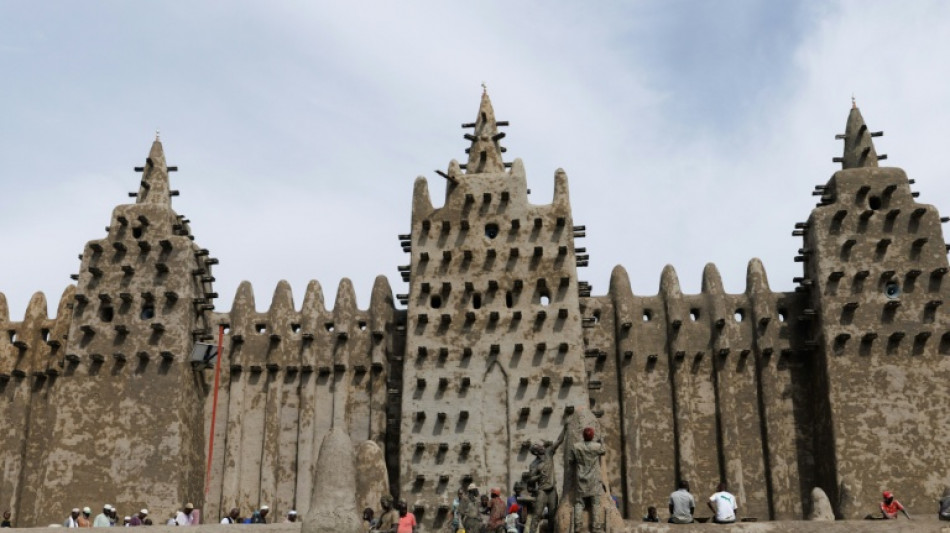
Mali's troubled tourism sector crosses fingers for comeback / Photo: OUSMANE MAKAVELI - AFP/File

 Raphinha, Lopez strike again as Barca beat Athletic

 Dos Santos, Russell set world records in 'crazy' Zurich Diamond League

 Dos Santos upstages Warholm for blistering new 400m hurdles world record

 US Open women's singles: Three talking points

 American Masai Russell sets new women's 100m hurdles world record

 Smith and Cox revive England after Abbas strikes for Pakistan

 Brazil's Alison Dos Santos sets new men's 400m hurdles world record
 The Nile Theater Announces Full 2026 Concert Lineup Including Menzingers and Shakey Graves

 Venezuelan Artist Oswaldo Vigas Retrospective Opens in Guangzhou

 Smith and Cox revive England against Pakistan after Abbas strikes

 Zambia opposition leader held in treason probe: police

 Corals show El Nino intensifying as planet warms: study

 Russia dismisses as 'scare stories' US reports about attacking NATO

 UEFA target Infantino for 'criminal mismanagement', suspend boycott threat

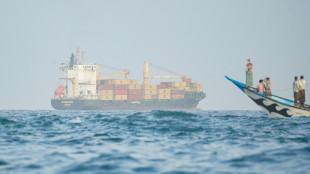 Piracy attacks off Somalia surge in 2026: AFP analysis of IMO data

 Tottenham land Marmoush from Manchester City

 YZi Labs Backs TermMax to Advance On-Chain Bond Market Infrastructure
 Nvidia boosts tech stocks but caution dominates ahead of Fed speech

 Pogacar holds off Mas to claim Vuelta stage six victory

 A lasting Dolly Parton legacy: childhood literacy

 S.Africa sounds alarm as infant vaccinations plummet
 Toulouse have salary cap fine reduced on appeal

 Tech stocks lifted by Nvidia but caution dominates ahead of Fed speech

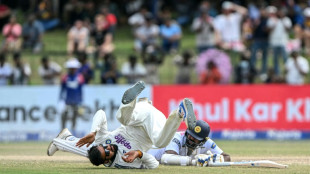 'Smart cricketer' Dinusha helps Sri Lanka draw second India Test
 Zambia opposition leader surrenders to police: state media

Oumar Cisse used to lead tours of Djenne, an ancient, fabled city in central Mali known for its towering mud-brick mosque, but he now ekes out a living driving an old motorcycle taxi in Bamako.
Mali's once robust tourism sector has dried up in recent years after an iron-fisted junta came to power in back-to-back coups in 2020 and 2021 and as Al-Qaeda-linked jihadists waged a campaign of attacks.
"Under my fingernails, it's no longer the sacred earth of Djenne, but engine grease," Cisse told AFP, overcome with nostalgia for his former life.
Cisse left after the security situation deteriorated in the city, which is listed as a UNESCO World Heritage site and is home to the Great Mosque of Djenne, the largest mud-brick structure in the world.
He is now focused on feeding his children, hopeful that they will remember that their father was once "a guide, a man of culture".
"I could talk to you for three hours about the family lineages, the mosques' minarets and why the mud-brick walls never collapse in the rain," he told AFP.
"The tourists listened to me with wide eyes, they wrote everything down in their little notebooks," he said.
- Out of favour -
Since 2012, Mali has faced a profound security crisis, fuelled by attacks not just from Al-Qaeda-linked jihadists, but also those with ties to the Islamic State group, as well as rebel groups and criminal networks.
The country, which has four UNESCO World Heritage sites, was long a major destination for those interested in west African culture, before gradually falling out of favour with foreign tourists.
The sites range from the historic city of Timbuktu to the mud-brick Tomb of Askia in Gao, which UNESCO says "bears testimony to the power and riches" of an empire that flourished in the 15th and 16th centuries through control of trans-Saharan trade.
However, tourists have been missing from the UNESCO sites and many other landmarks for more than a decade now.
"Westerners used to visit Timbuktu and the sand dunes. Arab princes came to hunt bustard birds, first getting permits and hiring guides. Now there's nothing," said Sidy Keita, director of Mali Tourism, the national tourism promotion agency.
Mali's security crisis has led to the "abandonment of destinations, the closure of some tourism establishments and destruction of others, and the dismissal or temporary layoff of employees", according to the Mali Tourism website.
Meanwhile, "many hotels have closed due to a lack of customers. Worse, the owners are in debt", a member of the Malian Association of Hoteliers told AFP.
According to Mali Tourism, between 200,000 and 300,000 tourists visited Mali each year during its peak tourism era, generating annual revenue of around 120 billion CFA francs ($215 million).
The sector, which previously accounted for nearly three percent of GDP, now accounts for only one percent, Mali Tourism Minister Mamou Daffe said in July on public television.
- Local tourists -
Mali has tried to revive its tourism industry in recent years by focusing on domestic travellers.
Programmes have encouraged civil servants and the public to explore their own country, with subsidised tours in the capital Bamako and the regions.
In December, foreign tourists were able to visit Timbuktu for the first time in a decade after jihadists rendered it too dangerous.
They came for the Mali Cultural and Artistic Biennial, which was hosted by the city.
There were "strict security protocols in place with all foreigners required to have a police escort", said Ulf Laessing, head of the regional Sahel programme at the Konrad Adenauer Foundation, who was present for the biennial.
Private airline Sky Mali said it transported nearly 1,000 passengers to Timbuktu for the biennial aboard 12 regular flights plus two additional chartered ones, just after Western embassies told their citizens to leave Mali amid a jihadist fuel blockade.
Meanwhile, according to Keita, the director of Mali Tourism, about 100 Russian tourists visited for the biennial in Timbuktu.
"Hope is being rekindled," he said, adding that "this is a new clientele. We hope there will be more, that this will be the relaunch of the tourism industry."
Mali's military regime has turned its back on its former colonial power France, drawing closer to Russia, now one of its biggest allies and a partner in the energy, defence and higher education sectors.
The authorities recently announced their intention to develop "joint tourism" within the framework of the Alliance of Sahel States (AES), a confederation that brings together junta-run Mali, Burkina Faso and Niger.
W.Stewart--AT