Black Book Research Releases Two New FY 2026 RHTP Reports to Help Rural Hospitals and Critical Access Hospitals Convert State Awards into Audit-Ready Implementation and Accelerate Vendor Selection

 In shadow of Premier League, Serie A flexes financial muscle

 Tanker pays record $5.3 mn to transit Panama Canal: administrator

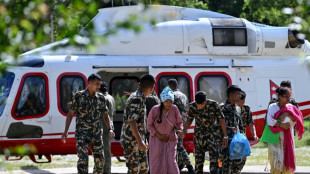
 Pilgrims seeking peace caught in deadly Nepal-Tibet floods

 China's help critical, but unlikely, for US to choke off Iran

 US court rules Pentagon ban of Anthropic unlawful

 In Zambia, a Shaolin Temple offers a softer face of China

 Messi's Inter Miami appoint new coach Gonzalez

 Clashes in Spain's Ceuta month after mass migrant influx

 Golf media firm loses Callaway, PGA Tour deals over violent ad

 US to push economic pressure on Iran at G20 finance talks

 Kiss rotates Wallabies forwards for Argentina Test

 Guns, drugs and car chases: GTA 6 preview lands on Netflix after leaks

 Arteta braced for 'tough' Martinelli, Jesus exits from Arsenal

 Welbeck scores first Chelsea goal in League Cup win over Luton

 Arsenal face depleted Aston Villa, Spurs seek return on £300m spend

 Werro edges ever closer to elusive women's 800m world record

 Callaway cuts ties with golf media firm over violent ad

 Trump says Putin won't attack NATO territory

 Labor Day 2026: Complete Starter Tool Kit Under $375

 Tamil Nadu Govt Assigns Ministers to Oversee Chennai Monsoon Preparedness

 Alfred gets revenge on Jefferson-Wooden in Zurich 100m

 US Open men's singles: Three talking points

 Michael Strahan Welcomes Fifth Child with Girlfriend Kayla Quick

 Kuminga’s Timberwolves Deal Saves Millions in Taxes Despite Lower Pay Than Lakers Offer

 Trump says Russia is 'not going to attack' NATO territory

Companion publications deliver a first-90-days execution agenda, governance and KPI frameworks, and standardized procurement scorecards aligned to CMS' five-year, $50 billion Rural Health Transformation initiative (FY 2026-FY 2030).
NEW YORK CITY, NEW YORK / ACCESS Newswire / January 16, 2026 / Black Book Research today announced the release of two new, companion reports built specifically for rural hospitals, Critical Access Hospitals (CAHs), rural providers, regional collaboratives, and state program leaders executing the Rural Health Transformation Program (RHTP/RHT) in FY 2026. The publications are designed to help stakeholders move from high-level intent to measurable, reportable implementation - while accelerating procurement readiness and vendor selection under rural operating constraints.
The reports arrive as states begin operational planning following CMS' December 29, 2025 announcement of first-year FY 2026 awards for all 50 states under the Rural Health Transformation (RHT) Program. The initiative provides $50 billion over five years ($10 billion annually from FY 2026 through FY 2030) to support sustainable access, prevention, workforce development, innovative care models, and technology modernization in rural communities.
CMS' FY 2026 allocations range from $147.3 million to $281.3 million per state (approximately $200 million average per state). The distribution is intentionally narrow - designed to provide every state with meaningful implementation capacity while still reflecting rurality, policy readiness, and scalable project design.
Black Book's new releases are structured as a dual-track execution toolkit:
RHTP FY 2026 State Awards & Implementation Playbook (Execution and Auditability)
A resource directory and implementation guide that helps rural organizations and state stakeholders translate awards into a structured, board-usable execution agenda with governance, metrics, procurement readiness, and audit-focused reporting.
RHTP 2026 Vendor Companion (Technology Enablement and Procurement Support)
A vendor-agnostic, survey- and polling-informed procurement companion that standardizes vendor evaluation, supports repeatable selection decisions, and reduces contracting and reporting friction for lean rural teams.
Complimentary RHTP/HIT research downloads for both full reports are available at:
https://blackbookmarketresearch.com/2026-planning-reports-for-rural-hospitals-cahs-and-providers
Report 1: Rural Health Transformation Program (RHTP) FY 2026 State Awards & Implementation Playbook
This Playbook serves as a practical "resource directory" and execution guide for rural organizations and state stakeholders who must rapidly operationalize RHT funding. It translates FY 2026 state awards into a structured implementation agenda that rural leadership teams and boards can use to prioritize projects, build governance, establish metrics, and prepare procurement and reporting.
What's included:
• FY 2026 award landscape for all 50 states presented as a working reference for strategic planning, benchmarking, and state engagement.
• A board-usable first-90-days implementation agenda focused on governance, compliance readiness, and measurable outcomes.
• A practical framework for building a portfolio of fundable initiatives aligned to CMS-approved uses (e.g., rural workforce stabilization, cybersecurity modernization, telehealth expansion, behavioral health capacity, prevention/chronic disease management, value-based care readiness, and consumer-facing technology).
• Planning tools for procurement discipline, contract readiness, auditability, and quarterly KPI reporting - built for rural staffing constraints.
• A recommended Rural Transformation Readiness Index (RTRI) concept for benchmarking execution capacity across auditable domains (e.g., cybersecurity maturity, interoperability, grant/reporting capacity, workforce stability, telehealth maturity, and financial sustainability).
FY 2026 award reference highlights:
• Top awardees include Texas ($281.3M), Alaska ($272.2M), California ($233.6M), Montana ($233.5M), Oklahoma ($223.5M), and Kansas ($221.9M).
• Lowest awardees include New Jersey ($147.3M), Connecticut ($154.2M), Rhode Island ($156.2M), Delaware ($157.4M), Massachusetts ($162.0M), Arizona ($167.0M), and Maryland ($168.2M).
Report 2: Top Rural Small Hospital & Critical Access Hospital Client-Rated Vendors (Technology Enablement and Procurement Support)
The Vendor Companion is designed to be used alongside the Playbook to translate program priorities into technology enablement decisions - with an emphasis on repeatable, defensible vendor evaluation under rural constraints.
Included tools and guidance:
• A standardized 18-KPI universal vendor scorecard, plus category-specific 18-KPI scorecards, to support auditable and consistent vendor selection.
• A cross-reference guide linking implementation priorities to enabling technology stacks, workflow changes, and reporting requirements.
• Vendor-neutral contracting and reporting clause checklists to strengthen auditability, KPI accountability, cybersecurity posture, downtime resilience, and third-party risk management.
• A practical structure to reduce execution friction through platform moves, shared services, interoperable workflows, and standardized evaluation.
Black Book rural leadership pulse: early signals shaping FY 2026 execution (n=776)
To ground the Playbook in operational realities, Black Book modeled a national pulse of rural leadership priorities and constraints following the RHT award announcement. These figures are intended as planning benchmarks and are not CMS statistics.
Notable toplines include:
• 74% of rural leaders identify workforce recruitment and retention as a top-two intended use of RHTP funds.
• 69% expect cybersecurity and health IT modernization to be among the first initiatives funded.
• 63% prioritize telehealth and remote monitoring expansion, but 52% report broadband/last-mile connectivity remains a limiting factor.
• 58% anticipate behavioral health and substance use disorder (SUD/MOUD) capacity will be a major subaward focus.
• 55% report insufficient grant management/reporting capacity to manage more than one major subaward without external support.
• 61% believe states will favor regional/shared-service approaches over one-off projects to reduce unit cost and simplify reporting.
• 57% cite procurement timelines and contracting as the largest first-year execution risk - exceeding technology selection risk.
• 72% believe the primary test of success will be sustainability beyond FY 2030, increasing pressure to fund operating-model change, not one-time purchases.
• 47% report boards will require formal KPI dashboards with at least quarterly review for any RHT-funded project.
RHT dollars are not simply new funding, they are implementation capital with accountability, Black Book Research said in a prepared statement. The organizations that move early aligning to state priorities, quantifying baseline performance, and preparing procurement and reporting will be positioned to shape subaward design and secure multi-year implementation funding.
"Execution capacity is the primary constraint in rural transformation," said Doug Brown of Black Book Research. "This companion report is engineered to reduce vendor selection friction and help organizations build measurable, auditable programs without adding administrative burden."
Both reports are available immediately for rural health executives, CAH and rural hospital boards, state program leaders, rural health offices and associations, and regional collaboratives engaged in RHTP planning and implementation. Download:
https://blackbookmarketresearch.com/2026-planning-reports-for-rural-hospitals-cahs-and-providers
About Black Book Research
Black Book Research is an independent, vendor-agnostic healthcare technology and services market research and advisory firm. Its methodologies incorporate primary survey research, stakeholder interviews, and longitudinal benchmarking to support decision-making in operationally complex, resource-constrained environments - particularly rural healthcare settings where measurable impact and sustainability are essential.
Media Contact
[email protected] | 800.863.7590
SOURCE: Black Book Research
View the original press release on ACCESS Newswire
E.Hall--AT