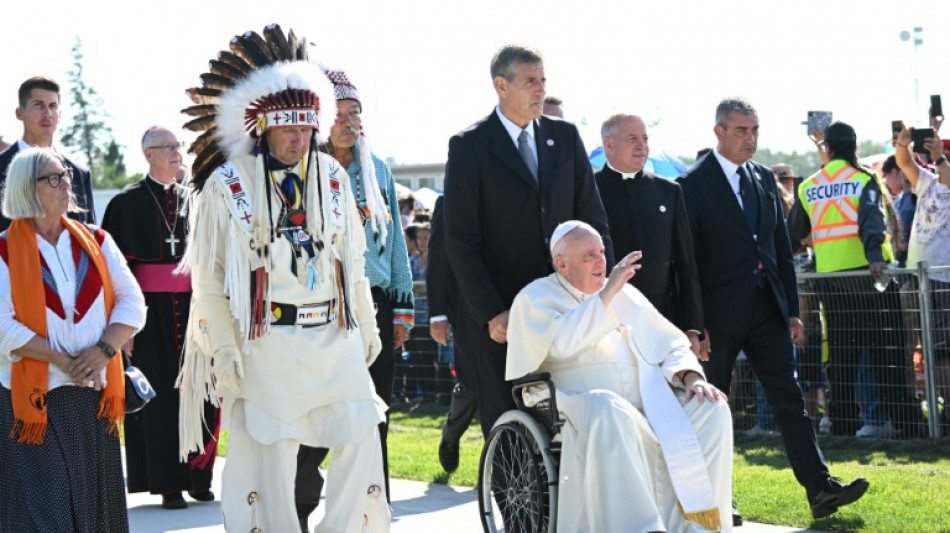
Pope Francis to address Canada's political leaders in Quebec / Photo: Patrick T. FALLON - AFP

 Zach Hickerson Recounts Hayden Panettiere's Final Moments in New Interview

 Luxembourg Housing Petition Passes Threshold for Parliamentary Consideration

 Raheem Sterling Receives Suspended Sentence After Lamborghini Crash

 Audience to Choose the Set List at Luxembourg's First FAMIL Jukebox Night

 Luxembourg Pay Rise Delayed as Regional and World Headlines Develop

 Chennai Urbanist Sashna Develops 'Anniki' Card Game to Gamify Tamil Nadu History

 Transport Minister Defends Land Seizure Powers for Toronto-Quebec City High-Speed Rail

 UAE Weather Forecast: Scattered Showers and Fog Expected as Temperatures Drop
Pope Francis will travel to Quebec City Wednesday, where he will address Canada's political leaders after dedicating the first part of his journey to apologizing for the abuse of Indigenous children at Catholic-run schools.
After two days in the western province of Alberta, during which he begged for forgiveness from the First Nations, Metis and Inuit people of Canada for abuse suffered over the span of a century, the 85-year-old pontiff will fly to Quebec City from Edmonton on Wednesday morning.
He will go first to the Citadel of Quebec, where he will meet with Mary Simon, the first Indigenous person to become Canada's governor general, and then with Prime Minister Justin Trudeau.
He will then deliver a speech to officials, Indigenous representatives and the diplomatic corps.
Francis has been welcomed in Canada and his apology for the Church's role in the residential school system has been hailed as historic, though many Indigenous people who have spoken to AFP have warned there is more work to do.
From the late 1800s to the 1990s, Canada's government sent about 150,000 children into 139 residential schools run by the Church, where they were cut off from their families, language and culture.
Many were physically and sexually abused, and thousands are believed to have died of disease, malnutrition or neglect.
For some, the healing had already begun.
Cindy Dearhead, a First Nations woman who was a student in one of the infamous schools, said she felt the pope's apology was "important."
"It was a long time coming, but finally a pope himself is acknowledging 'yes, I'm sorry,'" she told AFP at Lac Ste. Anne in Alberta, one of the most important pilgrimage sites in North America, as the pope visited the lake on Tuesday.
But for many others, that healing may well depend on what comes next.
"I think the apology has always been one thing, part of a process of reconciliation. To me, the actions that need to come behind it are very important," said Chief Peter Powder of the Mikisew Cree First Nations.
On Thursday, Francis will visit the National Shrine of Saint Anne de Beaupre, one of the main pilgrimage sites in North America, and preside over a mass. Later that day he will go to Notre Dame Cathedral in Quebec City to give a homily.
On Friday, he will travel to the Arctic archipelago of Nunavut, where he will visit the town of Iqaluit for the last stop of his six-day visit.
Francis has been suffering from knee pain and often uses a wheelchair. On Tuesday, he appeared tired and frail as he visited the lake, where he called for healing and sprinkled water he had blessed on to the assembled faithful.
R.Lee--AT


