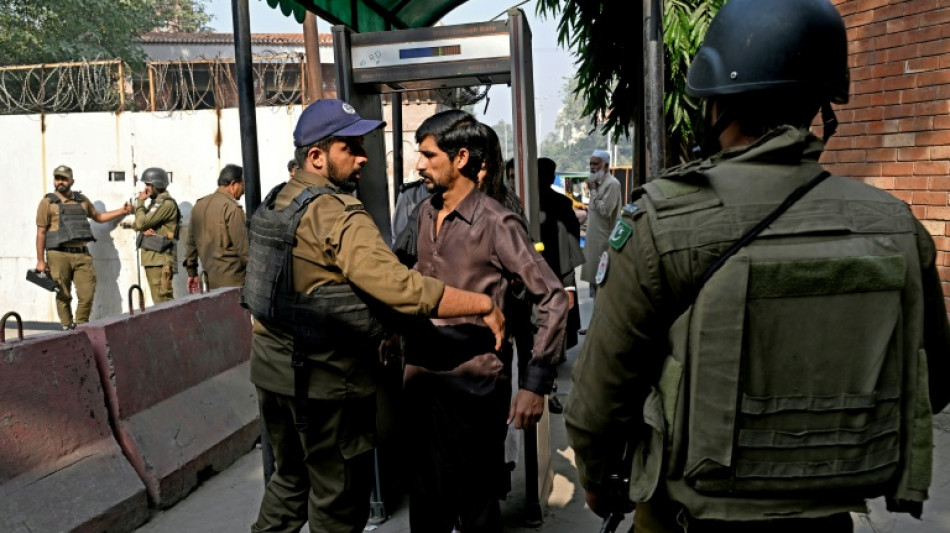
Pakistan tightens Islamabad security after suicide blast / Photo: Arif ALI - AFP

 Lorne Doerkson Sworn In as B.C. Premier, Urges Youth to Stay

 How Families Budget for Youth Sports Travel Seasons

 San Ġiljan Defeat Paredes 20-12 in Challenger Cup Opener

 Kuwait DGCA Delegation Attends ICAO Assembly in Montreal
 Charlie Puth and Ellie Goulding to Headline First Johnnie & Co. Festival in Mumbai

Residents in the Pakistani capital Islamabad were facing tightened security checks on Wednesday in the wake of a suicide bombing that left top officials vowing to halt the rise in deadly attacks.
The deadly blast outside district court buildings on Tuesday was claimed by a faction of the Pakistani Taliban, a militant group that has been behind a series of attacks in other parts of the country.
The district court remained closed on Wednesday while security was stepped up at other court buildings across the city, and long queues of vehicles formed at checkpoints.
"Our army, police, and all law enforcement agencies are alert and performing their duties. Unfortunately, the question remains: Where are these attacks coming from, and how are they happening?" said resident Fazal Satar, 58.
At least 12 people were killed and 27 wounded in the suicide bombing, the first such incident to hit the capital in nearly three years.
"It was a very powerful explosion," said Muhammad Imran, a 42-year-old police official who was wounded in the attack.
"It was a very sudden bang, and I felt like someone had thrown me to the ground," he told AFP.
Sharjeel Ahmed, a 26-year-old student, worried about how the violence would affect foreign investment and Pakistan's ability to host international sports matches.
"In my opinion, this is a serious security lapse, and we must learn from it. If such attacks continue, how will the world trust us?" he said.
Prime Minister Shehbaz Sharif and President Asif Zardari held security talks in the hours after the attack.
"Both leaders reiterated their commitment that operations against foreign-backed terrorists and their facilitators will continue until terrorism is completely eradicated," a statement from the president's office said.
- Judges, lawyers afraid -
Islamabad has long since accused the Taliban authorities in Afghanistan of sheltering the Pakistani Taliban, which the Kabul government denies.
The Taliban government expressed its "deep sorrow & condemnation" over the suicide bombing and a separate attack on a military-run college in Wana, near the Afghan frontier.
A Pakistani security source, who spoke on condition of anonymity because they were not authorised to speak publicly, said all recruits at the Cadet College Wana were rescued after a raid that killed five militants.
The insurgency waged by the Pakistani Taliban, known as the Tehreek-e-Taliban Pakistan (TTP), has focused mainly on Khyber Pakhtunkhwa province bordering Afghanistan.
Pakistan has seen an uptick in violence since the Afghan Taliban returned to power in 2021, and bilateral relations have plummeted in recent weeks.
The worst cross-border fighting in years killed more than 70 people last month, including dozens of Afghan civilians, according to the United Nations.
In Pakistan, the TTP threatened more attacks until Islamic law is implemented in the Muslim-majority country.
Hafiz Mazhar Malik Javeed, a lawyer burying a colleague killed in the suicide bombing, feared for the future.
"All the judges and lawyers were afraid," the 45-year-old said at the cemetery.
"We thought, maybe after some times, they will attack us again."
O.Brown--AT