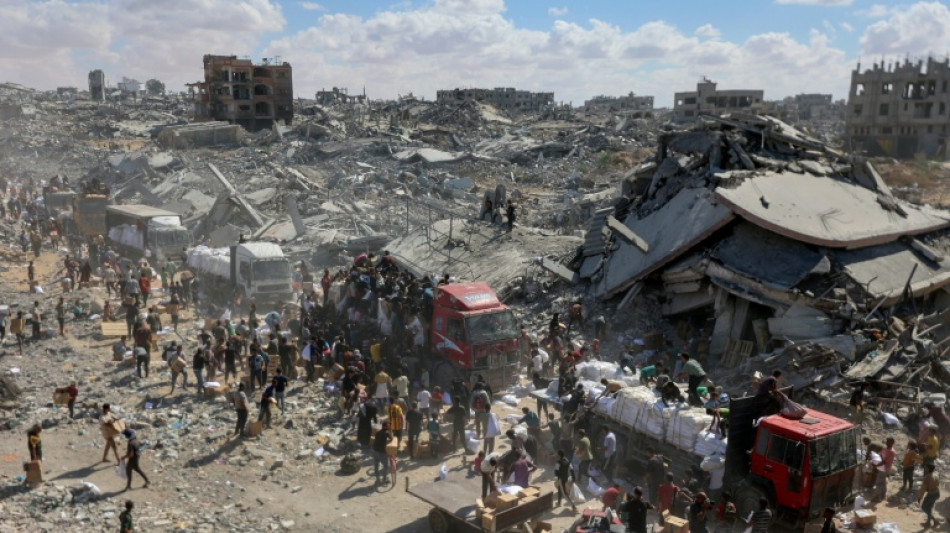
Aid to Gaza still a fraction of promised amounts: UN data / Photo: Omar AL-QATTAA - AFP

 Nepal flood survivors return to ruins to salvage memories

 Killing of Palestinian children and teens by Israel surges in West Bank

 Educators keep 9/11 memory alive for next generation, 25 years on

 Venezuelans view US oil deal with doubt, hope

 Gobena and Jepchirchir power to Sydney Marathon victories

 Iceland in suspense after close EU vote

 Wallabies hold on for victory in Argentina

 Juve notch second straight win, Fiorentina's centenary party falls flat

 Rybakina eases injury fears ahead of US Open
 Djokovic kicks off latest Grand Slam quest under US Open lights

 'Sorry' De Zerbi won't panic after Spurs shambles

 UN, Nepal warn of climate threat after deadly floods

 USTA boss says structure of new player council not yet set

 Tiny Elversberg stun Leverkusen on Bundesliga debut, Dortmund beat Hamburg

 BMC rejects negligence claims in three Rajawadi Hospital maternity cases

 Editorial questions Letitia James’ record as New York attorney general

 Los Angeles triplets weigh 19.3 pounds in unusually heavy birth

 Matt Leinart assesses Arch Manning and the leading names in college football

 Rural Tamil Nadu students present 64 technology projects at IIT-M research park

 Tamil Nadu goalball team’s national silver highlights need for wider support

 Tamil Nadu and NUS agree to expand postgraduate and research links

 India and China have not named two new border meeting sites

 Ankle ligament tear ends Neeraj Chopra’s 2026 season

 Thirty-seven Mumbai pilgrims return after Nepal flood disruption

 French campaign sharpens as far right accuses left over civil disobedience calls

Fewer than a hundred aid trucks operated by the UN and its partners have entered Gaza each day since a ceasefire earlier this month, a fraction of the total 600 trucks a day promised under the plan brokered by US President Donald Trump, data analysed by AFP shows.
Israel has authorised an average of 1,011 tonnes of aid -- or 94 trucks -- to enter Gaza each day between October 10, when the ceasefire took effect, and October 21, according to preliminary data from the United Nations.
This marks an increase compared to the 700 tonnes (or 62 trucks) supplied daily by the UN and partner NGOs between May 19 and October 9, though it is still far from the large-scale deliveries the UN has planned for in the immediate aftermath of the ceasefire.
"The situation still remains catastrophic because what's entering is not enough," World Health Organization chief Tedros Adhanom Ghebreyesus told reporters on Thursday, lamenting that "there is no dent in hunger because there is not enough food".
The International Court of Justice said Wednesday that Israel was obliged to ease the passage of aid into famine-wracked Gaza, stressing it had to provide Palestinians with the "basic needs" to survive.
The data analysed by AFP is compiled by the UN's "2720 Mechanism for Gaza", which has monitored and tracked humanitarian aid entering Gaza since May 19, the day after the end of Israel's two-month blockade of Gaza which prevented humanitarian aid from entering.
The program's tracking -- which relies on monitors verifying aid arrivals and collections for further distribution at Israeli checkpoints and in Gaza -- excludes commercial trucks as well as some private aid groups, such as the US- and Israel-backed Gaza Humanitarian Foundation.
The busiest day for humanitarian aid coming in through the UN2720 Mechanism was October 16, with 206 trucks entering Gaza.
On October 15, UN Humanitarian chief Tom Fletcher said that the aid entering in the previous few days was "a fraction of what's needed," with just "tens of trucks on a good day rather than the hundreds of trucks required."
At least 190,000 tonnes of aid have been positioned by the UN and partner NGOs to enter Gaza as soon as possible, though much of it is still waiting for clearance by Israel.
If the daily supply of aid continues at the pace it has been delivered since the ceasefire, it would take over six months for all of that aid to be delivered, according to an AFP analysis.
- Food and nutrition -
More than 93 percent of aid seen by the UN as it enters Gaza is food, with 1.7 percent made up of nutrition supplies -- which is specific food such as high-calorie supplements given to vulnerable people like malnourished children or pregnant women.
On August 22, the UN declared a famine in Gaza, the first in the Middle East, after experts warned 500,000 people faced "catastrophic" conditions.
Since then, close to 1,000 tonnes of nutrition supplies have been sent to Gaza.
The UN's World Food Programme (WFP), operating almost 70 percent of all aid trucks tracked by the UN2720 Mechanism since May, said it has delivered "enough (food) for close to half a million people for two weeks" since the ceasefire, according to a WFP spokesperson.
At an average of 850 tonnes a day from October 10-21 according to UN2720, which includes aid sent by the WFP as well as other actors, the amount of food arriving in Gaza is still well below the WFP's target of around 2,000 tonnes daily.
Other types of aid sent in the past weeks include water and sanitation products, shelter supplies, solid fuels such as wood pellets used for cooking, and health-related supplies.
On top of aid tracked by UN2720, an average of 164,000 litres of fuel have entered Gaza each day since the ceasefire, compared to 68,000 litres per day in the 30 days before, the UN Office of Project Services (UNOPS) told AFP on Tuesday.
The UN has said it expects 1.9 million litres of fuel would be needed in Gaza each week (around 270,000 per day) to properly operate its post-ceasefire humanitarian relief plan.
Since tracking began on May 19, UN2720 data shows much of the humanitarian aid sent into Gaza does not make it to its intented destination, with some aid reportedly intercepted "either peacefully by hungry people or forcefully [by] armed actors during transit in Gaza," according to the UN2720 Mechanism's website.
A.Taylor--AT