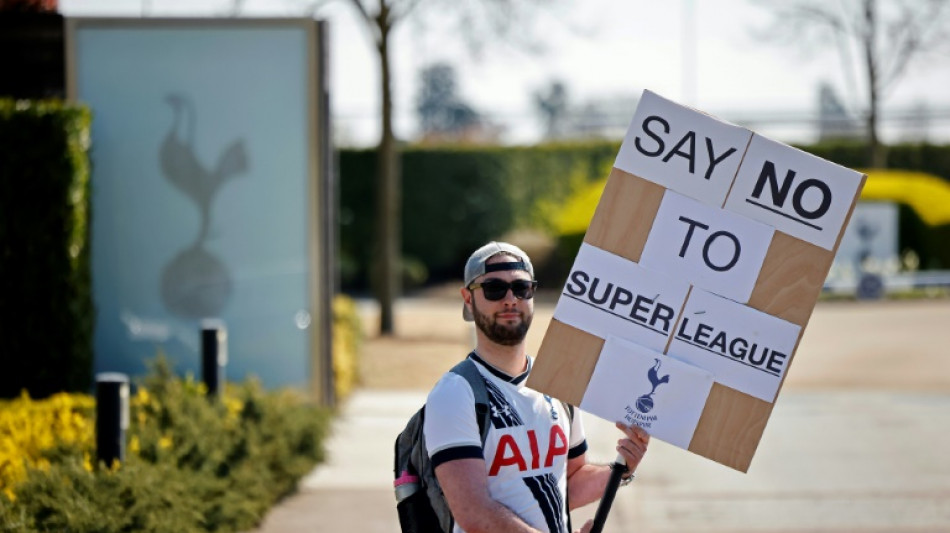
European court opens hearing into whether UEFA can block Super League / Photo: Tolga Akmen - AFP

 Zach Hickerson Recounts Hayden Panettiere's Final Moments in New Interview

 Luxembourg Housing Petition Passes Threshold for Parliamentary Consideration

 Raheem Sterling Receives Suspended Sentence After Lamborghini Crash

 Audience to Choose the Set List at Luxembourg's First FAMIL Jukebox Night

 Luxembourg Pay Rise Delayed as Regional and World Headlines Develop

 Chennai Urbanist Sashna Develops 'Anniki' Card Game to Gamify Tamil Nadu History

 Transport Minister Defends Land Seizure Powers for Toronto-Quebec City High-Speed Rail

 UAE Weather Forecast: Scattered Showers and Fog Expected as Temperatures Drop
Lawyers for the rump of the Super League, the short-lived rival to the Champions League, on Monday denounced the "monopolistic" aims of European football's governing body (UEFA) at the European Court of Justice in Luxembourg (CJEU).
The dispute over the alleged abuse of UEFA's dominant position is being heard by the CJEU on Monday and Tuesday. A decision is not expected before the end of 2022 or even early 2023.
The court is hearing the case at the request of a Madrid judge.
"We are here to defend the freedoms that make the EU a unique jurisdiction in the world, by proposing to fight against anti-economic practices," said Miguel Odriozola Alen, who is defending the Spanish-based Super League company.
He criticised UEFA, which had helped dissuade the "rebellious" clubs from embarking on the adventure, for being a "monopolistic entity", which should not be able to "arrogate to itself regulatory powers over a market in which it is in competition".
The Super League, a competition restricted to 12 major European clubs, was announced with great fanfare in April 2021. But in the face of fan fury and the threat of political action, the deal fell apart within 48 hours as nine clubs withdrew.
The three clubs who have refused to abandon the project, Real Madrid, Barcelona and Juventus, are challenging UEFA's threat of sanctions in a separate action in a Spanish court.
For UEFA, "a league closed to the richest clubs is incompatible with the European sporting model, which is based on merit," its lawyer Donald Slater said on Monday.
He argued that the Swiss-based organisation was "not seeking to maximise its income" but simply to ensure "through the application of common rules ... that sport fulfils societal functions", in accordance with the European treaties.
The stakes go far beyond the Super League, and even beyond football.
On Monday, on appeal, the CJEU dealt with another dispute between the International Skating Federation and two Dutch speed skaters, whom it had wanted to ban for life to prevent them from participating in a South Korean private competition.
That project was nipped in the bud by the reluctance of the athletes to take such a risk.
Earlier on Monday, 15 European supporters' associations, including fan groups from France, Spain, England and Germany issued a joint statement reiterating their "opposition" to the Super League, which they called "an existential threat to European football."
"The project is a billionaire's concept. It is anti-competitive in nature and, if implemented, would destroy the key principles on which the European model is based, such as sporting merit, promotion and relegation, qualification for Europe through success (in competitions at national level) and financial solidarity," said the statement.
T.Perez--AT


