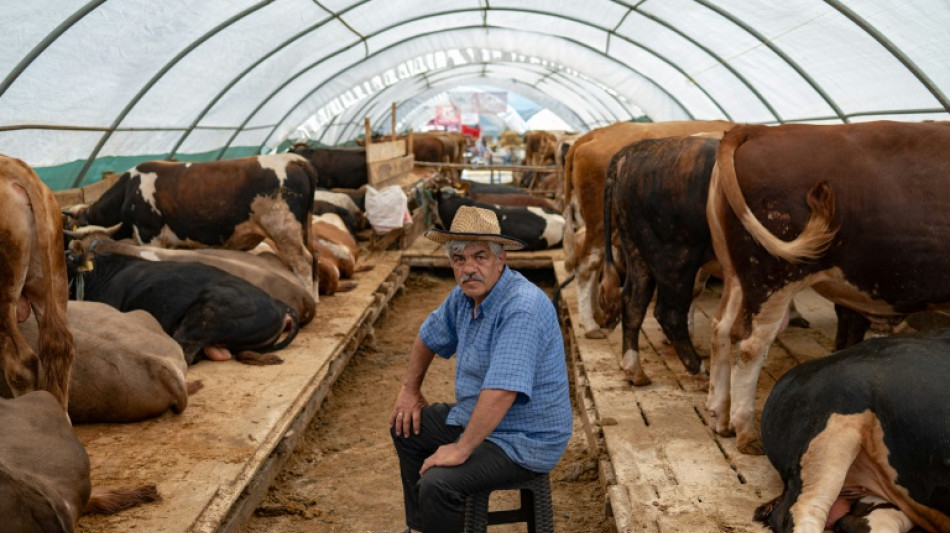
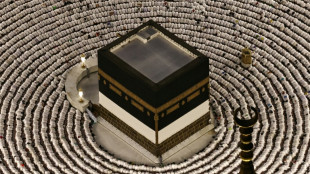
'Sacred duty': Inflation eats into Turkey's Muslim feast / Photo: Yasin AKGUL - AFP

 Fitzpatrick 'not comfortable' over Dubai golf finale
 Gaza apartment block collapse kills 21, including 12 children
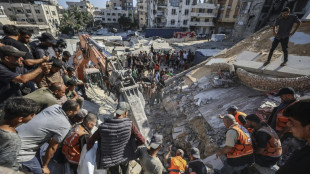 Gaza apartment block collapse leaves 21 dead

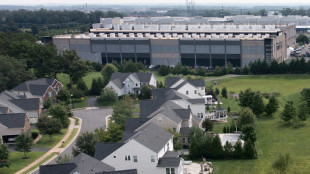 US House targets data centers as midterm backlash grows

 French ex-minister Dati goes on trial in Renault-Nissan corruption case
 'Being Heumann' captures joy in fight for disability rights
 Retired great Nadal to play in exhibition matches
 IR-MED and Dice Technologies Announce collaboration to Evaluate and Advance Pressure-Injury Prevention Platform in Japan
 Watts, Pitt, Cruz to light up Spain's top film festival
 Sweden expels Iran embassy employee over anti-Jewish threats
 Toogood Gold's Table Mountain Sits in the Shadow of a Nevada Gold Rush

 MEXC July–August Security Report: 38.66M USDT in Risk Funds Intercepted, Futures Insurance Fund Hits 792M USDT

 'Breathing toxin every day': Indonesians choked by haze feel helpless
 Stocks edge higher ahead of US Fed rate call

 Philippines ex-leader Duterte makes first in-person ICC appearance
 2027 Formula One calendar includes Monaco sprint race

 Palestinians are the real victims, Thunberg tells Ed Sheeran

 Hashim Thaci: From 'George Washington of Kosovo' to Hague convict
 Amnesty says Iran committed 'crimes against humanity' in crackdown on 2022 protests

 EU to ban social media for under 13s, curb access until 15
 Philippines ex-leader Duterte makes first appearance at ICC
 EU chief pitches 'associate member' status for Canada
 English village votes to 'secede' from UK over asylum centre plan

 Wildfires push endangered Sumatran elephants to brink: Indonesian NGO

 Stocks head higher as traders prepare for Fed decision
With inflation in Turkey galloping, the sheep Gul Er buys every year for the Muslim festival of sacrifice in Istanbul looks agonisingly out of reach.
Prices have doubled or even tripled since President Recep Tayyip Erdogan began an unorthodox economic experiment last year that has seen Turks' living standards suffer.
The young mother hopes to bargain down the price on one of the skimpiest-looking animals at a livestock fair held under white tents in a conservative corner of the city before the Kurban Bayrami (Eid al-Adha in Arabic) holiday.
"It is a sacred duty," she said of buying a sheep, which along with oxen and goats are sacrificed in the name of Allah, with the meat traditionally shared with the poor, friends and neighbours.
"But this year, prices are unaffordable," Er said, the stench of thousands of animals mixing with the sounds of haggling in the heavy summer air, ahead of Saturday's first full day of festivities.
Annual inflation in Turkey has officially reached 78.6 percent, although economists and many ordinary Turks doubt government data.
Even if the official figures are to be believed, that is higher than in any other emerging market and nearly 10 times the record levels rocking the European Union, where the cost of living is unleashing political crises.
An independent survey prepared by the ENAG group -- and believed by most Turks -- puts the annual inflation rate at 175 percent.
Besides clouding Erdogan's chances in next year's election, these figures spell trouble for the merchants at the Istanbul animal fair.
- Snowballing problems -
Turkey's agricultural chambers union chief Semsi Bayraktar expects sales to fall by a quarter this year.
Galip Toklu, a breeder who came to the 40,000-square-metre (10-acre) fair from the Black Sea city of Samsun, listed the ways inflation snowballs into seemingly endless problems.
The cost of animal feed has quadrupled while the amount he pays to drive his livestock to Istanbul has tripled since the last Kurban Bayrami, forcing Toklu to double the price of his meat.
"Last year, I sold 500 kilos (1,100 pounds) of beef for 20,000 liras. This year, I set my prices at 45,000 liras," he said.
Yet few can now afford Toklu's beef, while selling it any cheaper could put him out of business.
"Customers are unavoidably upset," he said, his face sullen under a wide-brimmed hat.
- 'Erdonomics' -
While this year's animal fair looks huge, its 160 tents are a fraction of the 500 erected in past years.
As the fair winds down, breeder Sinas Ates looks despondent, having failed to make a single sale in two days. Livestock farming in Turkey is "finished", he grumbled.
Just like the sacrifice of sheep, Erdogan's economic experiment -- dubbed "Erdonomics" by sceptical global markets -- is also linked to his faith.
Erdogan cites Islamic proscriptions on usury to justify his refusal to raise interest rates to fight inflation.
High interest rates cause prices to rise, according to Erdogan's logic, which contradicts accepted economic orthodoxy.
So Erdogan has pushed the central bank to set interest rates even lower. Analysts at Capital Economics in London see the possibility of a crash of the lira as "a major risk".
- 'Allah's orders' -
At the market, Salih Yeter has responded to the crisis by coming out to look for the perfect sheep with seven friends, who will all contribute to the purchase.
"People usually can't afford to eat meat," the 57-year-old said, adding that giving away meat to the poor is particularly important in times of trouble.
The price of food has soared by 93 percent in the past year, according to official data, with meat prices pushing even higher.
This is especially painful for Er, whose daughter has a metabolic condition that restricts her to a meat diet.
"I can't even respect my daughter's diet," the mother whispered.
But respect for the holy holiday's traditions is binding, said Selahattin Kose, a "hajji" (one who has made the pilgrimage to Mecca), from the eastern city of Erzurum.
"Prices have doubled, but we have to deal with it," Kose said. "It's Allah's orders."
A.Ruiz--AT