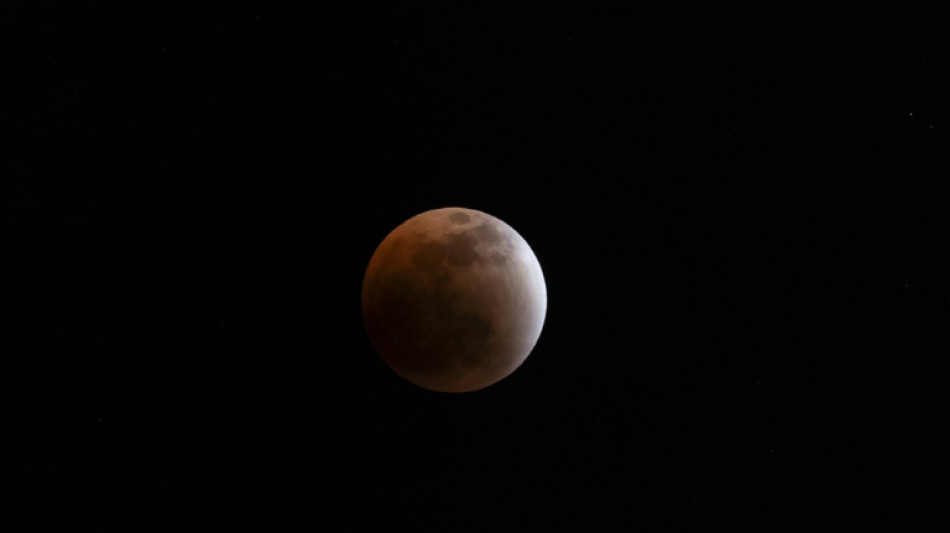
'Blood Moon' rises as Kenya looks to the stars for tourism / Photo: Tony KARUMBA - AFP

 Banff Avenue Transforms into High-End Retail Hub Amid Local Business Concerns

 Hemogenyx Pharmaceuticals PLC - Chairman Receives Prestigious Award
 Bob's Watches Founder Paul Altieri Unveils Private Collection of Vintage Rolex Watches in New Book, "NOT FOR SALE"

 India Imposes 162.5% Duty on Bulk Scotch Imports Amid UK Trade Pact Dispute

 Peaceful Repeat Vote in Douglas Ward 3 Amid Heightened Security

 Belgian Ambassador Marks King’s Day in Athens Amidst Strong Bilateral Trade Ties

 Rediff.com IPO Risks: Gmail Dominance and New Business Ventures

 Dubai Police Expand Luxury Patrol Fleet with 525-hp Defender

Under the Kenyan stars tourists and tribal dancers looked up at the rust red "blood moon" as the east African country launched a new tourism initiative promoting the country's night skies.
When the Sun, Earth and Moon line up, the shadow cast by the planet on its satellite makes it appear an eerie, deep red colour that has astounded humans for millennia.
The phenomenon was visible late Sunday across the planet with some of those in a remote lodge in Samburu county, hundreds of miles from capital Nairobi, where the Kenya's tourism ministry and the Kenya Space Agency launched a drive to push "astro-tourism".
Foreign tourists mingled with local dancers -- wearing fantastically colourful beads and draped cloths -- as they took turns gazing through telescopes at the slowly reddening moon and the kaleidoscope of stars around it.
"It's an amazing experience," Kenyan visitor Stella-Maris Miriti, 35, told AFP.
"At first I thought it was not happening because the moon was dark... but at 8.30 the magic happened," she added.
The tour operator had travelled up from Nairobi to see the "blood moon" away from the city's lights.
Waiting her turn at the telescope, was 26-year-old Maggie Debbe, visiting with her parents from Australia.
"I think it's awesome, I just did not expect any of this," she told AFP.
- 'Game-changer' -
Kenya hopes to capitalise on star-struck tourists like Debbe.
The country has some of the lowest light pollution levels in the world, according to the Bortle dark-sky scale -- which measures night sky light -- and an already thriving tourism industry which accounts for almost 10 percent of the country's GDP.
Astro-tourism could be a fresh reason for tourists to visit, believes Jacques Matara, the Kenya Space Agency's deputy director of Space Research and Innovation.
"We have that advantage of having some of the most beautiful and clear skies worldwide," he told AFP.
"Astro-tourism is our opportunity to create awareness about the utility of space for socio-economic development," he said.
"This is something that could be game-changing, especially in our tourism sector."
As the "blood moon" shone down between the stars, Johanns Hertogh-van der Laan, a 75-year-old ex-teacher from Holland, certainly agreed.
Having come to Kenya with his wife to see the wildlife, he said he had been blown away by the night skies.
"It has been, I think, 40 years ago that I saw it as clear as now," he told AFP.
S.Jackson--AT