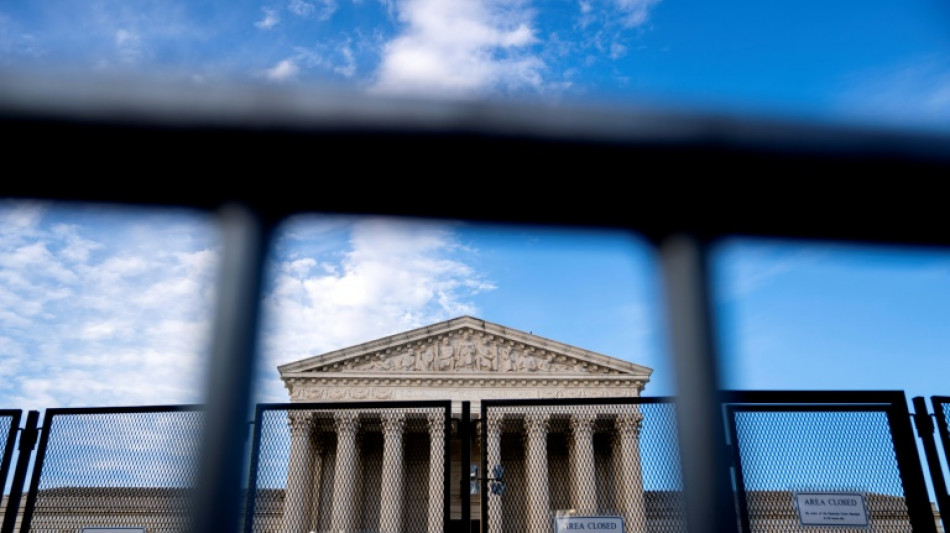
Like none other: profound impact of conservative US Supreme Court / Photo: Stefani Reynolds - AFP/File

 Fitzpatrick 'not comfortable' over Dubai golf finale

 Gaza apartment block collapse kills 21, including 12 children

 Gaza apartment block collapse leaves 21 dead

 US House targets data centers as midterm backlash grows

 French ex-minister Dati goes on trial in Renault-Nissan corruption case

 'Being Heumann' captures joy in fight for disability rights

 Retired great Nadal to play in exhibition matches

 IR-MED and Dice Technologies Announce collaboration to Evaluate and Advance Pressure-Injury Prevention Platform in Japan

 Watts, Pitt, Cruz to light up Spain's top film festival

 Sweden expels Iran embassy employee over anti-Jewish threats

 Toogood Gold's Table Mountain Sits in the Shadow of a Nevada Gold Rush

 MEXC July–August Security Report: 38.66M USDT in Risk Funds Intercepted, Futures Insurance Fund Hits 792M USDT

 'Breathing toxin every day': Indonesians choked by haze feel helpless

 Stocks edge higher ahead of US Fed rate call

 Philippines ex-leader Duterte makes first in-person ICC appearance

 2027 Formula One calendar includes Monaco sprint race

 Palestinians are the real victims, Thunberg tells Ed Sheeran

 Hashim Thaci: From 'George Washington of Kosovo' to Hague convict

 Amnesty says Iran committed 'crimes against humanity' in crackdown on 2022 protests

 EU to ban social media for under 13s, curb access until 15

 Philippines ex-leader Duterte makes first appearance at ICC

 EU chief pitches 'associate member' status for Canada

 English village votes to 'secede' from UK over asylum centre plan

 Wildfires push endangered Sumatran elephants to brink: Indonesian NGO

 Stocks head higher as traders prepare for Fed decision

Two years after President Donald Trump filled its ranks with conservatives, the US Supreme Court has engineered a sharp turn in US constitutional law that could have a profound effect on American life for decades.
Key decisions that rescinded abortion rights, permit Americans to tote their guns freely in public, expand religion in schools, remove voting rights protections, and impede the government's ability to set controls on greenhouse gases, have turned long-accepted rules of justice on their heads.
With a 6-3 majority on the bench, the conservatives led by Chief Justice John Roberts represent a mighty swing of the judicial pendulum from decades of a modestly progressive course.
Politically, the Roberts court is effectively payback by the Republican right, which has since the 1970s endeavored to claim control of the high court to reverse key decisions they view as excessive.
But analysts say the just-closed annual court season has revealed a set of judges more hard-line than anyone anticipated.
They have brashly tossed out the decisions of their respected predecessors, including, as with abortion, rights that previous courts said were guaranteed by the constitution.
"It's not unusual to see the pendulum swinging, and to have what might be considered course-corrections," said American University constitutional law professor Stephen Wermiel.
But in the term just ended, he said, the court took "a dramatic and sudden shift in a far more conservative direction."
"Two generations of Americans, maybe more, have grown up knowing certain sets of rights," Wermiel said.
"This is the rare instance in which the Supreme Court has dramatically taken back constitutional rights," he said.
- Political alignment -
"The last time there was an ideologically cohesive court was the Warren court, and that court pursued liberal objectives" said Neal Devins, a Supreme Court expert at the William & Mary University law school.
Led by Chief Justice Earl Warren, over 16 years from 1953 to 1969 that court made transformative decisions that expanded civil rights and civil liberties.
It effectively ended segregation of whites and Blacks, increased the power of the federal government, curtailed official Christian prayer sessions in public schools, and laid the ground for the 1973 decision that made abortion a constitutional right.
Warren's team overturned plenty of precedents, and was viewed with as much outrage by conservatives as liberals see the Roberts court.
But Devins points to stark differences. Four of the Warren court's conservative members were appointed by a Democratic president, and two liberal justices were chosen by a Republican.
On many crucial decisions, justices from both sides were in the majority and the dissenting minority. Their decisions did not cleanly align with the political divide between Republicans and Democrats.
Indeed, five of the seven justices who backed the 1973 abortion decision were appointed by Republicans.
In the current court, the conservatives were all appointed by Republican presidents -- three by Trump -- and there is far less crossover between the two sides, said Devins.
While the justices might not be consciously thinking in terms of Republican or Democratic politics, "This court is divided not just along ideological but along political party lines," said Devins.
Moreover, the decisions of the conservative six hew farther to the right than many Republicans appear to support.
"This court is willing to go further doctrinally than other courts," Devins said.
- Not our job -
Noteworthy about the Roberts court is its deep belief that the Supreme Courts of the past, like Warren's, took on issues that they had no business deciding.
For example, they said abortion is not a right in the constitution but a moral issue to be decided by the voters of each state.
And only Congress, not an independent government agency, has the broad power to establish things like regulatory caps for greenhouse gases, they said.
The current way government functions, Justice Neil Gorsuch wrote critically, reflects "the explosive growth of the administrative state since 1970."
However, critics say that ignores the reality that the states themselves are deeply divided over abortion, creating a deeply unequal environment for women.
And they say that government cannot function if regulatory agencies cannot implement policy.
"The court knows that Congress is effectively dysfunctional," said Harvard University law professor Richard Lazarus.
Yet it "threatens to upend the national government’s ability to safeguard the public health and welfare at the very moment when the United States, and all nations, are facing our greatest environmental challenge of all."
- Just getting going -
There is little sign that the conservative bloc will slow down. They have accepted more potentially landmark cases for the next term beginning in September, on affirmative action, election laws, and more on regulation of business.
"This court is just getting going. What they accomplish remains to be seen," said Devins.
Conservatives "now have an opportunity for the direction, after 50 years, to dramatically change," noted Wermiel. "And their view is they're not going to blow that opportunity."
W.Morales--AT