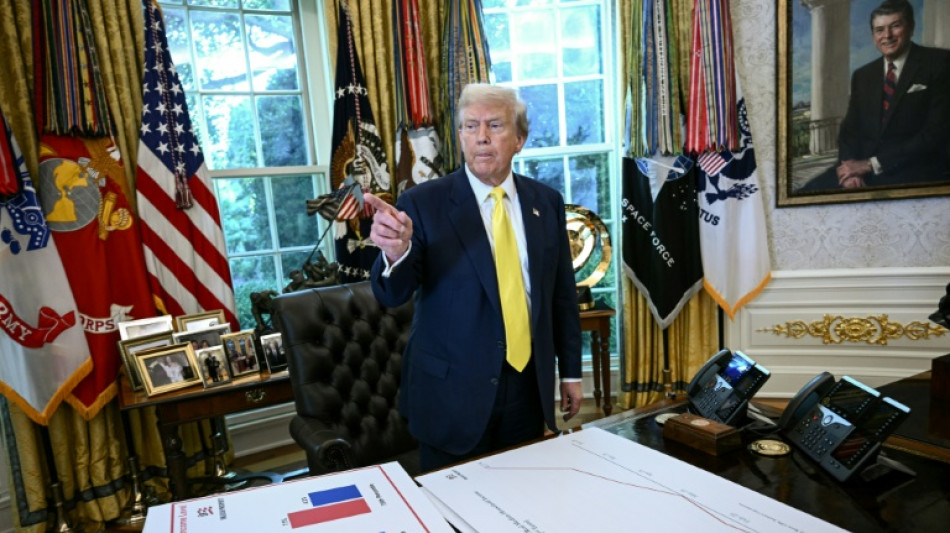
Trump says court halt of tariffs would cause 'Great Depression' / Photo: Brendan SMIALOWSKI - AFP

 Apple CEO Tim Cook gives nod to founder Steve Jobs in final memo

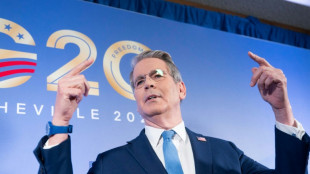
 Russian finance minister makes unexpected appearance at G20
 Happy to be back in NY, Sabalenka advances

 Naomi Watts to receive lifetime award at top Spain film fest

 Jury hears closing arguments in Tupac Shakur murder trial

 Pakistan sack coach, send seven players home after England defeats

 New storms threaten Grand Canyon flood search, 2 bodies recovered
 France takes aim at ultra-fast fashion with new levy

 Tribunal says India cannot withdraw from water treaty with Pakistan

 John Galliano pulls US exhibition after antisemitism backlash

 French Top 14 boss offers 'no guarantees' for first Club World Cup
 Munoz reunites with Glasner after joining Forest from Palace
 Liverpool sign Barcola from PSG for £124 million

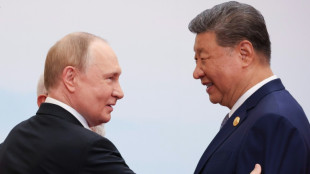
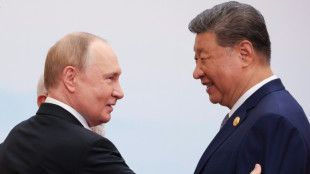 Putin, Xi hold talks in Kyrgyzstan as regional summit begins
 ChatGPT becomes first AI chatbot to face tougher EU rules

 Man City sign Palmeiras winger Allan on five-year deal
 More flooding feared at Grand Canyon after storm leaves 15 missing

 RedHill Divests Talicia® to Apotex for $18 Million Cash Upfront Plus Milestones to Fuel Strategic Growth Opportunities

 MEXC Data: BTC Breaks $80,000, Major-Asset Spot Trading Volume Surges 300%
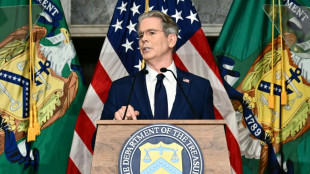 G20 finance talks open as US seeks to ramp up pressure on Iran

 Solving Agent Sprawl: The Case for Enterprise Orchestration

 Springboks switch Kolbe to full-back for third All Blacks Test

 Malaysia's Sarawak eyes cloud seeding as haze worsens

 World leaders need to see rising oceans in Pacific: UN official

 Xiaomi Pad 9 Pro Leak Suggests 12.5-Inch Display and Massive Battery
US President Donald Trump warned Friday of cataclysmic consequences on the US economy if a court rules that his imposition of sweeping tariffs constitutes an illegal power grab.
If a "Radical Left Court" strikes down the tariffs, "it would be impossible to ever recover, or pay back, these massive sums of money and honor," he wrote on his Truth Social platform.
"It would be 1929 all over again, a GREAT DEPRESSION!" he said.
Trump's hyperbolic statements come as a US appeals court weighs the legality of his broad use of emergency powers to enact sweeping tariffs on trading partners.
A lower court ruled against Trump in May, but the US Court of Appeals for the Federal Circuit put the ruling on hold as it considers the case.
Trump on Friday touted billions of dollars in tariff revenue "pouring" into the Treasury -- paid by US importers -- and recent stock market records, as proof his levies had created "the largest amount of money, wealth creation and influence the U.S.A. has ever seen."
Many economists meanwhile worry the tariffs are stoking inflation and see trade policy uncertainty as slowing investment.
Since returning to the White House in January, Trump has announced a slew of new tariffs, seeking to force a reordering of global trade that he has long claimed is biased against the United States.
In addition to sweeping tariffs invoked under declarations of economic emergencies, he has also instituted sectoral tariffs of between 25 percent and 50 percent on steel and other items.
Those levies have generally followed government investigations and are not at issue in the pending litigation.
At a July 31 hearing, members of the appeals court appeared skeptical of the Trump administration's arguments that it had broad discretion to declare national economic emergencies and invoke tariffs as a remedy.
To invoke his so-called "reciprocal" tariffs on many US trade partners, Trump declared a national emergency over "large and persistent annual US goods trade deficits."
Opponents to the White House policy have argued that such a reason does not qualify under the law Trump has cited for the tariffs, the International Emergency Economic Powers Act.
They also argue that levying blanket tariffs on imports requires the consent of Congress under the US Constitution.
The case is likely to end up in the Supreme Court, where conservatives enjoy a 6-3 majority, though analysts say the outcome is uncertain.
A.Ruiz--AT