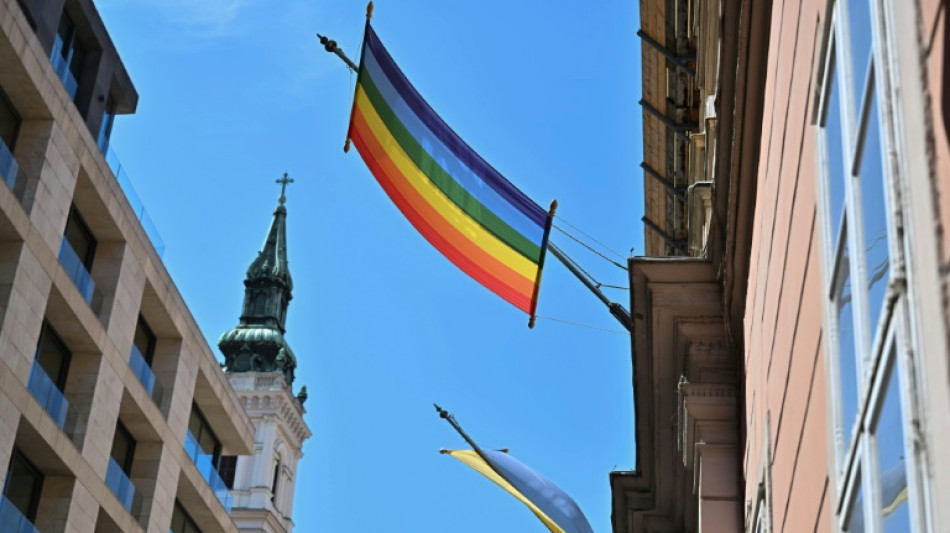
Budapest Pride to challenge Orban's ban in Hungary / Photo: Attila KISBENEDEK - AFP

 Villa sign Senegal winger Mbaye from PSG

 Former Peru minister last-minute contender for UN labour agency helm

 Messi legacy will 'live forever', says Beckham

 'Literally tasting the smoke': Malaysians suffer as haze worsens

 Kyiv's defences, 'hybrid' threat from Moscow headline EU talks

 Oil extends gains, stocks mostly down as Trump issues fresh Iran warning

 ThinkMarkets Expands Weekend Trading Offering, Launches Weekend League Competition

 Tibet activists accuse China of downplaying floods
 Afghanistan war victims left 'without justice', UN says

 Iran president offers US olive branch before Putin meeting
 China-Nepal flood toll tops 1,000 as tunnel rescue offers last hope

 Japan to relax overtime regulation under workaholic PM

 Thwarted Niger mutiny exposes junta's Russia dependence

 Illegal mining ravages S.Africa's economic hub
 Nepal's wall of missing offers last hope after Himalayan flood

 US to press G20 on light-touch AI regulation

 2 die in Grand Canyon flash flood, only 1 person unaccounted for
 US Army Secretary Driscoll submits resignation: White House
 Oil extends gains, stocks drop as Trump issues fresh Iran warning

 Tsitsipas says Kyrgios's positive cocaine test 'kind of expected'

 In Japan's mountains, a different way to manage bears

 Middle East war a boon for UAE defence giant with global ambitions

 Former gang member found guilty of murdering Tupac Shakur
 FireFox Gold Drills Downdip Extension of East Zone, including 1.0m at 124 g/t Au at the Mustajärvi Project in Lapland, Finland

 Pivotree Announces Normal Course Issuer Bid For Common Shares

A record number of people are expected to attend Saturday's Pride march in the Hungarian capital Budapest, defying a ban that marks an unprecedented regression of LGBTQ rights in the European Union.
Prime Minister Viktor Orban's ruling coalition amended laws and the constitution earlier this year to prohibit the annual celebration, justifying his years-long clampdown on LGBTQ rights on "child protection" grounds.
While Orban has been emboldened by the anti-diversity offensive of US President Donald Trump, his own initiatives have drawn protests at home and condemnation from the EU and rights groups.
The nationalist leader on Friday said that while police would not "break up" the 30th edition of the Pride march, those who took part should be aware of "legal consequences".
Despite the risk of a fine, more than 35,000 people are expected to gather at 2:00 pm (1200 GMT) near Budapest's city hall, an hour before the march begins.
Ministers from several EU countries, and dozens of European lawmakers are expected to attend in defiance of the ban, reminiscent of that in Moscow in 2006 and Istanbul in 2015.
"We're not just standing up for ourselves... If this law isn't overturned, eastern Europe could face a wave of similar measures," Pride organiser Viktoria Radvanyi said.
- Freshly installed cameras -
Earlier this week, EU chief Ursula von der Leyen called on the Hungarian authorities to reverse the ban.
Thirty-three countries have also spoken up in support of the march.
While parade organisers risk up to a year in prison, attendees can face fines up to 500 euros ($580). The latest legal changes empower the authorities to use facial-recognition technology to identify those who take part.
Freshly installed cameras have appeared on lamp posts along the planned route of the march.
However, opposition Budapest mayor Gergely Karacsony has insisted that no attendee can face any reprisals as the march -- co-organised by the city hall this time -- is a municipal event and does not require police approval.
"The police have only one task tomorrow, and it is a serious one: to ensure the safety of Hungarian and European citizens attending the event," Karacsony said during a briefing with visiting EU equalities commissioner Hadja Lahbib.
Far-right groups have announced multiple counterprotests along the planned route of the procession.
Justice Minister Bence Tuzson this week sent a letter to EU embassies cautioning diplomats and staff against participating because of the police ban.
Several EU countries have informed their citizens of the potential of fines through travel advisories.
- 'Polarising society' -
Since Orban's return to power in 2010, the country of 9.6 million people has been steadily rolling back LGBTQ rights.
Legal changes have effectively barred same-sex couples from adopting children, prevented transgender people from changing their name or gender in official documents, and a 2021 law forbade the "display and promotion" of homosexuality to under-18s.
This March, lawmakers passed a bill targeting the annual Pride march, amending the 2021 law to prohibit any gathering violating its provisions.
A month later, parliament also adopted a constitutional change to strengthen the legal foundations for the ban.
"Orban is employing a tried-and-tested recipe ahead of next year's election by generating a conflict," political analyst Daniel Mikecz told AFP. Orban was "polarising society", he added.
Voter opinion polls suggest Orban's Fidesz party has been losing ground to the opposition.
The first Pride march was held in 1970 in New York to mark the anniversary of the city's Stonewall riots in June 1969, which sparked the gay rights movement.
G.P.Martin--AT