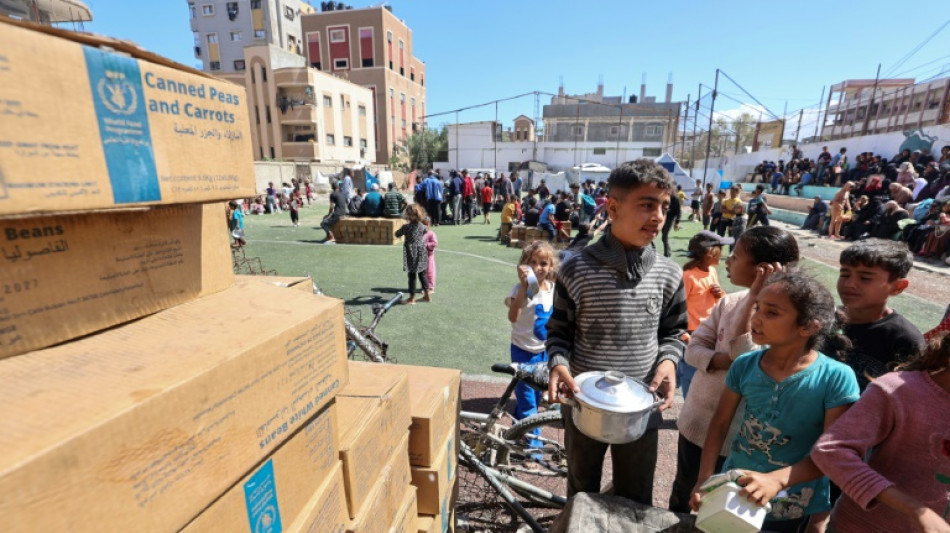
UN food, refugee agencies warn of huge cuts after funding losses / Photo: Eyad BABA - AFP

 DNA tests and funerals in Nepal, a week after deadly floods

 Iran threatens tougher strategy after US strikes kill 4 at wedding

 Chevron unveils deal to double Venezuela venture output in 5 years
 Uganda names its oil 'Pearl Sweet' as it prepares for first exports
 Tiger Woods driver's license suspended for five years after crash

 Germany probes latest sabotage attacks on power grid
 Wall Street stocks mixed as energy prices, bond yields turn lower

 Tiger Woods pleads guilty to reckless driving, license suspended
 Missing passengers likely went down with sunken ferry: N.Cyprus official

 Premier League clubs splash cash to smash transfer record
 Melting glaciers an 'immediate' climate risk: author of UN report

 Folarin Balogun's move to Everton collapses

 Pacific islands to face food shortages over global warming: scientists
 Venice jury head Maggie Gyllenhaal questions lack of women directors
 Stocks drop, bond yields rally on Mideast flare-up

 China expands Egypt investments in first Xi visit in a decade
 Messi departure leaves Argentina facing rebuild after golden era
 Ourbit SuperCEX Launches "Cosmic Wheel Season 3. Oracle Realm" on September 2 with 3M USDT Prize Pool

 Ebola death toll passes 3,000 in DR Congo: official data
 Hong Kong democracy activist Wong pleads guilty to foreign collusion

 World record prize winner Romantic Warrior retires from horse racing

 5,000 US sailors arrive in Thailand after months at sea
 Joshua Wong, Hong Kong's pro-democracy poster child

 Nepal tunnel rescuers seek trapped workers but hit dead ends

 Zverev wins wild five-setter, Rybakina and Gauff ease through at US Open

The UN's food and refugee agencies have warned of dire cuts to their services as funding plummets, especially from key donor the United States under President Donald Trump.
The UN World Food Programme (WFP) will cut staff by 25 to 30 percent as contributions to the global aid agency have dropped, according to an internal email seen Monday by AFP.
The head of the UN refugee agency (UNHCR) warned Monday that reduced contributions could force a one-third reduction in its activities, despite worldwide conflicts that continue to strain its resources.
Trump has moved to slash US contributions to the UN and its agencies since returning to the White House, causing funding chaos as Washington was previously the largest contributor to many budgets.
So far his administration has scrapped 83 percent of humanitarian programs funded by the US Agency for International Development (USAID).
The agency had an annual budget of $42.8 billion, representing 42 percent of total global humanitarian aid, including major contributions to UN agencies.
Other countries have also cut funding to UN agencies this year, but the United States' contributions dwarfed most others in the humanitarian aid sector.
- 'Less with less' -
The WFP is the world's largest humanitarian organization, charged with preventing famine and serious hunger globally, playing a vital role in getting food to crises like the war in Sudan and disaster zones.
"WFP must reduce its worldwide workforce by 25-30 percent, which could impact up to 6,000 roles," the email said.
"This structural shift -- necessary to preserve resources in support of vital operations -- will impact all geographies, divisions and levels in the organization."
Before the cuts, WFP, which was founded in 1961, had 23,000 staff and a presence in 120 countries, according to its website.
"The scale of the workforce reductions needed is difficult news to say and even more difficult to hear. Yet it is the necessary and responsible decision given our tenuous funding outlook," said the memo.
At UNHCR, High Commissioner Filippo Grandi told the Security Council that funding cuts "may conclude with the retrenchment of my organization to up to one-third of its capacity."
The United States has traditionally been UNHCR's top donor, making up more than 40 percent of total contributions received, amounting to approximately $2 billion per year, he noted.
But for 2025, the UNHCR has so far received around $350 million from Washington and is trying to convince the US administration to release an additional $700 million, which has been frozen.
"I cannot emphasize more how dramatic the situation is in this very moment," Grandi said.
"If this trend continues, we will not be able to do more with less. But as I have said many times, we will do less with less. We are already doing less with less," he added.
UNHCR employs more than 18,000 staff across 136 countries, with approximately 90 percent of those employees working in the field, according to its website.
Many UN agencies and departments are already feeling the impact of drastic cuts in donor contributions, forcing them to scale back vital operations for millions of people around the world.
The United States has defended its aid cuts, calling on other countries to do more.
"Every member state needs to better share the burden of humanitarian response to conflict," said acting US ambassador to the UN Dorothy Shea. "The United States has disproportionately shouldered this burden for decades."
A.Taylor--AT