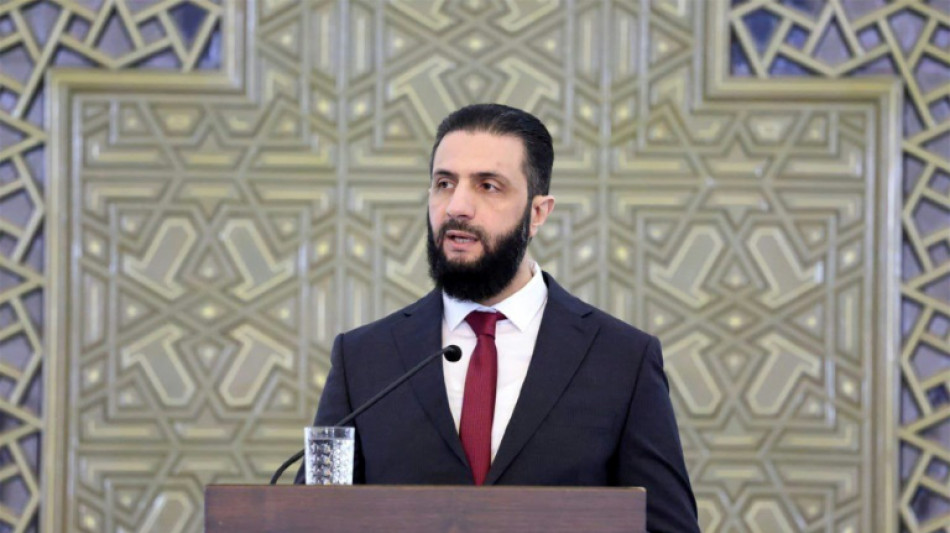
New Syria leader vows state 'monopoly' on weapons / Photo: - - SANA/AFP

 Former soldier stopped with blank round at Incheon Airport

 NYC Mayor Zohran Mamdani Undergoes Successful Achilles Surgery

 Korea Post breach exposes data of at least 113,855 customers
 Verso Books Releases Free Online Edition of The Encyclopedia of the American Left

 Alvechurch Sign Jenson Kilroy on Loan Following Redman Evans Departure

 US Aircraft Disable Iranian-Linked Vessel in Gulf of Oman; Tehran Vows to Defy Blockade

 Apple Black Friday Deals 2026: AirPods Pro 3, MacBook Air, and More

 Egyptian Business Leaders and Banks Pledge EGP 60 Million for Giza Ring Road Fire Victims

 Ireland’s Hearing Crisis: 300,000 Adults Wait Years for Care as National Plan Lags
 Malta-registered tanker sinks off Ibiza, killing one crew member
Syria's new interim president pledged on Tuesday to ensure the state has a monopoly on weapons at a national dialogue conference on the country's future after Bashar al-Assad's overthrow.
Ahmed al-Sharaa, whose Islamist group Hayat Tahrir al-Sham (HTS) led the rebel alliance that toppled Assad in December, also said he plans to establish a transitional justice committee.
The conference, held at Damascus's presidential palace, marks the beginning of a crucial phase for Syria's future governance after years of devastating civil war.
"The unity of arms and their monopoly by the state is not a luxury but a duty and an obligation," Sharaa told the gathering.
"Syria is indivisible; it is a complete whole, and its strength lies in its unity."
But parties in the autonomous Kurdish administration of northeast Syria slammed what they called the symbolic representation of minorities at the conference.
In a joint statement, the 35 parties said: "Conferences with token representation... are meaningless, worthless, and will not contribute to finding real solutions to the country's ongoing crisis."
Sharaa has previously said Kurdish-led forces should be integrated into Syria's national army.
Swathes of northern and northeastern Syria are controlled by a Kurdish-led administration whose de facto army, the Syrian Democratic Forces (SDF), spearheaded the fight that helped defeat Islamic State group jihadists in Syria in 2019, with US backing.
Hundreds of people attended the conference, including civil society, religious communities, opposition figures and artists.
The autonomous Kurdish administration and the SDF were not invited due to the exclusion of armed groups, according to organisers.
"Over the past two months, we have worked on pursuing those who committed crimes against Syrians," said Sharaa.
"We will work on forming a transitional justice body to restore people's rights, ensure justice and, God willing, bring criminals to justice," the interim president added.
A coalition led by Hayat Tahrir al-Sham seized power in Syria on December 8 after a lightning offensive. Sharaa, the Islamist group's leader, was named interim president in January.
An interim government has been charged with managing affairs until March 1, when a new government is set to be formed, reflecting "the diversity" of the population, according to the new authorities.
- Reforms -
Ahead of the national dialogue conference, the organising committee said it would focus on transitional justice, the constitution and institutional and economic reforms.
In his speech, Sharaa emphasised the importance of the rule of law.
"We must build our state on the rule of law, and the law must be respected by those who establish it," he said.
Syria's foreign policy would be based on "balance and openness", he said.
"We are keen to develop strong relations with countries that have respected our sovereignty while keeping the door open for dialogue with any party willing to rebuild its relations with us based on mutual respect."
HTS has its roots in Syria's former Al-Qaeda affiliate but cut ties in 2016.
It is proscribed as a terrorist organisation by many governments including the United States, though it has recently sought to moderate its rhetoric and vowed to protect Syria's religious and ethnic minorities.
Sharaa has said that HTS's dissolution would be announced during the national dialogue conference.
The offensive that toppled Assad ended five decades of his family's iron-fisted rule.
Sharaa said earlier this month that it could take four to five years to organise elections in Syria and two to three years to rewrite the constitution.
The new Syrian leader has been tasked with forming an interim parliament after the Assad era legislature was dissolved following his ouster.
P.A.Mendoza--AT