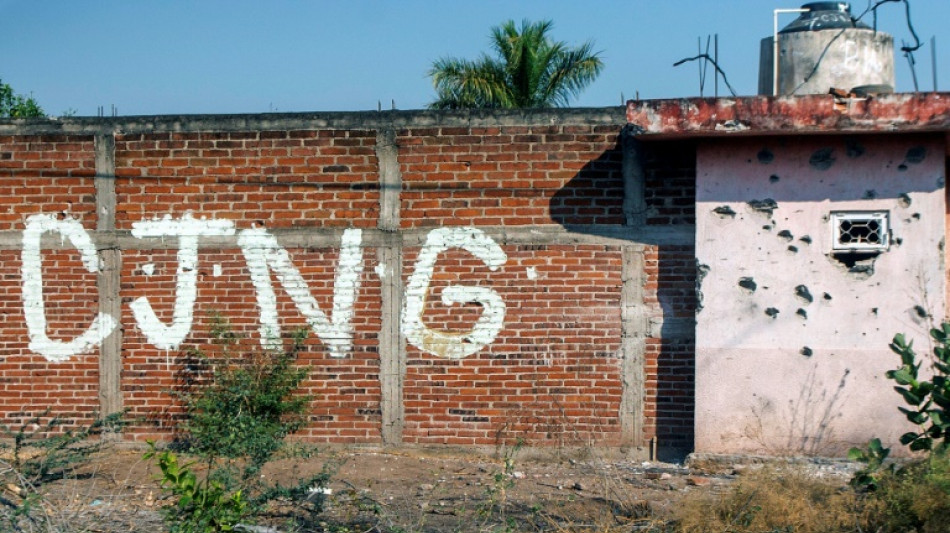
Latin America's 'terrorist' cartels in Trump's sights / Photo: ENRIQUE CASTRO - AFP/File

 Bundesliga brings the band back together in Premier League's shadow

 Asian stocks rally as traders pare rate bets ahead of jobs data
 War-bruised Myanmar finds relief in bareknuckle bloodsport

 Gauff downs Badosa to reach US Open third round

 New Zealand approves use of party drug MDMA to treat trauma

 Westerners test their mettle at World Nomad Games in Kyrgyzstan

 Gauff cruises into US Open third round

 Kyrgios gets month ban for cocaine, enters treatment programme
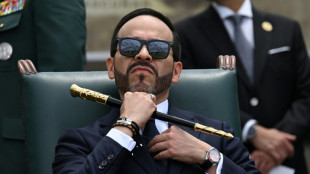 Colombian judge bans strikes on guerrillas if minors are present

 Khachanov shocks ailing Auger-Aliassime, Swiatek and Osaka advance at US Open

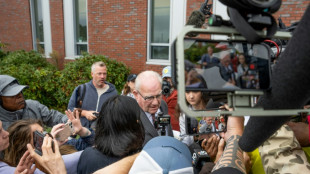 Lone juror blocking verdict in US mother's child murder trial: defense
 'Kinda chic' - Williams sisters set to launch US Open doubles bid

 Volkswagen says cutting 100,000 jobs by end of decade

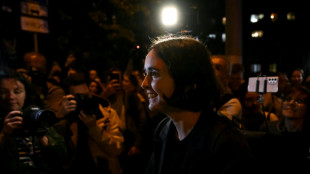 Russia slaps curfew on charity director over army criticism
 Ailing Auger-Aliassime upset by Khachanov at US Open
 Richarlison omitted from Tottenham's Premier League squad

 How El Nino is choking the Panama Canal

 Hamilton drives his Ferrari dream at Monza

 Senegal has an IMF loan, now what?

 Auger-Aliassime upset by Khachanov at US Open
 Hugging Face, the French start-up that became AI's warehouse
 World Cup winner Llorente retires from Spain team at 31

 Osaka squeezes into US Open third round

 Apple faces £2 bn lawsuit in UK over app privacy feature
 Former champ Swiatek eases into US Open third round

From Mexico's most ruthless drug cartels to Central America's most notorious street gang, these are the eight drug trafficking groups being designated terrorist organizations by US President Donald Trump's administration:
- Jalisco New Generation -
The Jalisco New Generation Cartel (CJNG), which emerged in 2010, is one of Mexico's largest, most powerful and ultra-violent criminal organizations.
The United States has offered a $15 million reward for the capture of its leader Nemesio Oseguera, alias "El Mecho," who is accused of fentanyl and methamphetamine trafficking.
According to the InSight Crime think tank, the group's tentacles extend to Guatemala, South America, Canada, China, Southeast Asia and Australia.
Present across most of Mexico, it fights bloody turf wars with the rival Sinaloa Cartel and has been accused of attacking high-ranking officials, including Omar Garcia Harfuch, now Mexico's security minister, in 2020.
- Sinaloa Cartel -
Founded in the 1980s by Joaquin "El Chapo" Guzman and Ismael "El Mayo" Zambada, the Sinaloa Cartel is one of Mexico's oldest criminal organizations, with a reputation for infiltrating the highest echelons of the state.
Guzman and Zambada are both in prison in the United States, leaving their successors fighting a bloody internal battle in their northwestern stronghold.
According to Washington, the group is the top trafficker of fentanyl and also smuggles methamphetamine, heroin, cocaine and marijuana.
With links to China-based chemical suppliers, the Sinaloa Cartel "dominates the fentanyl market through its manipulation of the global supply chain and the proliferation of clandestine fentanyl labs in Mexico," according to the US Drug Enforcement Administration.
In 2024, Mexico's former top security official Genaro Garcia Luna was sentenced to more than 38 years in a US prison for aiding the cartel.
- Tren de Aragua -
The Venezuelan gang, which emerged in Tocoron prison in the northern state of Aragua in 2014, is accused of kidnapping, robbery, drug dealing, prostitution and extortion.
It has also allegedly expanded into illegal gold mining and human trafficking.
The organization set up its headquarters in the Tocoron jail, turning it into a playground kitted out with a pool, a nightclub and a zoo.
Venezuelan authorities regained control of the prison in 2023 and announced that it had dismantled the gang, although its leader Hector Guerrero remains a fugitive.
- Mara Salvatrucha -
The group, also known as MS-13, was formed in Los Angeles in the 1980s by Salvadoran immigrants who fled the civil war in their home country.
After the conflict ended in 1992, convicted members of the organization were deported to El Salvador.
The gang spread to Guatemala and Honduras, turning the region into one of the most violent in the world.
Described by InSight Crime as "perhaps the most notorious street gang in the Western Hemisphere," its members are known for their intricate tattoos.
Many of them have been imprisoned under a crackdown on gangs by El Salvador's President Nayib Bukele.
- Gulf Cartel -
The Gulf Cartel was once one of Mexico's most fearsome criminal groups, but in recent years lost influence and split into multiple factions that control parts of the border with the United States.
Former leader Osiel Cardenas Guillen was captured in 2003 and extradited to the United States, where he was sentenced in 2010 to 25 years in prison.
He was released last August and deported to Mexico to faces several charges.
Nicknamed "El Mata Amigos" (Friend Killer), Cardenas Guillen recruited former Mexican special forces soldiers to form his personal guard, which ended up operating on its own under the name of Los Zetas, one of the country's most bloodthirsty gangs until its collapse.
- Carteles Unidos -
Carteles Unidos (United Cartels), which operates in the western Mexican state of Michoacan, has gained notoriety for its use of antipersonnel mines in the battle it is waging with the Jalisco New Generation Cartel.
According to the US Drug Enforcement Administration, it traffics methamphetamine and heroin.
- La Nueva Familia Michoacana -
La Nueva Familia Michoacana (The New Michoacan Family) is accused by Washington of trafficking drugs including fentanyl, heroin, cocaine, and marijuana into the United States.
It has been described as "one of the most violent and depraved drug cartels" by Washington, which has accused the group of trafficking "rainbow fentanyl" pills made in bright colors, shapes and sizes designed to attract children.
- Cartel del Noreste -
Made up of remnants of the ultra-violent Los Zetas, the Cartel del Noreste (Northeast Cartel) dominates an area of Mexico bordering Texas where it is known for its violent methods.
S.Jackson--AT