
Teamwork key to smashing European doping networks: WADA investigations chief / Photo: Andrej Ivanov - AFP

 How haze from Indonesian fires impacts Southeast Asia

 Trump sends envoys to Moscow, Kyiv with new plan to 'end war'

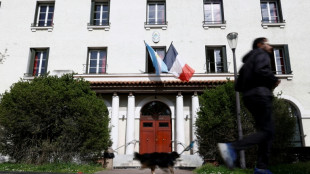 'Mini-dictatorship': Students slam Argentina-run residence in Paris

 The disgraced banker stirring the pot in Brazil's Supreme Court
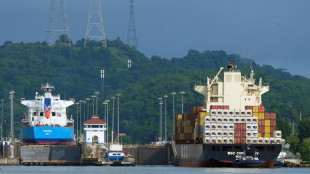 Panama Canal begins reducing crossings due to El Nino

 Trump again seeks to remove protections for wolves

 'Getting there' - Alcaraz into US Open last 16 along with Sabalenka

 Isak ready to show world his quality, says Van Dijk

 Stuttgart cruise past Cologne to bounce back from Bayern thumping

 'Smart, aggressive' Alcaraz into US Open last 16

 Isak fires Liverpool to first win under Iraola at Ipswich
 Stocks slip as robust US jobs data stokes rate hike odds

 Mistrial declared in case of US woman who killed her three children

 Seville, Alfred win at Diamond League finals, Duplantis hit with injury

 Moody’s Assigns First-Time Insurance Financial Strength Ratings to Freedom Insurance and Freedom Life

 Trump says envoys taking plan to 'end the war' to Moscow, Kyiv
 US Football Hall of Fame revamps selection process

 Judge declares mistrial in case of US woman who killed her children

 Edgar Davids art thief misses sentencing after being 'knocked out by luggage'
 Pegula rallies to reach US Open fourth round
 Defending champ Sabalenka leads way into US Open fourth round
 Bayeux Tapestry 'virtually unchanged', UK museum says, after France spots broken threads

 More than 120 killed in Yemen's worst clashes in years: sources

 Germany hunts climate activist suspected of power grid sabotage

 5 EU countries aim to send rejected migrants to 'return hub' by 2027
A collaboration between the Serbian anti-doping agency and law enforcement operatives who seized 3,000 kilogrammes of performance-enhancing drugs and broke up an organised crime gang last year is "the future in the fight against doping", WADA's Director of Intelligence and Investigations Gunter Younger has told AFP.
The collaboration stemmed from a proposal from the World Anti-Doping Agency to the European Union in 2022 to assist with funding of a week-long workshop bringing together law enforcement officers from across Europe and anti-doping personnel from national agencies.
The Serbian gang -- eight members were arrested -- had brought in doping products with an estimated worth of three million euros ($3.1 million) from India, Serbia's anti-doping agency said.
Although the raids were carried out by the police, they acted on intelligence gathered by the Serbian agency.
Similar operations have been carried out in Poland -- which uncovered a laboratory capable of producing one million steroid pills a day -- and in Austria, Denmark, Germany and Greece.
"It is the future in the fight against doping, because without law enforcement, sport organisations are overstretched" in the battle against products brought into countries by organised crime groups, Younger told AFP.
Although anti-doping personnel do not actively participate in the raids, their involvement adds an edgier element to WADA's global image.
"It is not the perception of the public of what we are," Younger said.
WADA's image came under the microscope last year after it cleared 23 Chinese swimmers who had failed doping tests, accepting the Chinese authorities' explanation that they had eaten contaminated food.
A report into the case cleared WADA of showing "favouritism" although it was insufficient for the United States which withdrew funding from the global doping body this year.
This month, WADA has had to defend its handling of the doping case concerning world tennis number one Jannik Sinner, with some players complaining that the Italian has been given preferential treatment by receiving a three-month ban.
- ' Whistleblowers are the key' -
Younger said the collaboration between law enforcement and national doping agencies in Europe had quickly produced results.
He said he had hoped the EU-assisted workshop would spawn six operations but "it went through the roof" and WADA was now collaborating on over 100 across Europe.
In the raids so far, "law enforcement have seized 25 tonnes of performance-enhancing drugs," the 57-year-old German said.
"Around 25 underground laboratories were dismantled.
"Our teams in Europe made sure that more than 500 million doses of performance-enhancing drugs were prevented from coming onto the global market."
Younger, a former head of the Bavarian cybercrime and counterfeit currency departments who joined WADA in 2016, says it was easier to get the attention of law enforcement bodies when organised crime was involved.
"They see that organised crimes groups shift more and more from classical drugs like heroin and cocaine to performance-enhancing drugs." he said.
"Why? Because they can use the same supply routes", but make "higher profits".
"Also the detection rate is very low because law enforcement usually are not so interested in performance-enhancing drugs."
Being in possession of one kilogramme of cocaine could earn someone a jail sentence of several years in some countries.
On the other hand, "for one kilogramme of performance-enhancing drugs, you get probably a fine. So that is why it was logical an organised crime group would discover this area."
Younger impressed on the law enforcement officers that although doping products may not be a priority, allowing them into their countries could lead to more sinister activities.
"We told (them) that organised crime groups are very quick in identifying the weak spots in a system." he said.
"If your country is not reacting on that, they might use your country as a hub for others."
While the police get the satisfaction of cracking an organised crime ring, the main benefit for WADA is obtaining the identities of the intended clients for the doping products.
The raid in Greece uncovered a list of 11,000 clients. Not all are members of an athlete's entourage but even just one name can open the way to uncovering athletes who are doping.
"We are hoping to get data from them about athletes, support personnel, doctors," he said.
None of this would be possible, Younger said, without whistleblowers.
"You need to be very creative in how you find the evidence and whistleblowers are our key," he said.
"We have a very strong whistleblower programme. We get almost 500 reports per year, which is a very good result for us.
"This is why I think this collaboration with law enforcement with the power they have is so important.
"It is the future in the fight against doping, because without law enforcement, sport organisations are overstretched" in the fight against organised crime groups.
Younger said the workshop -- there are plans for one in Asia and Oceania -- could be a game changer.
"We had this morning another big seizure," he said. "Someone said it was triggered by your workshop.
"I mean, that's beautiful. What else can you wish for?"
H.Thompson--AT