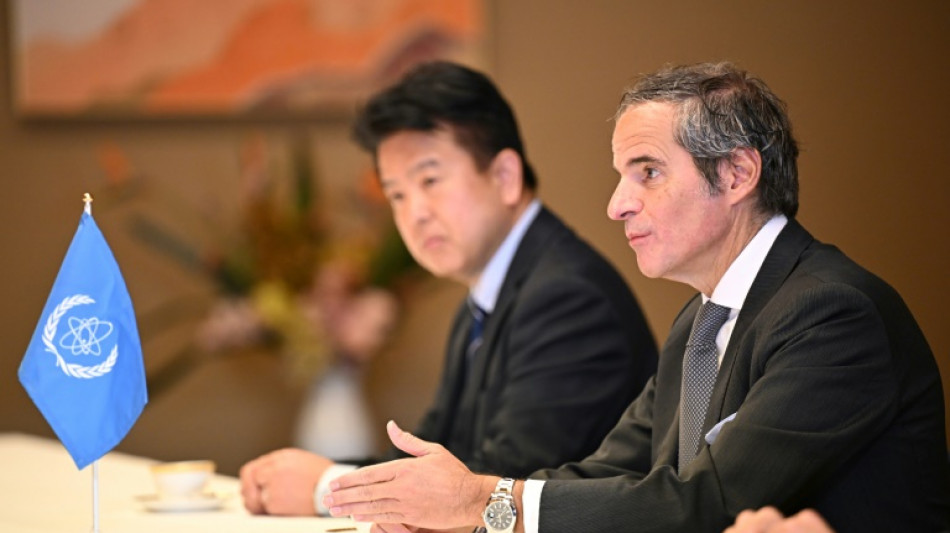
UN watchdog chief visits Fukushima as Japan returns to nuclear power / Photo: Philip FONG - AFP

 How haze from Indonesian fires impacts Southeast Asia

 Trump sends envoys to Moscow, Kyiv with new plan to 'end war'

 'Mini-dictatorship': Students slam Argentina-run residence in Paris

 The disgraced banker stirring the pot in Brazil's Supreme Court

 Panama Canal begins reducing crossings due to El Nino
 Trump again seeks to remove protections for wolves
 'Getting there' - Alcaraz into US Open last 16 along with Sabalenka

 Isak ready to show world his quality, says Van Dijk

 Stuttgart cruise past Cologne to bounce back from Bayern thumping

 'Smart, aggressive' Alcaraz into US Open last 16

 Isak fires Liverpool to first win under Iraola at Ipswich

 Stocks slip as robust US jobs data stokes rate hike odds

 Mistrial declared in case of US woman who killed her three children

 Seville, Alfred win at Diamond League finals, Duplantis hit with injury

 Moody’s Assigns First-Time Insurance Financial Strength Ratings to Freedom Insurance and Freedom Life

 Trump says envoys taking plan to 'end the war' to Moscow, Kyiv

 US Football Hall of Fame revamps selection process

 Judge declares mistrial in case of US woman who killed her children

 Edgar Davids art thief misses sentencing after being 'knocked out by luggage'

 Pegula rallies to reach US Open fourth round
 Defending champ Sabalenka leads way into US Open fourth round
 Bayeux Tapestry 'virtually unchanged', UK museum says, after France spots broken threads

 More than 120 killed in Yemen's worst clashes in years: sources

 Germany hunts climate activist suspected of power grid sabotage

 5 EU countries aim to send rejected migrants to 'return hub' by 2027

The UN nuclear watchdog chief visited Japan's stricken Fukushima plant on Wednesday, the day after Tokyo approved an energy plan that marks a return to nuclear power to meet growing demand for AI.
The International Atomic Energy Agency (IAEA) is monitoring Japan's efforts to decommission the Fukushima Daiichi plant after a 2011 earthquake-triggered tsunami killed 18,000 people and set off the worst nuclear disaster since Chernobyl.
As IAEA head Rafael Grossi arrived in Japan on Tuesday, the cabinet adopted a plan to increase reliance on nuclear power to help meet growing energy demand from artificial intelligence and microchip factories.
"At a moment where Japan is embarking on a gradual return to nuclear energy in its national energy mix, it is important that this is also done in complete safety and with the confidence of the society," Grossi said after meeting the foreign minister.
Japan had previously vowed to "reduce reliance on nuclear power as much as possible".
But this pledge was dropped from the latest Strategic Energy Plan -- which includes an intention to make renewables the country's top power source by 2040.
Under the plan, nuclear power will account for around 20 percent of Japan's energy supply by 2040, up from 5.6 percent in 2022.
The return to nuclear comes as the country is decommissioning Fukushima Daiichi, a process expected to take decades with the most dangerous part still ahead: removing around 880 tonnes of radioactive debris from the reactors.
Grossi, making his fifth visit to Fukushima, viewed the vast "interim" soil storage facilities near the plant for the first time.
Around 13 million cubic metres of soil and 300,000 cubic metres of ash from incinerated organic material -- enough to fill 10 stadiums -- were scraped from land in the region to remove harmful radiation.
On Wednesday, trucks and construction vehicles went back and forth between several areas where hundreds of large soil-filled black bags were stacked, some covered by a thin layer of snow.
Hanging on a locked fence around the storage site was a sign displaying the radiation level.
- Seafood bans -
Japan plans to recycle roughly 75 percent of the soil -- the portion with low radioactivity -- for building projects such as road and railway embankments.
The remaining material will be disposed of outside the Fukushima region ahead of a 2045 deadline.
Stripping topsoil was "very effective" to decontaminate land close to waterways, said Olivier Evrard, research director at France's Atomic Energy Commission.
But the operation was expensive, "generated a massive amount of waste and still poses fertility issues" for agriculture, he told AFP.
It stands in contrast to the decision to fence off a large area after the 1986 Chernobyl disaster and more or less "leave it to wildlife", Evrard said.
Experts from the IAEA and countries including China and South Korea will also take new seawater and fish samples from Fukushima on Wednesday.
Plant operator TEPCO began discharging 1.3 million tonnes of groundwater, seawater and rainwater, along with water used for cooling the reactors, into the sea in 2023.
The water release is endorsed by the IAEA and TEPCO says all radioactive elements have been filtered out except for tritium, levels of which are within safe limits.
However, countries including China and Russia have criticised the release and banned Japanese seafood imports.
China said in September it would "gradually resume" importing seafood from Japan but this has yet to begin.
A.Anderson--AT