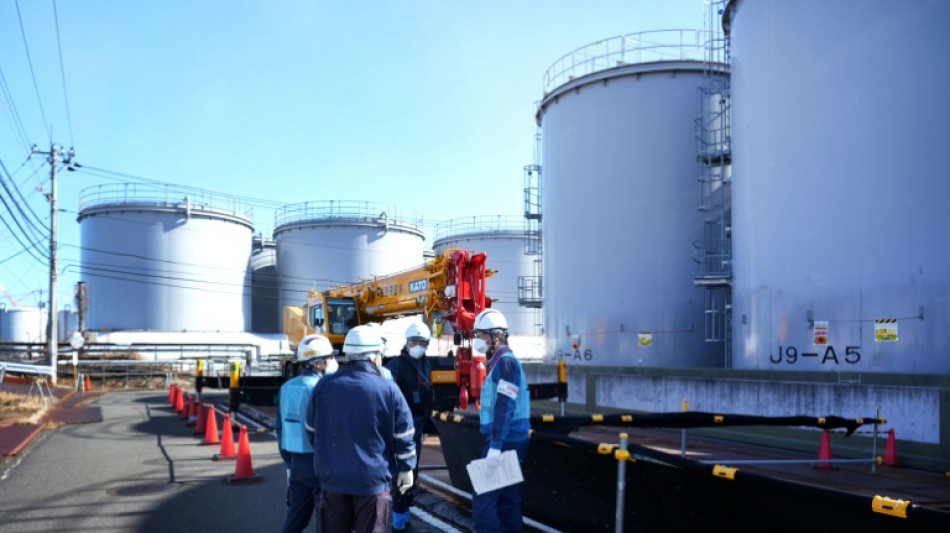
TEPCO takes on challenge of making space for Fukushima nuclear debris / Photo: Atish PATEL - AFP

 In Iceland, the mystery of the poet, the tomb and the Danish grocer

 Ratko Mladic: Bosnian Serb commander to convicted war criminal

 Bolivian army base blasts kill two, wound dozens
 Alcaraz, Sabalenka into US Open last 16 as Williams sisters lose on return

 Williams sisters fall in thrilling return to US Open doubles
 Bangladesh measles toll nears grim 1,000-child mark

 Bolivia farmers return to streets over diesel price hikes
 Tetris distances itself from controversial White House 'arcade' games

 Africa bigger, US smaller - UN adopts new map

 Bad weather will not affect All Blacks, says captain Savea

 Mbappe misses penalty as Parrott lifts Betis past Real Madrid

 PSG still winless in Ligue 1 as Monaco go top

 Defending champion Alcaraz reaches last 16 at US Open

 Lyles ends season before Budapest due to injury flare ups

 US Republicans announce probe into environment groups

 Sabalenka survives despite 'tricky' weed smell at US Open

 S&P Revises Outlook on Freedom Holding Corp. and Core Subsidiaries to Positive

 Job growth but record-high diesel prices -- Trump's midterms mixed bag

 Women's NBA comissioner Engelbert to retire at season's end

 Luis Enrique extends contract as PSG coach until 2030

 Duplantis pulls out of Diamond League finals

 Defending champ Sabalenka, Pegula lead way into US Open fourth round

 UK hard-right party rallies behind leader after new donation scandal

 Nigeria's Dangote refinery looks to raise $1.6 bn in IPO
 Portugal extends talks to privatise national carrier TAP
Workers at Japan's crippled Fukushima nuclear plant have started dismantling water storage tanks to free up space for tonnes of nuclear debris, 14 years after the facility was hit by a devastating tsunami.
Operator Tokyo Electric Power Company (TEPCO) has been charged with finding a suitable place to store around 880 tonnes of radioactive material that remains inside the Fukushima Daiichi plant's damaged reactors.
"Currently, there is no more land available in Fukushima Daiichi", Naoki Maeshiro, project manager for TEPCO, who is overseeing the operation which began on Friday, told AFP.
Three of plant's six reactors were operating when a tsunami caused by a massive earthquake hit on March 11, 2011, disabling their cooling systems and sending them into meltdown.
Ever since, TEPCO has been holding 1.3 million tonnes of water -- a combination of groundwater, seawater and rainwater -- at the site, along with water used for cooling the reactors.
The water, which is treated to remove various radioactive materials, has been held inside more than 1,000 tanks that occupy much of the plant.
In one of the zones called "J9", the giant steel tanks tower over employees at work, obstructing the view of the rest of the plant.
"To proceed with the next steps, such as retrieving the fuel debris, a certain amount of land is necessary," added Maeshiro.
Scrapping the water tanks became possible after TEPCO began discharging treated water from the plant into the Pacific Ocean in August 2023.
Japan and the International Atomic Energy Agency (IAEA) have assured that the operation does not harm the environment.
Getting rid of the welded containers is considered a crucial step in the decades-long decommissioning process.
Once removed, the utility company plans to build facilities to store highly dangerous molten fuel debris after extracting it from inside the reactors.
"As long as the fuel debris remains in its current state, the risks remain very high," Nobuhide Sato, a risk specialist at TEPCO, told AFP.
- Arcade-style claw machine -
The company has developed a telescopic device that can collect debris remotely for safety reasons and to avoid radioactive material leaks.
A demonstration attended by AFP was carried out in reactor number five, which was not in operation when the tsunami hit.
Before entering the zone, which is under high surveillance, employees put on masks, safety helmets, a full body protective white suit, and three pairs of socks and gloves as a precaution against radiation.
Armed with a flashlight, Sato stopped in front of a hole, around 60 centimetres (two feet) in diameter, that has been drilled into the structure protecting the reactor's core.
The plan is to extend the specially developed telescopic device several metres through the hole to reach the radioactive debris in the reactor.
The device resembles an arcade claw machine, so the "arm grabs the debris, lifts it, and retrieves it," said Sato.
In early November, TEPCO announced a debris sample weighing 0.7 grams (0.025 ounces) had been successfully extracted and sent to a laboratory near Tokyo.
The analysis will help determine radioactivity levels and the chemical composition of the molten fuel debris, a key step in the colossal dismantling project.
"Depending on the results, we will see whether it is better to use water to collect (the fuel debris) in the reactor or to do it in a dry environment," Sato said.
The TEPCO employee then enters the base of the reactor, where workers can only spend a maximum of two hours a day due to radiation levels.
"If we can properly recover the fuel debris and store it safely, it be a great help in reassuring nearby residents," Sato added.
A second sampling of nuclear material is scheduled between "March and April," according to TEPCO, which should provide enough information about its composition to move to the next stage -- a larger-scale extraction of radioactive debris by 2030.
The overall project is expected to take between 30 and 40 years, the company said.
M.Robinson--AT