
Split on drug culture, Mexican ballads flourish in digital age / Photo: CLAUDIO CRUZ - AFP

 US envoys in Moscow as Russia and Ukraine vow not to hit capitals during talks

 Motorsport governing body rejects Alpine boss's claims of bias

 US envoy on West Bank visit says Israel has responsibility for Palestinians

 Ethiopian Miss World contestant spotlights pain of sister's murder

 'Leader' Raphinha rising to Barca striker challenge

 Oasis fans gather in Venice for band reunion film

 Two Nepal rescues revive hopes 10 days after flood

 Pogacar to miss worlds after season-ending Vuelta crash

 Greenwood, Guendouzi handed bans after Fenerbahce-Lyon brawl

 In Iceland, the mystery of the poet, the tomb and the Danish grocer

 Ratko Mladic: Bosnian Serb commander to convicted war criminal

 Bolivian army base blasts kill two, wound dozens

 Alcaraz, Sabalenka into US Open last 16 as Williams sisters lose on return

 Williams sisters fall in thrilling return to US Open doubles

 Bangladesh measles toll nears grim 1,000-child mark

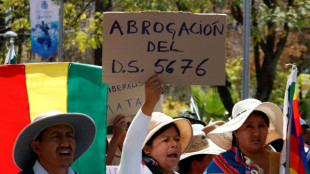 Bolivia farmers return to streets over diesel price hikes

 Panama Canal begins reducing crossings due to El Nino

 Trump again seeks to remove protections for wolves

 'Getting there' - Alcaraz into US Open last 16 along with Sabalenka

 Isak ready to show world his quality, says Van Dijk

 Stuttgart cruise past Cologne to bounce back from Bayern thumping

 'Smart, aggressive' Alcaraz into US Open last 16

 Isak fires Liverpool to first win under Iraola at Ipswich

 Stocks slip as robust US jobs data stokes rate hike odds

 Mistrial declared in case of US woman who killed her three children

With songs chronicling the lives of drug traffickers or railing against violence, a new generation of Mexican ballad singers are enjoying success and skirting censorship through digital platforms.
Abraham Vazquez, 22, and Vivir Quintana, 32, are two of the new faces of the "corrido" genre that emerged during the Mexican revolution of 1910-1917 to tell an alternative story to the official narrative.
Vazquez, originally from the northern state of Chihuahua, boasts 1.1 million listeners monthly on Spotify.
His rap-infused "narcocorrido" -- a ballad about drug traffickers -- "El de las dos pistolas" (The one with the two guns) has been played 52.8 million times on the digital music platform.
The video for the song exalts the world of gangsters with wads of dollars, guns, and women in a swimming pool. It has been viewed 27.7 million times on YouTube.
Fed up with her students listening to such songs, Quintana, a teacher from the northern state of Coahuila, turned to "anti-narcocorrido," which emerged five years ago, to denounce gender and criminal violence.
She recently released "El corrido de Milo Vela" (The Ballad of Milo Vela) -- a tribute to journalist Miguel Angel Lopez, murdered in 2011 along with his wife and son in the eastern state of Veracruz.
"It was to replace drug traffickers with those who really defend the country, those who defend the truth... I think we're at a very critical moment," she told AFP, referring to the murders of 11 Mexican reporters this year alone.
Another of Quintana's songs, "Cancion sin Miedo" (Song without Fear), has become a feminist anthem.
Accused of being apologists for organized crime, narcocorrido singers have seen their songs banned in the states of Sinaloa, Baja California and Chihuahua, where punishments range from 36 hours' detention to fines of $20,000.
Even well-known bands have been punished, including norteno acts Los Tigres del Norte, who were fined in Chihuahua in 2012 and 2017, and Los Tucanes, who have been banned in Tijuana since 2008.
- 'Difficult to control' -
The genre has flourished on digital platforms, which facilitate production, access and interaction between artists and audiences, researcher Juan Antonio Fernandez said.
"With the platforms, it's very difficult to control it because unfortunately young people see drug trafficking as an aspirational activity, where they can get easy money," he told AFP.
The genre's popularity is also helped by the rags-to-riches stories the songs tell.
"The imaginary drug trafficker goes from being an individual from a rural background -- growing drugs -- to be a more urbanized drug trafficker, more connected with today's youth," Fernandez said.
In 2019, during the Coachella festival in California, hundreds of boys danced with Los Tucanes wearing shirts with the image of Joaquin "Chapo" Guzman, the notorious drug lord imprisoned in the United States.
In the government's view, the narcocorridos -- three of whose performers have been murdered since 2006 -- promote gang culture and represent a "social risk" that must be tackled, Fernandez said.
But Teodoro Bello, a veteran composer of famous Los Tigres del Norte songs, rejects the label as he considers it stigmatizing.
For him, there is only the corrido genre.
His 1997 song "Jefe de Jefes" (Boss of bosses) performed by Los Tigres del Norte was thought to have been inspired by Miguel Angel Felix Gallardo, a major cartel boss in the 1980s.
But, Bello told AFP, "'the boss of bosses' is the one who is the best in his profession: a doctor, a lawyer or even a journalist."
Despite the flirtation with crime, even President Andres Manuel Lopez Obrador plays songs by Los Tigres del Norte at his daily news conference. He says one reason is to refute comments by Texas Governor Greg Abbott on immigration.
S.Jackson--AT