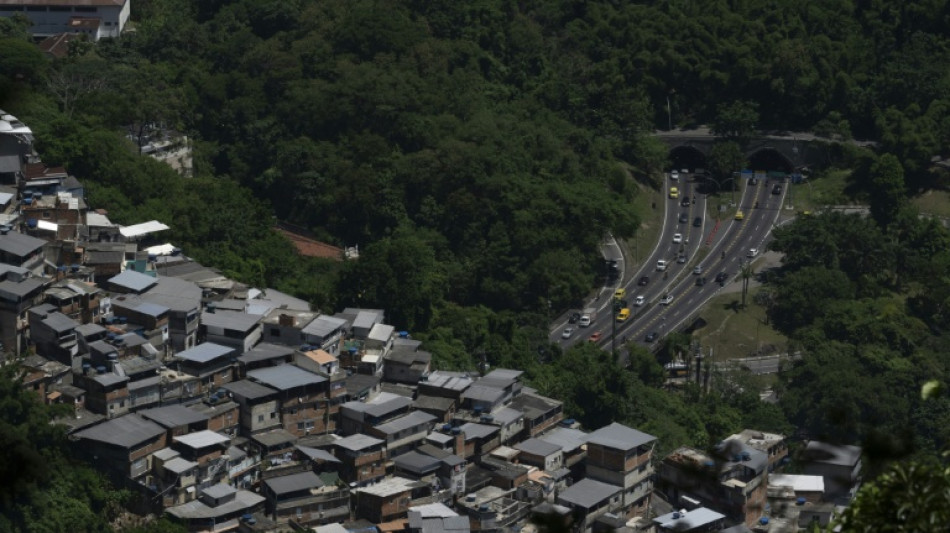
In Rio de Janeiro, a wrong turn leads from paradise to peril / Photo: Pablo PORCIUNCULA - AFP

 In Iceland, the mystery of the poet, the tomb and the Danish grocer

 Ratko Mladic: Bosnian Serb commander to convicted war criminal

 Bolivian army base blasts kill two, wound dozens
 Alcaraz, Sabalenka into US Open last 16 as Williams sisters lose on return

 Williams sisters fall in thrilling return to US Open doubles
 Bangladesh measles toll nears grim 1,000-child mark

 Bolivia farmers return to streets over diesel price hikes

 Tetris distances itself from controversial White House 'arcade' games

 Africa bigger, US smaller - UN adopts new map

 Bad weather will not affect All Blacks, says captain Savea

 Mbappe misses penalty as Parrott lifts Betis past Real Madrid

 PSG still winless in Ligue 1 as Monaco go top

 Defending champion Alcaraz reaches last 16 at US Open

 Lyles ends season before Budapest due to injury flare ups

 US Republicans announce probe into environment groups

 Sabalenka survives despite 'tricky' weed smell at US Open

 S&P Revises Outlook on Freedom Holding Corp. and Core Subsidiaries to Positive

 Job growth but record-high diesel prices -- Trump's midterms mixed bag

 Women's NBA comissioner Engelbert to retire at season's end

 Luis Enrique extends contract as PSG coach until 2030

 Duplantis pulls out of Diamond League finals

 Defending champ Sabalenka, Pegula lead way into US Open fourth round

 UK hard-right party rallies behind leader after new donation scandal

 Nigeria's Dangote refinery looks to raise $1.6 bn in IPO

 Portugal extends talks to privatise national carrier TAP
One victim was visiting Rio de Janeiro's iconic Christ the Redeemer statue. Another hopped into an Uber for a night out in the seaside city.
Both ended up shot dead after GPS navigation apps suddenly diverted them into favelas dominated by drug-trafficking gangs locked in an intense battle for territory.
Most of the millions of tourists who visit Rio every year enjoy its world-famous carnival, beaches, and nightlife without coming close to the gang wars that thrum beneath the surface.
However, recent shootings by jittery men with rifles stationed at the entrances to these urban settlements have cast a fresh spotlight on Rio's security challenges.
In December, an Argentine tourist returning from the Christ statue with his wife and children followed his GPS into a favela. He was shot twice and later died in hospital.
Two weeks later, a Brazilian woman from Sao Paulo was shot in the neck and died after her Uber driver made a wrong turn while taking her to a party.
In mid-January, a dashcam video went viral of another Uber driver begging rifle-toting men for mercy after being diverted into the Cidade Alta favela with his terrified passenger in the backseat.
"The guys there are afraid it is police or rival gangs," said Brazilian-American lawyer Victor Sarto, 41, who received a scolding at gunpoint when he and a group of friends ended up in a favela after a visit to the Christ statue in 2019.
- 'Scenery changes fast' -
The Fogo Cruzado watchdog said 19 people were shot, five fatally, after incidents in which civilians and police officers accidentally entered favelas in 2024 -- the highest number since it began tracking such incidents in 2016.
"This obviously has to do with the geography of Rio de Janeiro. And it has to do with the problem of territorial control of Rio de Janeiro, without a shadow of a doubt," said the institute's data director, Maria Isabel Couto.
Rio's favelas -- home to around 1.5 million people -- cling to the steep hills that dramatically frame the city.
Others are wedged in between condominiums or alongside major highways.
"The scenery changes fast," Rio's state security secretary Victor dos Santos told AFP.
"So when someone enters a place like this very quickly, the criminal who is there, alert, waiting for an adversary, ends up shooting first and only checking later to see who it is."
Uber said in a statement to AFP that its safety technology "may block trip requests from areas with public safety challenges at specific times and on certain days."
A spokesman for Google -- which owns two popular navigation apps -- said the company would not comment on the reported problem of maps diverting users into dangerous areas.
- 'There are rules' -
Rio has at least four criminal factions vying for territorial power and 20 percent of the metropolitan region is under control of these groups, said Couto.
A longtime resident of Cidade Alta -- where five people were shot and injured after accidentally entering the favela in 2024 -- told AFP "there are rules" that locals know when driving in.
These include driving at most "20km (12 miles) per hour.... You have to have the windows open, with the headlights on and a hazard light flashing," he said, asking not to be named for his safety.
Couto rejected the idea of "no-go zones" in the city's favelas, where both poor and middle-class people reside and already battle shoddy transportation links.
Rights groups say favela residents also suffer an outsized impact from regular police operations which shut down schools and businesses and barely make a dent against the gangs.
Brazil's Supreme Court is currently weighing whether to maintain five-year-old rules limiting police operations in favelas to reduce the high rate of deaths of residents.
- 'A resort for criminals' -
But the stricter measures have been criticized by authorities.
Rio de Janeiro Mayor Eduardo Paes said the measures gave the impression that the city had become "a resort for criminals," with gangs and militia expanding territorial control and restricting the free circulation of people in some areas.
On Wednesday a shootout during a police operation near Cidade Alta led to a common sight: residents of Rio leaving their cars on a major highway to hunker down alongside a central barrier as bullets flew.
Local media reported a police helicopter had to make an emergency landing after being hit by gunfire.
The security secretary Santos said that the increase of people getting shot as they accidentally enter favelas came as conflict between Rio's armed groups turned "very intense" in 2024.
He said criminal factions were no longer just selling drugs but seizing control of valuable services to favelas like internet, water, electricity and transport.
"Today, territory is synonymous with revenue."
A.Ruiz--AT