India readies for mammoth Hindu festival of 400 million pilgrims / Photo: Niharika KULKARNI - AFP/File

 Nottinghamshire Councillor Urges Mayor to Spend £350m on Transport Projects

 US Aircraft Disable Iranian-Linked Vessel in Gulf of Oman; Tehran Vows to Defy Blockade

 Apple Black Friday Deals 2026: AirPods Pro 3, MacBook Air, and More

 Egyptian Business Leaders and Banks Pledge EGP 60 Million for Giza Ring Road Fire Victims

 Ireland’s Hearing Crisis: 300,000 Adults Wait Years for Care as National Plan Lags

 Malta-registered tanker sinks off Ibiza, killing one crew member

 INGLOT Malta offers Black Friday discounts of up to 60%
 Muscat says European elections took priority over population report

 Long-running San Diego Greek restaurant to close in February 2027
 Mumbai region records five-year high in post-monsoon python rescues

 The Point launches at Manama Waterfront as first phase sells out
The world's largest gathering of humanity begins in India on Monday with the opening of the Kumbh Mela, a six-week Hindu festival organisers expect to attract up to 400 million pilgrims.
Organisers say the scale of preparations for the Kumbh Mela is akin to setting up a temporary country from scratch -- in this case, one more populous than the United States and Canada combined.
"Some 350 to 400 million devotees are going to visit the mela, so you can imagine the scale of preparations," festival spokesman Vivek Chaturvedi said.
Around 150,000 toilets have been built and a network of community kitchens can each feed up to 50,000 people at the same time.
Another 68,000 LED light poles have been erected for a gathering so large that its bright lights can be seen from space.
Authorities and the police have also set up a network of "lost and found" centres and an accompanying phone app to help pilgrims lost in the immense crowd "to reunite with their families".
India is the world's most populous nation, with 1.4 billion people, and so is used to large crowds.
The last celebration at the site, the "ardh" or half Kumbh Mela in 2019, attracted 240 million pilgrims, according to India's government.
That compares to an estimated 1.8 million Muslims who take part in the annual hajj pilgrimage to Mecca in Saudi Arabia.
The government calls the Kumbh Mela a "vibrant blend of cultures, traditions, and languages, showcasing a 'mini-India' where millions come together without formal invitations".
- 'Plunge in the river' -
The Kumbh Mela, or "festival of the sacred pitcher", is held at the confluence of the Ganges, the Yamuna and the mythical Sarasvati rivers.
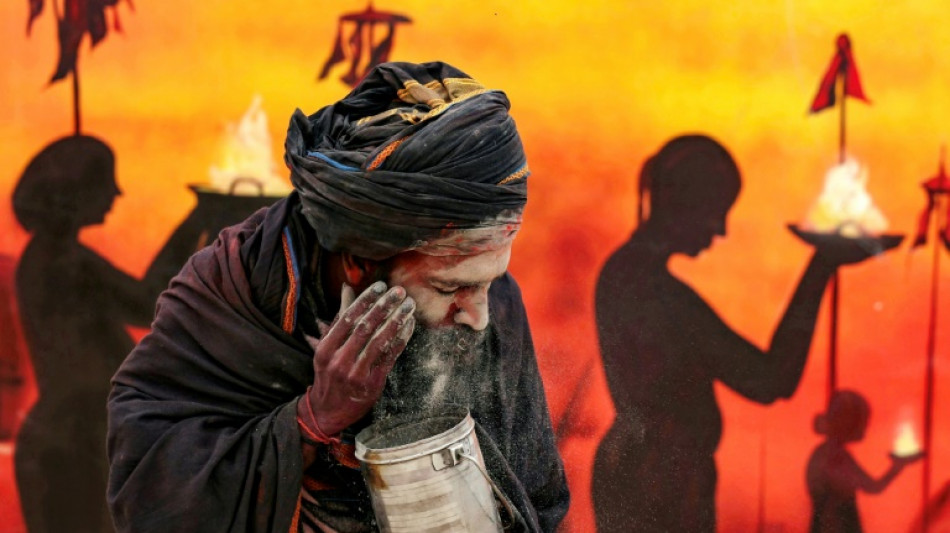
Its emblematic ritual is mass bathing in the holy rivers, with the dawn charge often led by naked, ash-smeared holy men, many of whom will have walked for weeks to reach the site.
Hindus believe that those who immerse themselves in the waters cleanse themselves of sin, breaking free from the cycle of rebirth and ultimately attaining salvation.
Many pilgrims embrace a life of simplicity during the festival -- vowing non-violence, celibacy and the offering of alms -- and focusing on prayer and meditation.
Santosh Mishra, 55, from a village near the holy Hindu city of Varanasi, said he and his neighbours were "super excited" for the fair to begin.
"The whole village will be going," Mishra told AFP. "It's a great feeling when everyone takes a plunge in the river together."
The festival is rooted in Hindu mythology, a battle between deities and demons for control of a pitcher containing the nectar of immortality.
Four drops of nectar were spilt during the battle and one landed at Prayagraj, where the Kumbh Mela is held every 12 years.
The other three fell on the cities of Nashik, Ujjain and Haridwar, where smaller festivals are held in intervening years.
The exact date of each celebration is based on the astrological positions of the Sun, Moon and Jupiter.
- 'Central spiritual role' -
Ceremonies include the visually spectacular "aarti", when vast numbers of priests perform rituals holding flickering lamps.
Devotees also float a sea of twinkling prayer lamps, crafted from baked flour, which glow with burning mustard oil or clarified butter.
Monday marks the start of festivities, coinciding with the full moon, with celebrations culminating on February 26, the final holy bathing day.
The mythic battle that undergirds the Kumbh Mela celebrations is mentioned in the Rig Veda, a sacred Hindu text written more than 3,000 years ago.
The festival was also mentioned by Chinese Buddhist monk and scholar Hiuen Tsang, who attended in the seventh century.
UNESCO lists the Kumbh Mela as part of the Intangible Cultural Heritage of Humanity.
It describes it as "the largest peaceful congregation of pilgrims on earth", saying it "plays a central spiritual role in the country, exerting a mesmeric influence on ordinary Indians".
P.Hernandez--AT