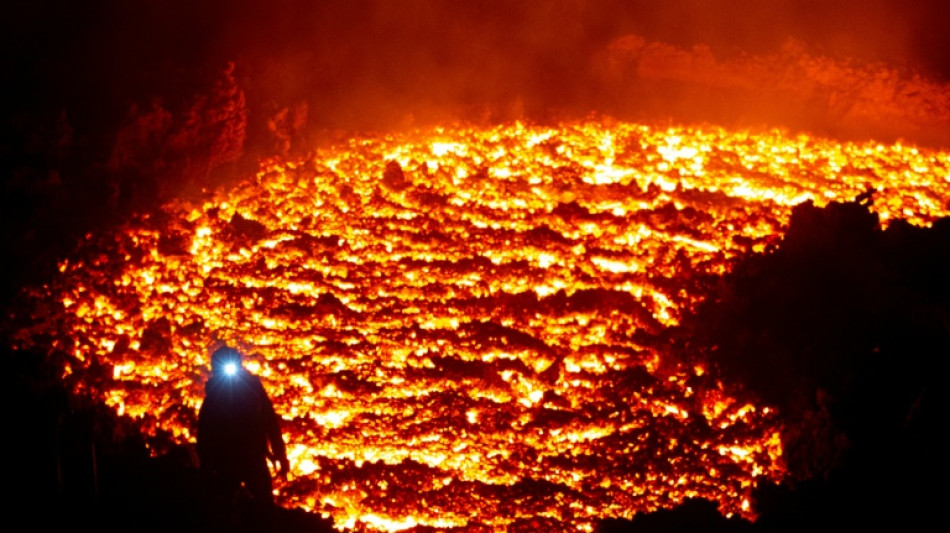
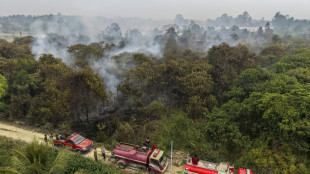
Volcanoes 'hidden source' of CO2 in past climate change: study / Photo: MAXIM FESYUNOV - AFP/File

 US envoys have 'more effective proposals': Ukraine official

 Defending champion Alcaraz powers into US Open quarter-finals

 Amazon cargo plane overshoots Miami runway, hits vehicles, catches fire

 Toll from Yemen clashes passes 300 as civilians flee homes

 Sabalenka books US Open quarter-final clash with Noskova

 German AfD supporters jubilant at far right's thumping win

 Zelensky warns war likely to continue into winter after US talks

 Arsenal deliver statement fightback to end Chelsea's flying start

 Leclerc accepts blame as Hamilton laments Ferrari approach

 Sabalenka surges past Townsend to reach US Open quarter-finals

 Smiling face of Germany's far-right AfD: Ulrich Siegmund

 Lebanon president calls for US help as Israeli strikes kill 7

 Yamal hits double as perfect Barca thrash Valencia

 Venice festival turns gaze on war reporters, media industry

 Sensational Antonelli wins Italian GP from back of grid

 Susan Sarandon says still losing roles over Gaza stance

 US envoys hold 'important' talks in first trip to Kyiv

 Championship leader Antonelli wins Italian Grand Prix

 Vardy signs for Championship strugglers Burnley
 FIFA confirms Infantino will run in presidential election

 With joy and grief, Palestinian football marks return
 Iran threatens greater force if US launches more attacks
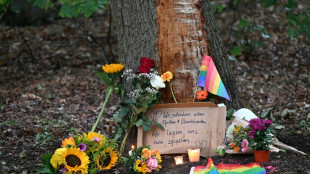 Vandals uproot Berlin tree commemorating Pride attack victims

 Trump envoys arrive in Kyiv for first Ukraine visit
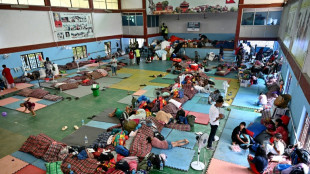
 Indonesia's main airport suspends operations after volcanic eruption

Massive fields of magma underneath ancient volcanoes spewed out carbon dioxide long after eruptions on the surface had ended, potentially explaining why past global warming episodes lasted longer than expected, a study said Wednesday.
Humans are emitting far more planet-heating carbon-dioxide (C02) than all the world's volcanoes put together. But scientists hope that by studying climate change in Earth's distant past, they can understand how the world heats up -- and crucially, how it can cool down again.
Scientists have long been puzzled by how long it took Earth's atmosphere to recover from a mass extinction event 252 million years ago that ended the Permian period.
It was the most severe extinction event in our planet's history, wiping out roughly 90 percent of marine species and 70 percent of those on land.
Scientists believe the upheaval was caused by huge volcanic eruptions in Siberia. The eruptions created what are called large igneous provinces -- huge underground regions of magma and rock -- which have been linked to four of the five big mass extinctions since complex life appeared on Earth.
It took Earth's climate nearly five million years to recover.
But according to scientific models, the world should have regrouped much more quickly.
"Earth's natural thermostat seems to have gone haywire during and after this event," said Benjamin Black, a researcher at Rutgers University in the United States and lead author of a new study in the journal Nature Geoscience.
- 'This gives me hope' -
To find out more, the US-led team carried out chemical analyses of lava, used computer models to simulate inner-Earth processes and compared climate records preserved in rock.
Their results suggested that even once volcanic activity had ended during past episodes, magma kept releasing carbon dioxide deep in the Earth's crust and mantle, which continued heating the globe.
"Our findings are important because they identify a hidden source of CO2 to the atmosphere during moments in Earth's past when climate has warmed abruptly and stayed warm much longer than we expected," Black said in a statement.
"We think we have figured out an important piece of the puzzle for how Earth's climate was disrupted, and perhaps just as importantly, how it recovered."
Black told AFP that the process described in the study "definitely cannot explain present-day climate change".
All the world's volcanoes currently "release less than one percent as much carbon to the atmosphere as human activities," he explained.
The type of volcanism the team investigated was last seen on Earth 16 million years ago, Black said, and was so enormous it could "cover the continental United States or Europe half a kilometre deep in lava".
But if the findings are confirmed, it could show that Earth's thermostat is working better than scientists had thought.
"This gives me hope that geologic processes will be able to gradually draw anthropogenic CO2 back out of the atmosphere," Black said.
"But it will still take hundreds of thousands to millions of years, which is obviously a long time for human beings."
F.Ramirez--AT