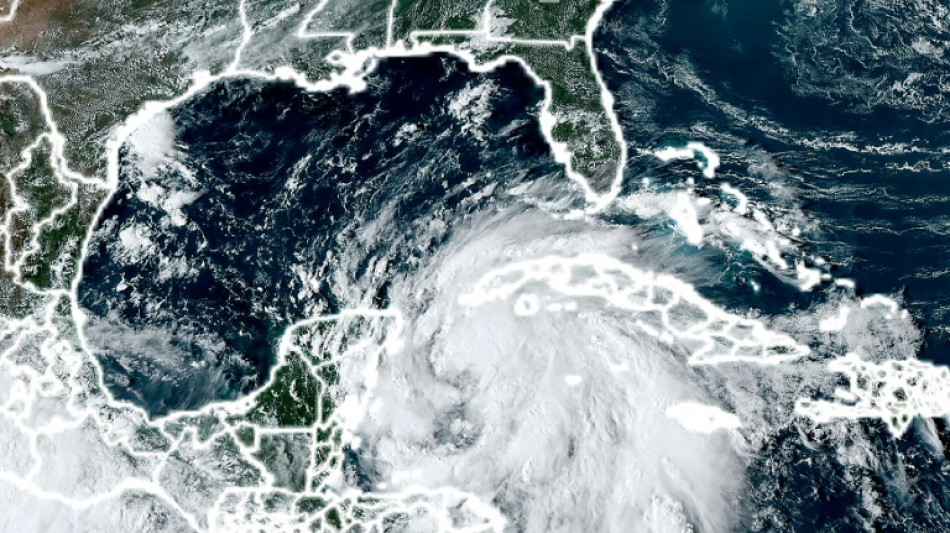
Climate change made deadly Hurricane Helene more intense: study / Photo: - - NOAA/AFP

 Tiafoe tops Medvedev in straight sets at US Open

 Zverev seeks US Open last eight as Osaka faces Rybakina

 Alcaraz turns up heat to reach US Open quarters

 Gatti salvages Juve draw with AC Milan in Serie A

 Sinayoko stars as unbeaten Paris FC down Marseille

 Still on top: 'Spider-Man' dominates North American box office

 Zelensky in fresh talks with US envoys: Ukraine official

 Noskova edges Kostyuk to reach US Open quarter-finals

 Alonso urges Chelsea to learn from painful defeat at Arsenal

 Defending champion Sabalenka reaches US Open quarter-finals

 Minnows Augsburg sink Frankfurt to top Bundesliga table

 Yamal hits double as 'nearly perfect' Barca thrash Valencia

 Antonelli living 'a dream' after astonishing home win

 Impressive Daryz keeps Arc double dream alive
 Strasbourg hit Troyes for six as Amo-Ameyaw sparkles

 German far-right AfD landslide winner in eastern state vote

 Carrick defends Man Utd start despite defensive concerns

 More than 140 killed in latest Yemen clashes: military sources

 Van Aert claims shortened Vuelta stage 15 win in high heat

 Everton shrug off transfer window woes to hold Man Utd

 'Nothing has changed': FIFA confirms Infantino to run for re-election

 UN's Nepal chief makes emotional plea for flood-ravaged country

 Italian GP red-flagged after massive Leclerc crash

 US envoys hold talks with Zelensky on first Kyiv visit

 'Truly scared': Blazes outpace firefighters in Indonesian Borneo

Hurricane Helene's torrential rain and powerful winds were made about 10 percent more intense due to climate change, according to a study published Wednesday by the World Weather Attribution (WWA) group.
Although a 10 percent increase "might seem relatively small... that small change in the hazard really leads to big change in impacts and damage," said climate scientist Friederike Otto, who heads the research organization.
The study also found that fossil fuels -- the primary cause of climate change -- have made hurricanes like Helene 2.5 times more likely to occur.
In other words, storms of Helene's magnitude were formerly anticipated once every 130 years, but now the probability is closer to once every 53 years, on average.
To conduct the study, researchers focused on three aspects of Hurricane Helene: precipitation, winds and the water temperature of the Gulf of Mexico -- a key factor in its formation.
"All aspects of this event were amplified by climate change to different degrees," Ben Clarke, a co-author of the study and researcher at Imperial College London, told a press conference.
"And we'll see more of the same as the world continues to warm," he continued.
The research by WWA, an international group of scientists and meteorologists who study the role of climate change in extreme weather events, comes as the southeastern US state of Florida prepares for the arrival of another major hurricane, Milton, just 10 days after it was hit by Helene.
- Destruction -
Helene made landfall in northwestern Florida on September 26 as a Category 4 hurricane with winds up to 140 mph (225 kph).
The storm then moved north, causing heavy rain and devastating floods in several states, including North Carolina, where it claimed the highest death toll.
The authors of the study emphasized that the risk posed by hurricanes has increased in scope beyond coastal areas.
Bernadette Woods Placky, chief meteorologist at NGO Climate Central, said Helene "had so much intensity" that it would take time for it to lose strength, but the "storm was moving fast... so it could go farther inland pretty quickly."
This study utilized three methodologies to examine the three aspects of the storm, and was conducted by researchers from the US, the UK, Sweden and the Netherlands.
To study its rainfall, researchers used an approach based on both observation and climate models, depending on the two regions involved: one for coastal areas like Florida, and another for inland areas like the Appalachian mountains.
In both cases, the study found precipitation had increased by 10 percent because of global warming, which is currently at 1.3 degrees Celsius above pre-industrial levels.
To study Helene's winds, scientists looked at hurricane data dating back as far as 1900.
They determined Helene's winds were 11 percent stronger, or 13 mph (21 kph), as a result of climate change.
Lastly, the researchers examined the water temperature in the Gulf of Mexico, where Helene formed, finding it was around 2 degrees Celsius above normal.
This record temperature was made 200 to 500 times more likely due to climate change, the study asserts.
Warmer oceans release more water vapor, providing more energy for storms as they form.
"If humans continue to burn fossil fuels, the US will face even more destructive hurricanes," Clarke warned in a statement.
O.Gutierrez--AT