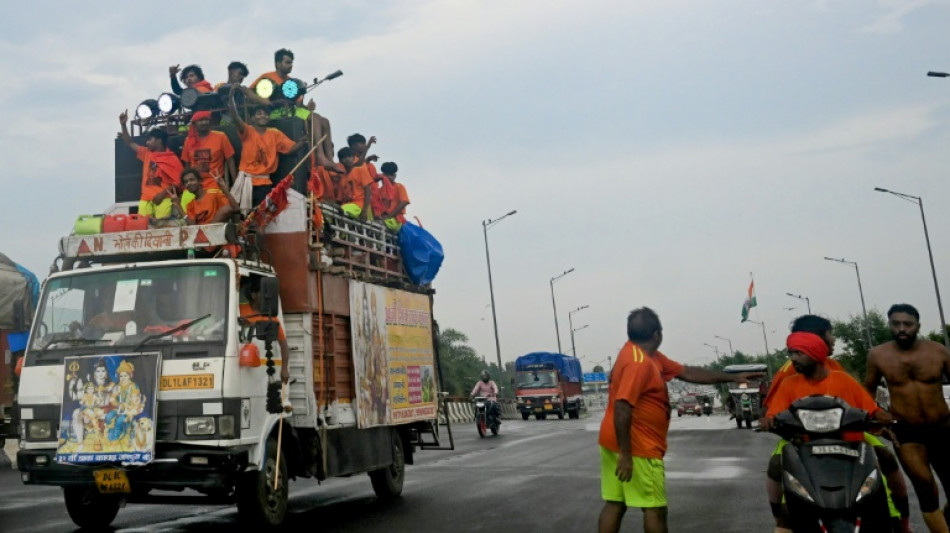
India's bad boy pilgrimage for Hindu god of destruction / Photo: Money SHARMA - AFP

 Dukascopy Bank Unveils AI-Powered Trading, 25,000+ Stock CFDs and a New Flagship E-Banking App

 Tech firms rally but Asian markets mixed, with eyes on US inflation

 Nepal holds day of mourning as families pray missing still alive
 African players in Europe: Mbeumo fires solo goal as United draw

 Malaysia cancels haze emergency, but warns problems remain

 Philippine sensation Eala looks forward to Asian Games 'fun'
 Jakarta airport extends closure after volcano eruption

 Lonely woman director in Venice sees industry backsliding on gender

 Tech firms rally on mixed day for Asian markets, with eyes on US inflation

 World number one An sends Asian Games warning with China hat-trick

 PSG go for three in a row as Champions League returns

 "Super-human' Alcaraz books US Open quarter-final clash with Shelton

 ECB set to hike interest rates as Iran war flares anew

 AI data centers are less thirsty now, tech giants say

 North Korea vows nuclear-armed navy as US ally drills open

 Under-fire Labuschagne named in Australia Test squad for South Africa

 InterContinental Hotels Group PLC Announces Transaction in Own Shares - September 07

 Best Way to Protect A 401(k) in 2026: Guide Released by Experts

 Tiafoe tops Medvedev in straight sets at US Open

 Zverev seeks US Open last eight as Osaka faces Rybakina

 Alcaraz turns up heat to reach US Open quarters

 Gatti salvages Juve draw with AC Milan in Serie A

 Sinayoko stars as unbeaten Paris FC down Marseille

 Still on top: 'Spider-Man' dominates North American box office
 Zelensky in fresh talks with US envoys: Ukraine official

The Hindu sacred month of Shravan honours the god of destruction Lord Shiva, and in northern India, it has become increasingly associated with mob violence by saffron-clad devotees.
Analysts say the increase in violence, and the muted response to stop it by the authorities, is a reaction to Prime Minister Narendra Modi's Hindu-first politics.
Millions of people mark the month by trekking -- some hundreds of kilometres -- to collect holy water from the sacred Ganges river and carry it home to shrines, a celebration of the monsoon rains and new beginnings.
Many are young and poor men, dedicated to their deity -- but also partying and taking a break from tough day-wage labour for a rare few weeks of fun, blaring loud music and smoking strong cannabis.
They are known as "Kanwarias", after the bamboo poles across their shoulders they use to carry the heavy containers of sacred water.
This year, after the month-long pilgrimage started in late July, lawlessness surged.
The pilgrims have been caught multiple times on camera running riot -- seen in videos shared widely on social media and verified by AFP.
They include vandalising a fuel station for being asked to stop smoking, violent road rage leaving passers-by grievously injured, and groups of Kanwarias fighting among themselves.
Pilgrims insist that hooliganism is restricted to a few stray incidents, blaming devotees who over-indulge in cannabis.
"There are rotten apples everywhere," 30-year-old Sachin Chawla told AFP, a Kanwaria puffing out clouds of fragrant smoke from a hand-rolled cigarette.
"Some people tend to get high and create a ruckus."
- 'Subordinate to the party' -
Modi's Hindu nationalist Bharatiya Janata Party (BJP) has boosted support for the travellers.
In the country's most populous state Uttar Pradesh -- whose chief minister is a hardline Hindu monk and key BJP leader -- top government officials showered flower petals on the devotees from a helicopter.
That came days after pilgrims overturned a government security car.
The Modi government has "put across the message that the state is subordinate to the party in power", said Sanjay Srivastava, an anthropologist teaching at SOAS University of London.
"This messaging seems to be clearly understood on the ground".
Many devout Hindus are vegetarian during Shravan, and in several BJP-run states, local administrations ban meat on pilgrim routes.
But this year, some went further.
Two state governments ordered restaurants to display the names of their owners, a rule that critics said was intended to divide restaurants by religion and target minority Muslims.
The order was later suspended by the Supreme Court.
- Ancient tradition, new popularity -
Rickshaw-puller Kamal Kumar had spent two weeks walking nearly 200 kilometres (125 miles) carrying 70 litres (15 gallons) of water in containers slung from a bamboo pole across his shoulders.
He had a day to go to his destination, a temple in the capital Delhi.
"I do it for Baba," said the 20-year-old, using a term of endearment for Shiva. "Whatever I have, it is his doing."
The number of devotees undertaking this journey is swelling by the year, according to official numbers.
Organisers estimate some 45 million people -- more than the population of Canada -- assembled in the holy Ganges-side city of Haridwar to collect water this year, a rise of 50 percent from 2017.
Most are poor, male, unemployed, or work precarious menial jobs.
The offer of aid from a god has resounding appeal in "an uncertain economy with large-scale unemployment", Srivastava said.
"Everyone around me goes, so I also decided to go," said Siddharth Kumar, a jobless 18-year-old who resides in a slum on the fringes of Delhi.
"I hope god does something for me and my family."
Srivastava said more men now undertake the pilgrimage because there is a "broader climate of encouragement for participation in public religious activities".
Popularity has been boosted within the context of "underemployed men's activities, as well as a source seeking divine intervention for their precarious economic situation," he added.
- 'Holiday' -
The pilgrimage allows the working class to briefly "occupy the centre stage", said sociologist Ravinder Kaur, from the University of Copenhagen.
"It is as much an expression of vast class and caste inequalities that shape contemporary India," she said.
For many men, the journey is as much an opportunity to bond with friends.
Less dedicated devotees skip the walk, crowding into open trucks or on motorbikes, playing thumping music.
"I went with my friends from the neighbourhood on our motorbikes," said 23-year-old electrician Sunny Prajapati.
"Along with the chance to offer our prayers, we also get to go on a joy ride together –- it is like a holiday."
P.Hernandez--AT