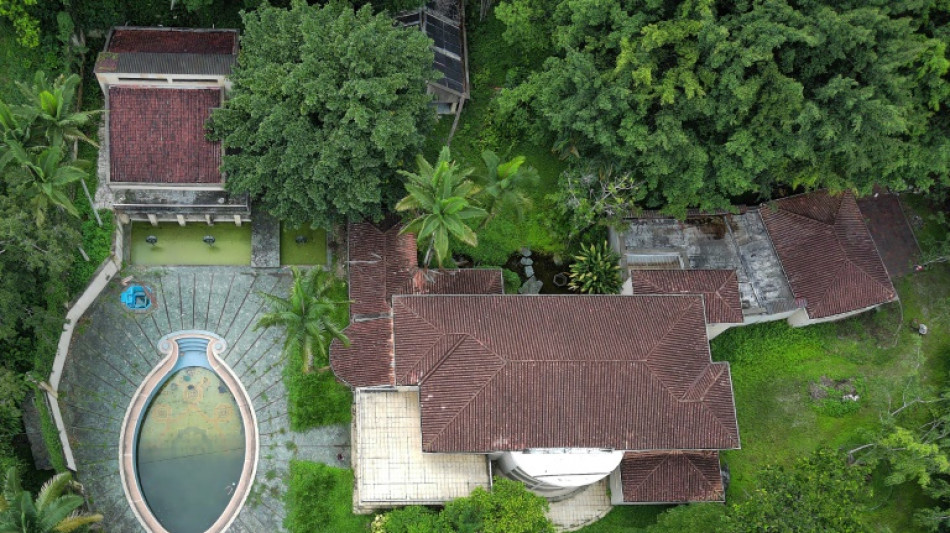
Colombian dens of iniquity recycled to serve victims / Photo: JAIME SALDARRIAGA - AFP

 Germany's Merz 'shocked' by far-right state win but vows to stay course

 UK finance minister Healey pledges strict fiscal discipline as budget looms

 Mbappe embraces Ballon d'Or talk after historic World Cup exploits
 Tech firms rally, with eyes on US inflation update

 Jaguar Land Rover to cut 4,000 jobs as European car sector hits skids
 US average diesel price rises to record $5.90 a gallon: AAA

 Dukascopy Bank Unveils AI-Powered Trading, 25,000+ Stock CFDs and a New Flagship E-Banking App
 Tech firms rally but Asian markets mixed, with eyes on US inflation

 Nepal holds day of mourning as families pray missing still alive
 African players in Europe: Mbeumo fires solo goal as United draw
 Malaysia cancels haze emergency, but warns problems remain

 Philippine sensation Eala looks forward to Asian Games 'fun'
 Jakarta airport extends closure after volcano eruption

 Lonely woman director in Venice sees industry backsliding on gender
 Tech firms rally on mixed day for Asian markets, with eyes on US inflation

 World number one An sends Asian Games warning with China hat-trick

 PSG go for three in a row as Champions League returns

 "Super-human' Alcaraz books US Open quarter-final clash with Shelton

 ECB set to hike interest rates as Iran war flares anew

 AI data centers are less thirsty now, tech giants say

 North Korea vows nuclear-armed navy as US ally drills open

 Under-fire Labuschagne named in Australia Test squad for South Africa

 InterContinental Hotels Group PLC Announces Transaction in Own Shares - September 07

 Genflow Biosciences PLC Announces Appointment of Investor Relations Adviser

 Tiafoe tops Medvedev in straight sets at US Open

In a mansion with golden faucets and an oyster-shaped bathtub, Colombian paramilitary fighters and drug lords once planned the most horrific crimes. Now, the opulent property will be put to the service of their victims.
In Medellin, the luxury Montecasino estate was a venue for planning the assassinations of presidential candidates and massacres of rural people accused of supporting leftist guerrillas, according to the testimony of former hitmen.
It was owned by brothers Carlos, Vicente and Fidel Castano -- heads of the United Self-Defense Forces of Colombia (AUC), a US-designated "terrorist" organization set up to fight the FARC guerrilla group and known for human rights abuses.
Murderous drug kingpin Pablo Escobar attended meetings and parties hosted at the house in El Poblado, Medellin's most exclusive neighborhood.
With its marble floors and immense gardens, the house was seized by the state in 2010 after the brothers' demise.
Five years later, it was handed over to Colombia's Victims' Unit -- a group created to identify and aid the estimated 9.5 million people who suffered in the country's decades-long civil conflict.
It was leased at first to private entities, but now, on the orders of Colombia's first-ever leftist president, Gustavo Petro, Montecasino is to be managed by the country's forensic police.
A laboratory will be built there to identify mortal remains in a country where more than 111,000 people are believed to have gone missing in the decades-long conflict over ideology, territory, trafficking routes and revenge.
"No one could have imagined all the crimes and abuses taking place in that house," Claudia Patricia Vallejo, a departmental director of the Victims' Unit, told AFP of Montecasino.
"Many people were tortured there," she added.
- Still in the dark -
Luz Galeano, 60, hopes the initiative will finally shed light on the fate of her husband, Luis Laverde, who disappeared without a trace in 2008.
"I've looked for him everywhere, but I still don't know what happened to him or who was responsible," she told AFP at her home in Medellin, clutching a photo of her mustachioed husband.
Laverde was abducted from a bus in Medellin at a time that residents of the city were under siege from AUC fighters targeting sectors under guerrilla control.
On the day of his inauguration on August 7, 2022, Petro had pledged to use assets seized from criminal groups towards a "productive economy" in service of those most in need.
The task of selling or leasing thousands of seized properties was confided to a special assets unit (SAE) in the finance ministry.
SAE president Daniel Rojas recently reported that an audit from two years ago showed that only about a fifth of the 33,000-odd properties under the unit's control were producing an income -- a figure yet to be updated.
The office of the comptroller general of Colombia recently reported the theft of luxury watches and other items from SAE-managed properties, with losses running into the millions.
- State policy -
In Chia, a city near the capital Bogota, stands further testimony to the once untouchable status and opulence of Colombia's drug lords: a towering castle built in 1898 to later serve as a presidential palace, and bought by Escobar associate Juan Camilo Zapata.
After Zapata's assassination in 1993, the Castillo de Marroquin was seized by the SAE, which leased it to a company that organized weddings and concerts there.
Under Petro's directive, the castle will be handed to the National Pedagogical University with about 9,000 students.
The building itself will be turned into a museum, while a large part of the grounds will be set aside for academic, cultural and sporting activities.
For university rector Helberth Choachi, repurposing criminally-attained assets for the public good should not be a decision of individual governments, but fixed state policy.
"All assets... from drug trafficking, responsible for so many human rights violations in this country, (should) pass in an act of reparation to public entities and the communities who were hardest hit," he told AFP.
A.Williams--AT