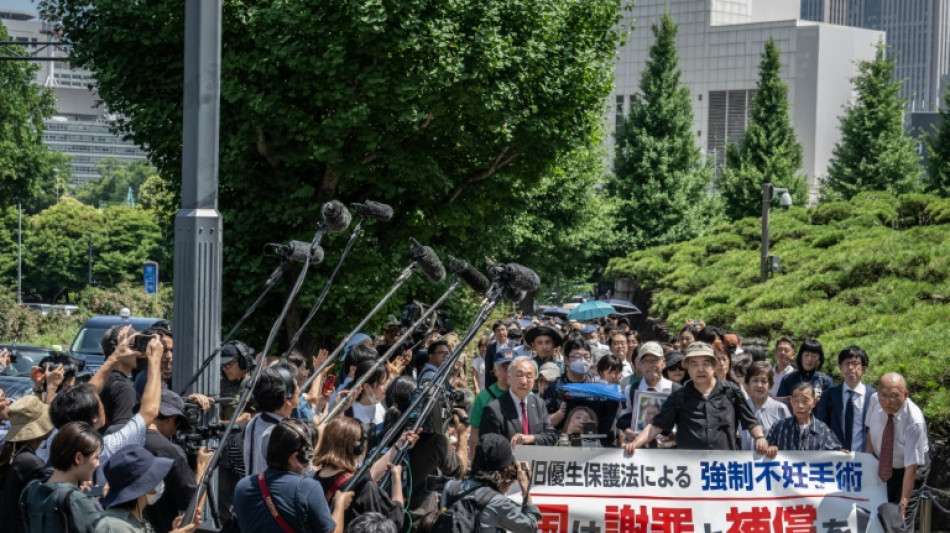
Japan's top court rules forced sterilisation law unconstitutional / Photo: Yuichi YAMAZAKI - AFP

 Thousands bid farewell to Bosnian Serb war criminal in Belgrade

 EU chief announces 200-mn-euro investment package for Greenland

 Lebanon says Israel conducts wave of deadly strikes

 Cipheras Group - Apex AI Fund Deploys 290-Billion-Parameter Proprietary Large Language Model

 Germany's Merz 'shocked' by far-right state win but vows to stay course

 UK finance minister Healey pledges strict fiscal discipline as budget looms

 Mbappe embraces Ballon d'Or talk after historic World Cup exploits

 Tech firms rally, with eyes on US inflation update

 Jaguar Land Rover to cut 4,000 jobs as European car sector hits skids

 US average diesel price rises to record $5.90 a gallon: AAA

 Dukascopy Bank Unveils AI-Powered Trading, 25,000+ Stock CFDs and a New Flagship E-Banking App

 Tech firms rally but Asian markets mixed, with eyes on US inflation

 Nepal holds day of mourning as families pray missing still alive

 African players in Europe: Mbeumo fires solo goal as United draw

 Malaysia cancels haze emergency, but warns problems remain

 Philippine sensation Eala looks forward to Asian Games 'fun'

 Jakarta airport extends closure after volcano eruption

 Lonely woman director in Venice sees industry backsliding on gender

 Tech firms rally on mixed day for Asian markets, with eyes on US inflation

 World number one An sends Asian Games warning with China hat-trick

 PSG go for three in a row as Champions League returns

 "Super-human' Alcaraz books US Open quarter-final clash with Shelton

 ECB set to hike interest rates as Iran war flares anew

 AI data centers are less thirsty now, tech giants say

 North Korea vows nuclear-armed navy as US ally drills open

Japan's top court ruled on Wednesday that a defunct eugenics law under which thousands of people were forcibly sterilised between 1948 and 1996 was unconstitutional, local media reported.
The Supreme Court also ruled that a 20-year statute of limitations on compensation claims could not be applied, a major victory for victims who have endured decades of suffering.
Japan's government acknowledges that around 16,500 people were forcibly sterilised under the eugenics law that was in place between 1948 and 1996.
The law allowed doctors to sterilise people with inheritable intellectual disabilities to "prevent the generation of poor quality descendants".
Another 8,500 people were sterilised with their consent, according to authorities, although lawyers say even those cases were likely "de facto forced" because of the pressure individuals faced.
A 1953 government notice said physical restraint, anaesthesia and even "deception" could be used for the operations.
"I've spent an agonising 66 years because of the government surgery. I want my life back that I was robbed of," victim Saburo Kita, who uses a pseudonym, said before Wednesday's ruling.
Kita was convinced to undergo a vasectomy when he was 14 at a facility housing troubled children. He only confided what had happened to his wife shortly before she died in 2013.
"Only when the government faces up to what it did and takes responsibility will I be able to accept my life, even just a little," Kita, now 81, told a news conference last year.
- Apology -
The number of operations in Japan slowed to a trickle in the 1980s and 1990s before the law was scrapped in 1996.
That dark history was thrust back under the spotlight in 2018 when a woman in her 60s sued the government over a procedure she had undergone at age 15, opening the floodgates for similar lawsuits.
The government, for its part, "wholeheartedly" apologised after legislation was passed in 2019 stipulating a lump-sum payment of 3.2 million yen (around $20,000 today) per victim.
However, survivors say that was too little to match the severity of their suffering and took their fight to court.
Regional courts have mostly agreed in recent years that the eugenics law constituted a violation of Japan's constitution.
However, judges have been divided on whether claims are valid beyond the 20-year statute of limitations.
Some have said that applying such limitations was extremely cruel and unfair, ordering the state to pay damages. But others dismissed cases, saying the window for pursuing damages had closed.
"The ruling will hopefully pave the way for active steps to be taken by the government to eliminate the kind of eugenic mentality that it created," Kita's lawyer, Naoto Sekiya, told AFP before Wednesday's ruling.
A.O.Scott--AT