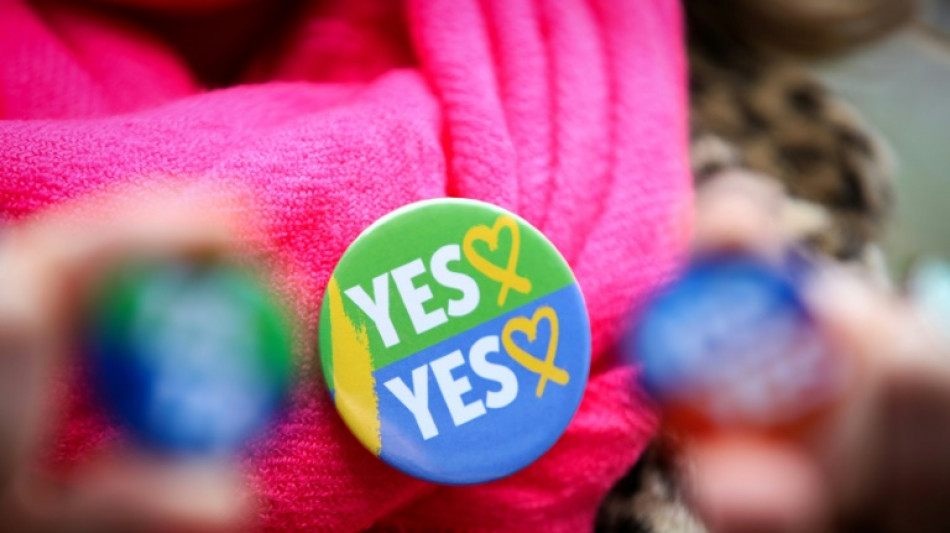
Ireland votes to update constitution on women, family / Photo: PAUL FAITH - AFP

 Nepal flood death toll rises as rescuers scour tunnels

 France's Mistral sees value soar with 3 bn euro cash infusion

 Nepal glacier saw exceptional heat before collapse caused deadly floods: researcher

 Ethiopia boosts drone production to fight rebels

 Yemen rebels hit Saudi Arabia with wave of strikes, wounding 73

 Nepalis mark a year since deadly protests that toppled government

 Rubio launches Latin America tour to cement US influence

 France tries 14 over deadliest Channel migrant crossing disaster

 Australia threatens hefty fines if big tech fails 'duty of care'

 Zverev romps into quarter-finals as Darderi downed

 Kauai on tornado watch as Hurricane Lowell nears Hawaiian islands

 Pakistan roll the dice in search of consolation win over England

 Yen extends gains as traders eye rate hike, tech rallies again

 'The ber months': Christmas arrives early in the Philippines

 N. Korea calls Russia bridge a sign of tighter ties

 US sanctions threaten to crush Iranian students' dreams

 Former champ Gauff holds off Jovic to reach US Open quarter-finals

 Battery X Metals to Appoint Accomplished Technology and Consumer Brands Executive Nicholas Reichenbach to Board of Directors
 Equitech-Bio Expands Reagent Portfolio with New IgG Offering and Publication-Backed Product Validation from Bioz

 CPG Life Fund I Launches $20 Million Operator-Led CPG Fund

 Who is the Best Female Cosmetic Surgeon in Florida?

 CANEX Metals Announces C$6.5 Million Strategic Financing Led By C$3 Million Investment by Eric Fier

 Helio Sets September Roadshow Across Austin, Houston, Phoenix, Scottsdale
 Gaming Realms PLC Announces Interim Results

 Universal Edge Technologies Establishes Senior Advisory Committee, Names Mark Powell and Mark P. Mills as Founding Members
Ireland begins voting in a double referendum Friday on proposals to modernise constitutional references to the make-up of a family and women's role in the home.
All the major political parties support a "Yes-Yes" vote, and until recently polls predicted a smooth passage for both on International Women's Day.
Polls open at 0700 GMT and close at 2200 GMT, with results in both votes expected by late Saturday.
But surveys in the run-up to the ballots have logged rising unease about the vagueness of the two questions -- and the outcome of the votes.
This week Prime Minister Leo Varadkar, who heads the centre-right-green governing coalition that proposed the questions, admitted that the results were "in the balance".
The two proposals, called the family amendment and the care amendment, would make changes to the text of Article 41 in EU member Ireland's constitution that was written in 1937.
The first asks citizens to expand the definition of family from those founded on marriage to also include "durable relationships" such as cohabiting couples and their children.
The second proposes replacing old-fashioned language around the role of "women in the home" with a clause recognising care provided by family members to one another.
The votes are the latest to tackle outdated legislation in Ireland where the Catholic Church was once all-powerful.
Voters in the country of 5.3 million opted to end constitutional limits on same-sex marriage in 2015 and abortion in 2018.
- Confusion -
As well as the governing parties and the main opposition party Sinn Fein, women's rights and family carer groups have also urged citizens to "vote for equality".
"We see these changes as small steps forward and therefore on balance have advocated a 'yes' vote," said leftist-nationalist Sinn Fein leader Mary Lou McDonald on Thursday.
"It's really important that we change our constitution to reflect the reality of our lives in Ireland and the reality of families," Orla O'Connor, director of the National Women's Council of Ireland, told AFP.
But "No" campaigners argue the concept of "durable relationship" is undefined and confuses voters, and that women and mothers are being "cancelled" from the constitution.
Disability rights activists also told AFP that the care amendment appears to portray disabled people as a burden on families, with the state abdicating its role in providing care.
Meanwhile ultra-conservative voices have warned that the changes could constitutionally protect polygamous relationships, and increase immigration via migrant family reunions -- claims all denied by the government.
For Yvonne Galligan, a political scientist, the care amendment is the "more complex" and more likely of the two referendum questions to deliver a "No" vote.
"People could vote 'No' for very different reasons, some to preserve the paternalistic status quo and enhance it, and others because it doesn't recognise disability rights," said Galligan, a professor at the Technological University of Dublin.
F.Wilson--AT