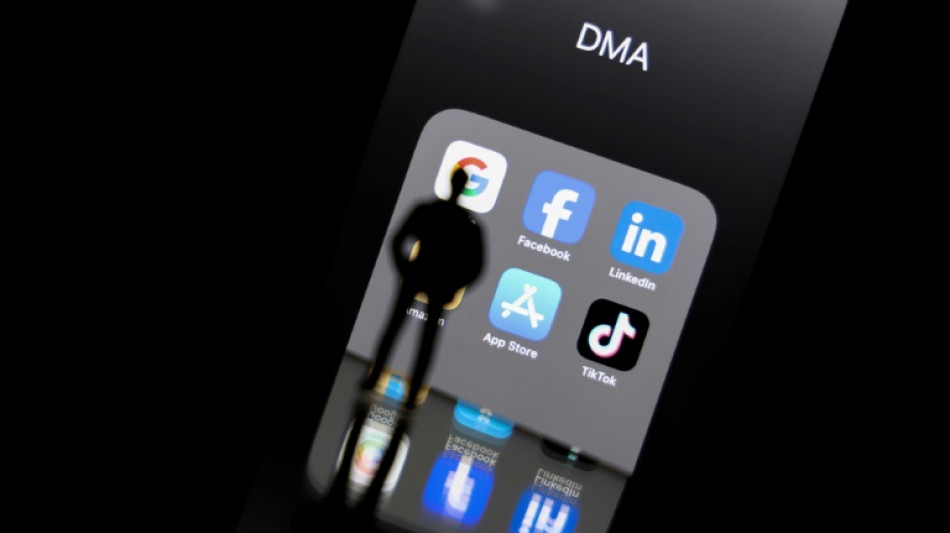
EU curbs kick in to make big tech play by its market rules / Photo: Kenzo TRIBOUILLARD - AFP/File

 Nepal flood death toll rises as rescuers scour tunnels

 France's Mistral sees value soar with 3 bn euro cash infusion

 Nepal glacier saw exceptional heat before collapse caused deadly floods: researcher

 Ethiopia boosts drone production to fight rebels

 Yemen rebels hit Saudi Arabia with wave of strikes, wounding 73

 Nepalis mark a year since deadly protests that toppled government

 Rubio launches Latin America tour to cement US influence
 France tries 14 over deadliest Channel migrant crossing disaster

 Australia threatens hefty fines if big tech fails 'duty of care'

 Zverev romps into quarter-finals as Darderi downed
 Kauai on tornado watch as Hurricane Lowell nears Hawaiian islands

 Pakistan roll the dice in search of consolation win over England

 Yen extends gains as traders eye rate hike, tech rallies again

 'The ber months': Christmas arrives early in the Philippines

 N. Korea calls Russia bridge a sign of tighter ties

 US sanctions threaten to crush Iranian students' dreams

 Former champ Gauff holds off Jovic to reach US Open quarter-finals

 Battery X Metals to Appoint Accomplished Technology and Consumer Brands Executive Nicholas Reichenbach to Board of Directors
 Equitech-Bio Expands Reagent Portfolio with New IgG Offering and Publication-Backed Product Validation from Bioz

 CPG Life Fund I Launches $20 Million Operator-Led CPG Fund

 Who is the Best Female Cosmetic Surgeon in Florida?

 CANEX Metals Announces C$6.5 Million Strategic Financing Led By C$3 Million Investment by Eric Fier

 Helio Sets September Roadshow Across Austin, Houston, Phoenix, Scottsdale
 Gaming Realms PLC Announces Interim Results

 Universal Edge Technologies Establishes Senior Advisory Committee, Names Mark Powell and Mark P. Mills as Founding Members
The EU's landmark curbs on how tech titans do business online kick in from Thursday, but just how far Brussels succeeds in bringing the giants to heel will hinge on bitter battles that lie ahead.
Wielding a tough new legal arsenal, Brussels is determined to force a change in behaviour by the world's biggest tech firms, to create a more competitive online field that allows smaller players to flourish.
The bloc's Digital Markets Act (DMA) ushers in a long list of do's and don'ts for six so-called "gatekeepers" designated by the European Union: Apple, Amazon, Google owner Alphabet, TikTok parent ByteDance, Meta and Microsoft.
"What we need right here from gatekeepers is changing behaviour," the bloc's competition commissioner Margrethe Vestager had told AFP.
The big six will have to tell Brussels about any buyout, as well as provide European users with more choices when they pick web browsers or search engines.
Users should also soon be able to send messages between apps, for example from Meta's WhatsApp to services such as Signal or Telegram.
The six giants must file compliance reports with the European Commission by the end of Thursday and adhere to all rules when the clock strikes midnight (2300 GMT) in Brussels.
But experts warn enforcement will be difficult, and the EU already faces a slew of legal challenges.
"Getting big tech to comply with these new rules will be an enormous task," Bram Vranken, researcher at Corporate Europe Observatory, told AFP.
"Even now, almost eight years after the adoption of the GDPR" -- the EU's mammoth data protection law -- "the EU is still struggling in getting Facebook to respect the privacy of millions of people in Europe," Vranken added.
Brussels slapped a 1.2-billion-euro ($1.3 billion) fine on Meta over data privacy violations last year.
On Monday, the EU hit Apple with a more than 1.8-billion-euro fine for violating antitrust rules by preventing European users from accessing information about alternative, cheaper music streaming services.
Apple is already at the centre of a feud after Epic Games said the company halted the Fortnite-maker's effort to develop a competing app store for its offerings.
The commission, the bloc's powerful competition regulator, has asked Apple for more details and is evaluating whether the iPhone-maker violated any laws.
- 'Pick and choose' cases -
When it comes to DMA enforcement, an EU official admitted that limited resources meant the commission would have to "pick and choose" which cases to pursue.
The commission would not comment on the claim.
Senior officials acknowledge instant compliance may not be realistic.
"We will see some compliance, full compliance by some companies. But I do think that there will be non-compliance cases," Vestager said.
She added that Brussels would not shy away from tougher action.
The commission can slap fines of up to 10 percent on a company's worldwide turnover for a violation. That can rise to 20 percent for repeat offenders.
In extreme cases, Brussels can demand the break up of companies.
"The commission will not hesitate to fully enforce the new rules using the entire toolbox at its disposal," spokesperson Johannes Bahrke told reporters.
The EU's 27 countries have been pushing the commission to focus resources on enforcement, and at least nine major laws covering the digital space have been created since 2019.
Analysts have advised the EU to be realistic about the resources enforcement will require.
- EU 'building up' -
The sheer volume of new laws, "creates a risk that the Commission and national enforcers will lack the resources to implement them properly," Zach Meyers, of the Centre for European Reform think tank, wrote in a February report.
Vestager has said the commission is "building up" capacity -- but also acknowledged officials would need to prioritise cases.
Currently, the commission has 80 staff members working on the DMA, a spokesperson said, while there are 123 full-time employees focused on enforcing the Digital Services Act (DSA), a content moderation law.
On the corporate side, Meta and TikTok said last year they each had more than 1,000 people working on DSA implementation at the time.
Google says that, on the DMA alone, "thousands of engineers" are working on compliance.
But competition expert Fiona Scott Morton tempered the concerns about enforcement, arguing that is "always an issue" -- and that the DMA was created with that in mind.
"The law is set up to try to combat that -- by putting the burden on the firms themselves for both complying and explaining how they're complying and proving that they have complied," the Bruegel think tank senior fellow told AFP.
W.Moreno--AT