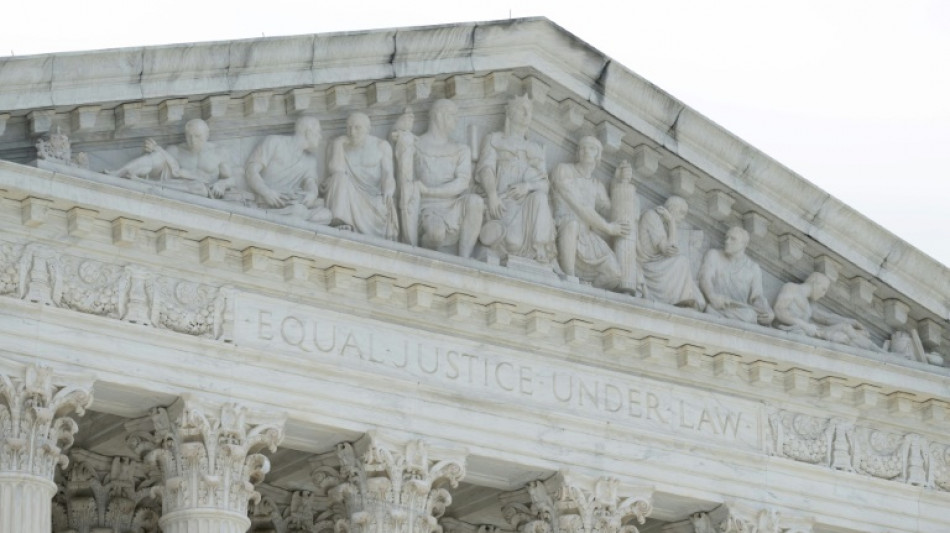
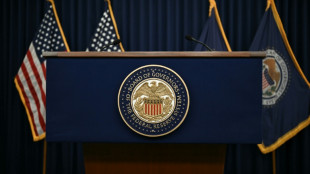
US Supreme Court appears inclined to rein in federal agencies / Photo: SAUL LOEB - AFP/File

 Expanded World Cup; same old story as Europe dominates quarter-finals

 Morocco's Saibari out of France World Cup quarter-final

 Trump orders new strikes on Iran over attacks on shipping in Hormuz

 PSG's Lee set to join Atletico Madrid
 Iran plays with fire, but calculates Trump will hold back

 Oil surges, stocks slide as Trump says Iran ceasefire over

 Meta to build $9 billion data center in western Canada

 Rogers backs Kane to outshine Haaland in World Cup showdown

 Some US Fed officials considered June rate hike on war fallout

 UN launches appeal for nearly $300 mn in Venezuela quake relief

 US to remove Syria from terror blacklist, in new boost to Sharaa

 Court rejects Trump request to restore his name to Kennedy Center

 MLB pitching great Verlander to retire after 2026 season

 Artificial cloud brightening could tame El Nino, but with risks: study

 Shocked and shaken, Venezuela quake survivors get psychological help

 France, Morocco kick off blockbuster World Cup quarter-finals

 Amorim hails 'ambitious' AC Milan, promises to learn Italian

 Cancer survivor Traeen takes the long road to Tour yellow

 Easing Russian Olympic restrictions 'terrible', says Wimbledon star Kostyuk

 'Unbelievable' Kooij wins Tour de France 5th stage in chaotic sprint finish

 Britain's Fery to face Zverev in Wimbledon semi-finals

 Zverev sees off Fritz to make first Wimbledon semi-final

 Barcelona sets new heat record at 40.7C: weather agencies

 'The Pitt,' 'Hacks' lead Emmy nominations

 France lose appeal against Olise booking at World Cup

The conservative-leaning US Supreme Court on Wednesday appeared inclined to weaken the power of federal agencies, which regulate myriad issues affecting the everyday lives of Americans -- from consumer safety to air pollution.
At the heart of the matter is a 1984 ruling in Chevron v. Natural Resources Defense Council, which said judges should defer to government agencies in determining a "reasonable" interpretation of the law if the language is ambiguous.
At the time, the case was a win for the administration of Republican president Ronald Reagan, who accused the country's progressive federal judges of burying corporate America under masses of unnecessary and restrictive red tape.
But the political right has since decried the ruling, saying it unfairly empowers the central government over the judiciary, and means agencies can alter the meaning of statutes, depending on who's in charge.
On Wednesday, the nine justices barely touched the facts of the current case on the docket, which relates to a rule requiring fishing boats in the US northeast to pay for federal observers boarding their vessels to keep watch on overfishing.
Instead, they quickly pivoted to how the precedent set in the Chevron case affected the proceedings -- and how that 1984 ruling might be outdated.
- 'Flood of litigation' -
Elizabeth Prelogar, representing the administration of Democratic President Joe Biden, argued that overruling the Chevron decision would spark an "unwarranted shock to the legal system."
She warned that lower courts could get clogged with cases, and a situation could arise where statutes would be interpreted differently in various states based on the interpretation of judges.
"You lose the uniformity value, and it diminishes the force of the political accountability value," she said.
But most of the six right-leaning justices seemed unmoved by her arguments.
"Chevron itself ushers in shocks to the system every four or eight years when a new administration comes in -- whether it's communications law, or securities law or competition law, environmental law..." said Justice Brett Kavanaugh.
The court's three progressive justices, all women, called for maintaining the status quo.
Justice Ketanji Brown Jackson, a Biden appointee, said she was "worried about the courts becoming uber-legislators."
"Isn't it sort of impractical and chaotic to have a world in which every undefined term in a statute is subject to litigation, if you're trying to govern?" she said.
For Justice Elena Kagan, "it's best to defer to people who do know, who have had long experience on the ground."
"Judges should know what they don't know," Kagan added.
Amy Coney Barrett, who was appointed by Biden's Republican predecessor Donald Trump and whose vote could be decisive for the majority, asked about the possibility of an eventual "flood of litigation."
The court's decision is not expected for several months.
In June 2022, the Supreme Court had already limited the power of federal agencies to an extent.
It ruled that the Environmental Protection Agency did not have overarching power to regulate emissions from coal-fired power plants, saying that "it is not credible that Congress gave the EPA the authority to pass such a measure."
F.Wilson--AT