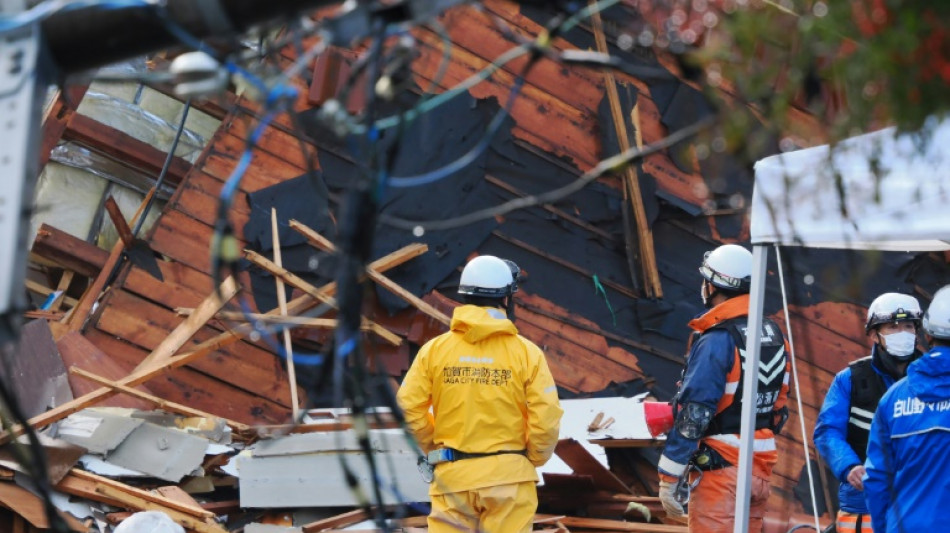
Elderly woman pulled from rubble five days after Japan quake / Photo: Toshifumi KITAMURA - AFP

 All Blacks make five changes for Italy Nations Championship clash

 Western Europe records its hottest June as heatwaves surge: EU monitor

 Fashion's mystery man Margiela sells off his archives

 Nuclear test-scarred Marshall Islands criticises China missile

 Chip titan SK hynix to set price for mega US listing

 Crude extends rally as US-Iran flare-up rocks peace hopes
 Democrat accused of rape exits key US Senate race

 Japan student Ito keeps place against Ireland as Jones returns

 Belgium bid to crack Spain's ironclad defence in World Cup quarter-final

 US man sentenced after swapping 17th century manuscript

 US launches new strikes on Iran after Trump vows to hit 'hard'

 Taylor Swift fans pay $25 for garbage from outside wedding

 After quakes, Venezuelans fear losing damaged homes

 PSG's Lee set to join Athletico

 Erdogan gave pistols to NATO leaders, Starmer says

 Nocera Expands Diversified Technology Strategy With Binding Agreement to Acquire an Equity Interest in INERGX, an Integrated Energy Storage and Power Platform for AI, Defense and Mission-Critical Demand
 China sends nuclear missile message as US looks elsewhere

 Justin Bieber added to 11-minute World Cup final halftime show

 Fery targets Wimbledon final birthday present after royal seal of approval

 Egypt file complaint against referee after World Cup exit

 Women's semi-finalists in uncharted territory at Wimbledon
 US man jailed after swapping 17th century manuscript

 UN maritime head urges halt to Hormuz transit to protect seafarers

 Trump skips new Air Force One on return from Turkey NATO summit

 New York building that buckled now 'stable,' says mayor

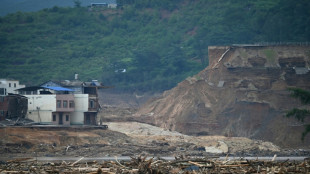
A woman in her 90s trapped for five days under rubble caused by a huge earthquake in central Japan was rescued against the odds, but snow and storms were further complicating relief efforts on Sunday.
At least 128 people have died since the 7.5 magnitude tremor on New Year's Day and its aftershocks -- a toll sure to rise, with 195 others reported missing, according to local authorities.
The shockwaves toppled buildings, sparked a major fire and triggered tsunami waves over a metre high on the Sea of Japan side of the main island of Honshu.
The hope of finding survivors usually fades three days after a destructive quake.
But an elderly woman spent five days under the wreckage of a collapsed house in the city of Suzu on the hard-hit Noto Peninsula before being saved on Saturday.
She was taken to hospital and was able to hold a conversation, according to public broadcaster NHK.
"Hang in there!" rescuers were heard calling to the woman in police footage from the rainy scene published by local media.
"You're gonna be OK!" they shouted. "Stay positive!"
A Tokyo police spokesman confirmed to AFP that the rescue had been carried out by officers from Tokyo and Fukuoka, but he could not give further details.
Not all were so lucky. In the town of Anamizu, a 52-year-old man who lost his 21-year-old son and his parents-in-law waited to hear news of his wife, his other three children and more family members.
"I want them to be alive. It's unthinkable that I could be left alone," he told NHK.
- Sleet and snow -
On Sunday, rain, sleet and snow made the recovery efforts of thousands of police, troops and other rescuers even more challenging.
The cold weather is also likely to worsen conditions for more than 28,800 people in 404 government shelters.
Continuous rain has increased the risk of fresh landslides, while heavy snow through Monday could cause more buildings to collapse under its weight, the regional government warned.
At least 2,000 people in many communities on the remote peninsula have been cut off by damaged roads, with some of an estimated 1,000 landslides also blocking aid vehicles.
That means relief materials have been slow to reach areas suffering water and power outages.
Around 20,700 households in the wider Ishikawa region remained without electricity on Sunday. More than 66,100 households were without water.
"The first priority has been to rescue people under the rubble, and to reach isolated communities," Prime Minister Fumio Kishida said in an interview with NHK on Sunday.
The military has sent small groups of troops to each of the isolated communities on foot, he said.
The government has also "deployed various police and fire department helicopters" to reach them, Kishida added.
"In parallel with these efforts, we need to improve the conditions in shelters, and the health of those suffering in the disaster," because they may have to stay in place for extended periods, he warned.
In Anamizu, rescuers in heavy-duty orange or blue waterproof suits were seen carrying the body of a landslide victim covered in a blue tarp under a toppled pylon.
And among the widespread destruction in the city of Wajima, the traditional red gate of one shrine remained standing, but the view through it was a now-familiar mess of splintered wood and toppled beams.
But in a coastal village called Akasaki, visited by AFP, no houses had collapsed -- thanks to their unusual design.
To withstand the rough environment at the tip of a headland, the houses have few glass windows, and the exterior walls are made from sturdy wooden slats layered horizontally.
"I felt so encouraged, because the village was still there standing," said Masaki Sato, who maintains one of the homes remotely.
Japan experiences hundreds of earthquakes every year, though most cause no damage with strict building codes in place for more than four decades.
But many structures are older, especially in rapidly ageing communities in rural areas like Noto.
The country is haunted by the monster quake of 2011 that triggered a tsunami, left around 18,500 people dead or missing and caused a nuclear catastrophe at the Fukushima plant.
Japan's last earthquake disaster to cause more than 100 deaths was in 2016 in the southern city of Kumamoto, where 276 people died.
F.Ramirez--AT