Pioneering Cuban movie maintains its relevance 30 years later / Photo: Adalberto ROQUE - AFP

 Machado ready to meet Venezuela leader after shock return

 Lula celebrates election win as Brazil markets tumble
 France's Macron accuses social media of sowing discord ahead of election

 Anthropic unveils IPO filing showing soaring sales and AI risks

 US singer Chris Brown avoids jail over London nightclub brawl

 US singer Chris Brown avoids jail over UK nightclub brawl

 Man Utd crisis deepens as Carrick faces axe

 Serbian student movement eyes power after resounding snap poll victory

 Eala breezes past world number 411 in Tokyo opener

 Swedish Centre Party leader says government coalition talks failed
 Barca's big-game defeats pose familiar questions

 Russia says open to mini Ukraine ceasefires, but no let up in war

 Bangladesh measles crisis 'warning sign' of other outbreaks: report

 'Historic victory': World leaders celebrate Lula's re-election
 Stock markets mixed ahead of tech earnings, central bank decisions

 Mother renews anti-bullying appeal a decade after son’s death

 'Historic victory': Leftist leaders in the Americas celebrate Lula's re-election
 African players in Europe: Jackson brace ends City's perfect record

 Argentine police arrest stepfather after pregnant 10-year-old reaches hospital

 Mother dies after rescuing sons from riptide in the Bahamas

 James Blunt reportedly sought extra underwear during Celebrity Traitors filming

 Trump says Canada trade deal coming 'soon'

 Police urge home-security checks as darker evenings return

 Kane primed to pip Yamal, Mbappe to Ballon d'Or glory
 UK households advised to prepare for three days without essential services

It has been three decades since the seminal film "Strawberry and Chocolate" generated both ovations and tears, marking a before and an after in Cuban cinema.
The film was cathartic in a country that only barely had come to recognize the rights of homosexuals.
But the actor who was the protagonist, Jorge Perugorria, says Cuba has moved backward in terms of the freedom of expression also invoked by the movie.
The International Festival of New Latin American Cinema, which opens Friday in Havana, will pay two tributes to the film, known in Spanish as "Fresa y Chocolate," which received a standing ovation at its premiere in 1993.
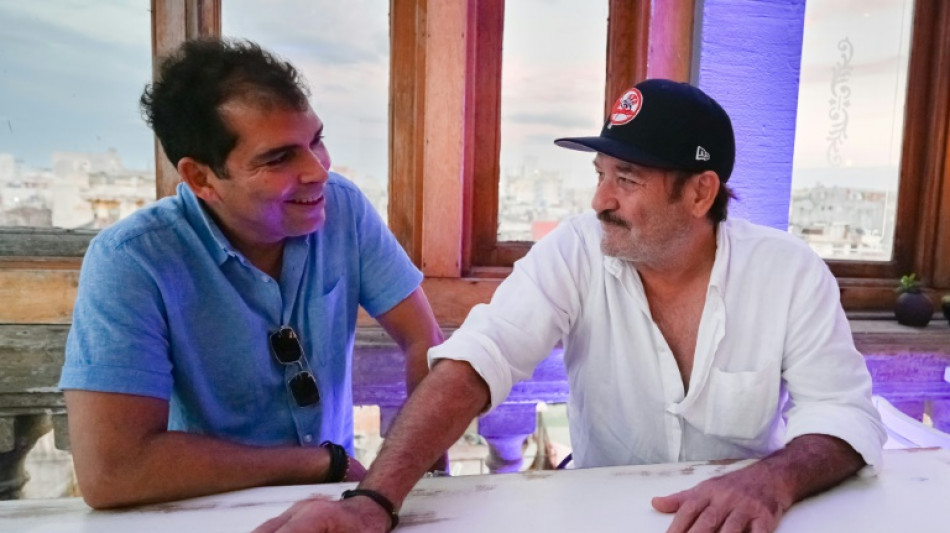
Perugorria, 58, talked to AFP about the film along with the rest of its cast in an emotional reunion at La Guarida restaurant, a mansion in central Havana that in the early years of the revolution was subdivided into apartments and served as setting for the movie.
On the terrace of the mansion, Perugorria, recalls the "collective catharsis" that the film provoked.
"It was as if the public had the need to see that film... because it dealt perhaps with what many had in their heads... frustrations" and issues buried and out of reach of the public, he recalls.
At the time, following the collapse of the Soviet Union, a severe economic crisis -- called the "special period" -- pummeled the island, and an obscure policy that marginalized homosexuals and dissidents was only beginning to be reevaluated.
In the film, Diego, a refined gay art lover, befriends David, a staunch defender of the ruling Communist Party, in an environment of censorship and homophobia.
- 'Impossible metaphor' -
"That final embrace," between Diego and David at the end of the film, "is a song, a reconciliation between Cubans," but "it is farther away today than it was 30 years ago," says Perugorria, who plays Diego.
"The differences between Cubans have widened," and the embrace "has become an almost impossible metaphor," he adds.
For Vladimir Cruz, 58, who played the role of David, the film identified both the repressed and the repressors.
"We had experiences of people who came out of the cinema and said: 'I have acted like this, I have been intolerant, I have repressed homosexuals,'" Cruz recalls among photos and sculptures preserved from the set.
The story shows how "the right to participate in society was taken away from those who thought differently. And in that sense, I think Cuban society... has progressed, but at the official level we have gone downhill," Cruz says.
He celebrates the legalization of equal marriage in 2022.
"But anyone who thinks differently, (even) one millimeter, with respect to the predominant ideology or the official ideology, continues to suffer the same problems that Diego had and that led him to migrate," Cruz says.
Nearly 500,000 Cubans, or almost 5 percent of the population, left the island left the island since 2021 in an unprecedented wave, according to US immigration figures.
Perugorria agrees: "Today, just as the exhibition of German (another character in the film) was censored 30 years ago, films and exhibitions are still censored."
Cuba needs "a cultural policy that is for everyone in our diversity, our complexity, not just for a group that thinks one way," says Perugorria.
- 'Cornered and harassed' -
"'Strawberry and Chocolate' advocates for that" and is still "current," Perugorria maintains, citing the case of the more than 300 young people who staged an unprecedented protest for freedom of expression in November 2020.
A good part of them emigrated.
"It's sad to think that there are people who don't just leave, but are thrown out, because they are cornered and harassed," he says.
Behind the cameras, another fraternal story was built between Tomas Gutierrez Alea (1928-1996) and Juan Carlos Tabio (1943-2021), codirectors of the film.
Seriously ill, Gutierrez Alea underwent surgery during filming, but returned to the set four days later. The actors say that he would slowly climb the wide stairs of the mansion to direct in the mornings, then Tabio would follow his friend's recommendations in detail on the set.
"That story of friendship between these two great artists and their love for cinema also had a lot of weight in the film," says Perugorria.
B.Torres--AT