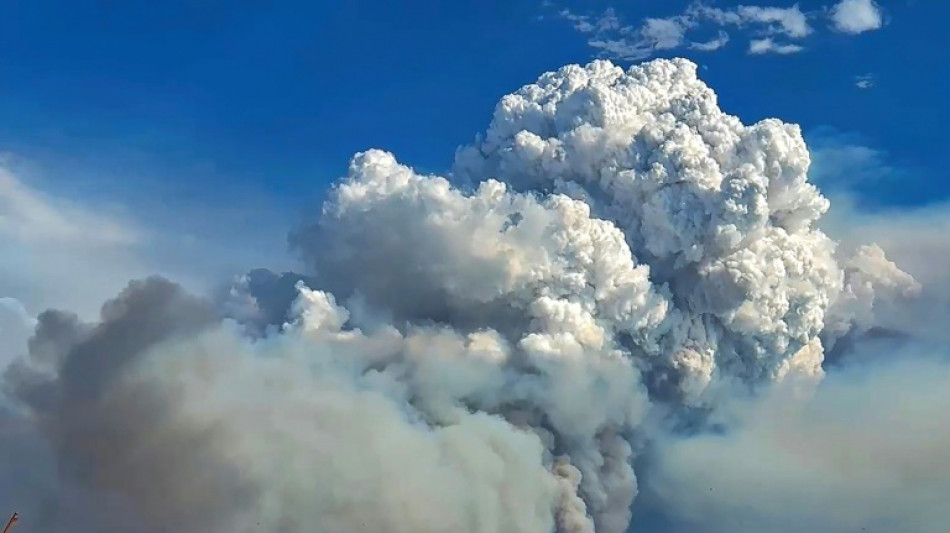
'Out of control' fires endanger wildlife in Brazilian wetlands / Photo: Rogerio FLORENTINO - AFP

 Mbappe, Dembele fire France past Morocco into World Cup semi-finals

 Chip titan SK hynix readies for mega US listing

 Iyer says India in 'transition' after latest thrashing by England

 Iyer says India in 'transition' after latest England thrashing

 Silencing World Cup hotshot Haaland vital, says England's O'Reilly

 Australian sprint sensation Gout Gout set to miss rest of season

 England thrash India by nine wickets for T20 series win

 Wimbledon run came 'out of nowhere', says finalist Noskova

 India captain Kaur hopes Lord's Test can offset World Cup woes

 China factory fire kills at least 28 people

 Dubai Police Unveil Next Generation of ‘Ghiath’ Smart Patrols Powered by BYD

 Djokovic faces Sinner showdown, Fery eyes Wimbledon final

 Noskova books all-Czech Wimbledon final clash with Muchova

 England's Quansah handed two-game World Cup ban

 UK sets record for number of days over 34C

 Haaland relishing 'special' World Cup showdown with England

 FIFA lashes 'unfounded allegations' after Argentina-Egypt clash
 'Only revenge': Iran mourners defiant at Khamenei burial

 Pogacar reclaims Tour de France yellow jersey with stage six win

 US existing home sales dip in June as cost worries persist

 Russia subjecting 1.6 million Ukrainian children to military brainwashing: OSCE report

 Strengthening El Nino likely to 'rank among largest' on record: US agency

 Jorge Jesus to take over as Portugal coach after World Cup exit

 Ebola outbreak is 'fastest growing ever' as 600 die

 Stocks shrug off tensions to rise on renewed tech interest

The Pantanal wetlands in western Brazil are famed as a paradise of biodiversity, but these days they have enormous clouds of smoke billowing over them, as raging wildfires reduce vast expanses to scorched earth.
Known for its lush landscapes and vibrant wildlife, including jaguars, caimans, macaws and monkeys, the Pantanal is home to the world's biggest tropical wetlands and, in normal times, a thriving ecotourism industry.
But in recent weeks it has been ravaged by fires that are threatening its iconic wildlife, as Brazil suffers through a southern hemisphere spring of droughts and record heat.
There were 2,387 fires in the Pantanal in the first 13 days of November, an increase of more than 1,000 percent from the entire month of November 2022, according to satellite monitoring by Brazilian space research agency INPE.
"The situation is completely out of control. And between the heat wave and the wind, it's only going to get worse," says biologist Gustavo Figueiroa, 31, head of the environmental group SOS Pantanal.
"The Pantanal is a region that's used to fires. Normally, it regenerates naturally. But this many fires isn't normal."
The Pantanal sits at the southern edge of the Amazon rainforest, stretching from Brazil into Bolivia and Paraguay across more than 170,000 square kilometers (65,000 square miles).
It has been hit hard by drought this year, with normally flooded areas reduced to shriveled ponds.
At one such spot along the dirt highway across the region, the 150-kilometer (95-mile) "Transpantaneira," a small group of caimans can be seen trying to swim in the shallow water.
Nearby, the corpse of another sits rotting on the bank.
Elsewhere, a dead porcupine lays on a carpet of ash in the charred remains of what was once a forest.
"It probably died of smoke inhalation," says veterinarian Aracelli Hammann, who is volunteering with a wildlife rescue group.
They made the grim find in the Encontro das Aguas park, home to the world's largest jaguar population.
Nearly one-third of the park has been hit by fires in the past month, according to environmental group ICV.
The other main front that firefighters are battling is in the Pantanal National Park to the southwest, where fires have burned 24 percent of the surface area.
Figueiroa warns the two fire fronts "are about to merge."
Exacerbating the situation, firefighters face huge logistical battles, given that many hard-hit areas are only reachable by boat.
- 'Domino effect' -
Experts say the fires are mainly caused by human activity, especially burning land to clear it for farming.
Climate conditions have only made things worse.
Experts say even when animals survive the flames, they risk starvation.
"We've seen a range of dead animals, including insects, reptiles, amphibians, small mammals, which are unable to flee," says Figueiroa.
"They're part of an invisible food chain, and each death has a domino effect, reaching all the way up to the apex predator, the jaguar."
In a clearing, a group of monkeys rushes to devour bananas and eggs left for them by volunteers.
"We call it 'gray hunger' -- when fire reduces all the vegetation to ashes and there are no natural food sources left in the area for animals that survive the flames," says Jennifer Larreia, 33, head of animal rescue group E o Bicho.
Th.Gonzalez--AT