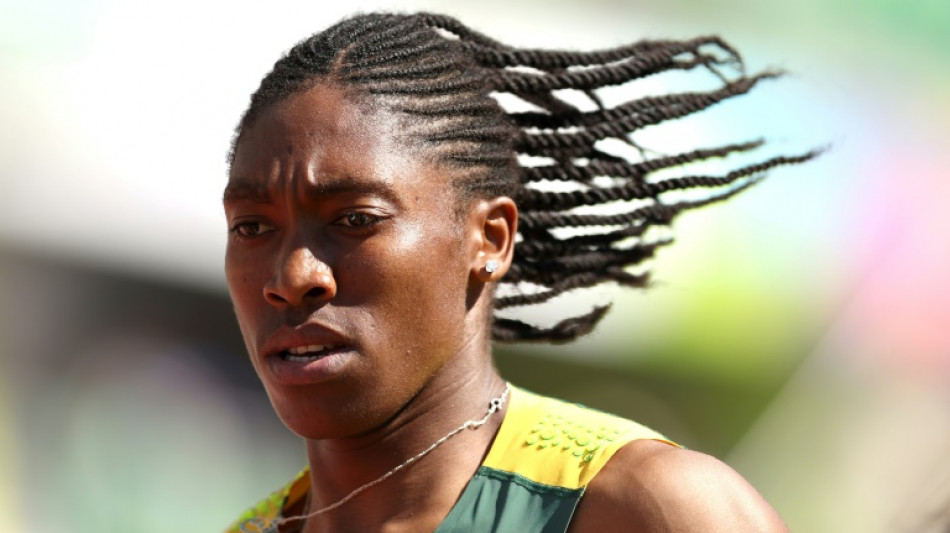
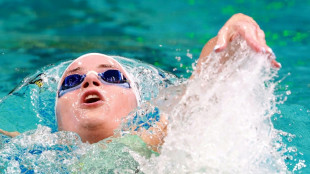
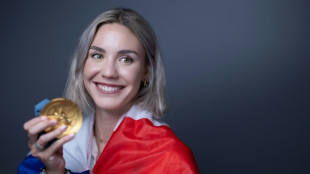
Olympic champion Semenya 'not ashamed' to be different / Photo: Patrick Smith - GETTY IMAGES NORTH AMERICA/AFP/File

 Deschamps hails Mbappe after superstar fires France into World Cup semis

 OpenAI number two Simo steps down to focus on health

 Iran buries Khamenei after new fighting with US erupts

 Can ageless Messi keep delivering for Argentina at World Cup?

 Chip titan SK hynix to raise $26.5 bn in blockbuster US listing
 Bayeux Tapestry begins epic journey from France to London

 Mbappe, Dembele fire France past Morocco into World Cup semi-finals

 Chip titan SK hynix readies for mega US listing
 Iyer says India in 'transition' after latest thrashing by England
 Iyer says India in 'transition' after latest England thrashing
 Silencing World Cup hotshot Haaland vital, says England's O'Reilly

 Australian sprint sensation Gout Gout set to miss rest of season

 England thrash India by nine wickets for T20 series win

 Wimbledon run came 'out of nowhere', says finalist Noskova

 India captain Kaur hopes Lord's Test can offset World Cup woes

 China factory fire kills at least 28 people

 Dubai Police Unveil Next Generation of ‘Ghiath’ Smart Patrols Powered by BYD
 Djokovic faces Sinner showdown, Fery eyes Wimbledon final
 Noskova books all-Czech Wimbledon final clash with Muchova
 England's Quansah handed two-game World Cup ban

 UK sets record for number of days over 34C

 Haaland relishing 'special' World Cup showdown with England
 FIFA lashes 'unfounded allegations' after Argentina-Egypt clash

 'Only revenge': Iran mourners defiant at Khamenei burial
 Pogacar reclaims Tour de France yellow jersey with stage six win
Double Olympic champion Caster Semenya said she is "not going to be ashamed because I am different" as she focuses on her long-running dispute with athletics authorities.
The South African, who is classed as having "differences in sexual development (DSD)" but has always been legally identified as female, has refused to take drugs to reduce her testosterone levels since athletics' governing body introduced the rules in 2018.
As a result, she has been barred from competing at her favourite distance of 800m.
The Grand Chamber of the European Court of Human Rights (ECHR) agreed on Monday to rule on the case of Semenya.
The 32-year-old won a lengthy legal battle in July against the Swiss government at the Strasbourg-based international court, which ruled she was the victim of discrimination.
But Swiss authorities, supported by World Athletics, had announced their intention to take the matter to the ECHR's Grand Chamber, whose rulings are binding.
Semenya said in an interview with the BBC on Tuesday that she is focused on "winning battles against the authorities" rather than competing, with next year's Paris Olympics not in her plans.
"For me I believe if you are a woman, you are a woman, no matter the differences you have," she said.
"I have realised I want to live my life and fight for what I think and I believe in myself. I know I am a woman and anything that comes along with it just accept it."
She added: "At the end of the day, I know I am different. I don't care about the medical terms or what they tell me. Being born without a uterus or internal testicles -- those don't make me less of a woman.
"Those are the differences I was born with and I will embrace them. I am not going to be ashamed because I am different."
- 'Inclusivity, diversity' -
Semenya, who won Olympic 800m gold in 2012 and 2016 and is a three-time world champion over the distance, said last week she had achieved all she wanted to on the track and is now focused on her battle with the sport's authorities.
"My future is to fight injustice, fight for inclusivity and diversity," she said.
"For me, I'm not going to allow leaders who come for the selfish means into our business to destroy it. I'm about empowering women and making sure they have a voice."
The ruling by the ECHR in July was largely symbolic as it does not call into question the World Athletics ruling and does not pave the way for Semenya to return to competition without taking the medication.
World Athletics introduced the DSD regulations to create a level playing field in women's events ranging from 400m to one mile.
Semenya was forced to move up to the 5,000m, a distance in which she failed to reach the final at last year's world championships in Eugene, Oregon.
In March this year, the federation amended the rules. DSD athletes now have to reduce their amount of blood testosterone to below 2.5 nanomoles per litre, down from the previous level of five, and remain below this threshold for two years.
World Athletics also removed the principle of restricted events for DSD athletes, meaning regulations now cover all distances.
P.A.Mendoza--AT