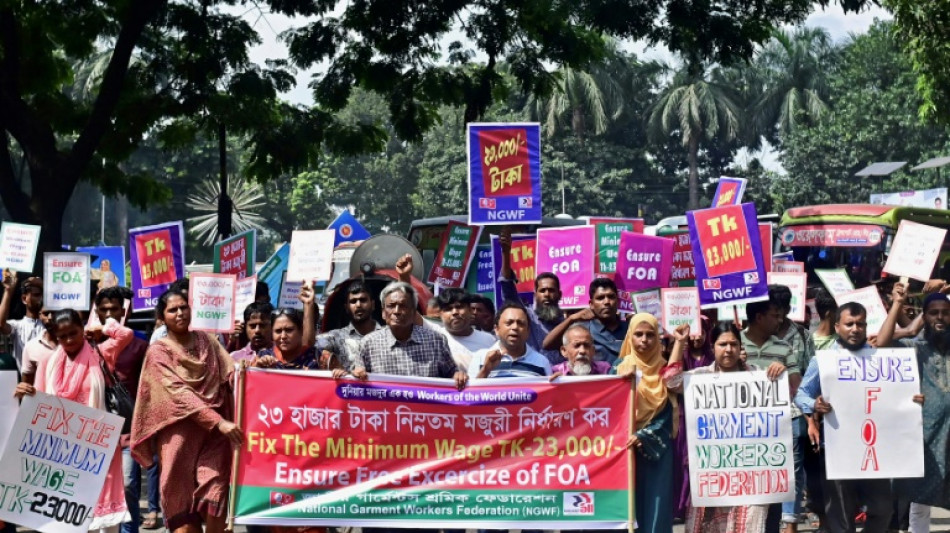
Two dead as Bangladesh garment workers protest low pay / Photo: Munir uz ZAMAN - AFP/File

 Humanitarians look to put the AI in aid
 Indian haute couture presence 'overdue', says designer Manish Malhotra

 'Everyone' expects Spain to beat us, says Belgium coach
 France's Galthie says 'hot and cold' Australia still a threat

 Mbappe warns 'a long way to go' for France at World Cup after reaching semis

 Deschamps hails Mbappe after superstar fires France into World Cup semis

 OpenAI number two Simo steps down to focus on health

 Iran buries Khamenei after new fighting with US erupts

 Can ageless Messi keep delivering for Argentina at World Cup?

 Chip titan SK hynix to raise $26.5 bn in blockbuster US listing
 Bayeux Tapestry begins epic journey from France to London
 Mbappe, Dembele fire France past Morocco into World Cup semi-finals

 Chip titan SK hynix readies for mega US listing

 Iyer says India in 'transition' after latest thrashing by England
 Iyer says India in 'transition' after latest England thrashing

 Silencing World Cup hotshot Haaland vital, says England's O'Reilly

 Australian sprint sensation Gout Gout set to miss rest of season
 England thrash India by nine wickets for T20 series win

 Wimbledon run came 'out of nowhere', says finalist Noskova

 India captain Kaur hopes Lord's Test can offset World Cup woes

 China factory fire kills at least 28 people
 Dubai Police Unveil Next Generation of ‘Ghiath’ Smart Patrols Powered by BYD
 Djokovic faces Sinner showdown, Fery eyes Wimbledon final

 Noskova books all-Czech Wimbledon final clash with Muchova
 England's Quansah handed two-game World Cup ban

Thousands of garment workers in Bangladesh walked off the job in protest at low wages Monday, sparking clashes with security forces and damaging multiple factories in unrest that left at least two people dead, police said.
Bangladesh is one of the world's largest garment exporters, with the industry accounting for 85 percent of the South Asian country's $55 billion in annual exports, but conditions are dire for many of its four million apparel workers.
Police said at least 10,000 workers left their shifts and staged protests in Gazipur, the country's largest industrial city, where a six-storey factory was torched, leading to one of the two fatalities.
Another 7,000 protested in the central towns of Ashulia and Hemayetpur, authorities said.
Ashulia garment union leader Mohammad Ibrahim disputed the police figures, saying there were more than 100,000 protesters.
The worst violence erupted on a highway north of the capital Dhaka to Mymensingh, where at least 4,000 workers clashed with police, blocked the road and set fire to a pick-up truck, officers told AFP.
"One garment worker was injured during the clashes, and he died as he was taken to a hospital," said Sarwar Alam, chief of the industrial police unit in Gazipur.
"They hurled rocks at our officers like rain. Some policemen were injured during the clashes. We fired tear gas and sound grenades to disperse the workers."
In Gazipur, workers targetted plants which they claimed did not allow workers to join the demonstrations, torching a factory at Konabari, police and a fire service official said.
"One worker of ABM Fashions died from suffocation after the fire spread to the first three floors," Gazipur fire service chief Abdullah Al Arefin told AFP.
"We rescued another worker alive," he added.
Police said at least 40 factories were damaged after protesters smashed windows and damaged furniture.
Mahbubur Rahman, police chief of Bangladesh's industrial regions, told AFP authorities were talking to union leaders to peacefully resolve the protests.
- 'Basic needs' -
Bangladesh is home to around 3,500 garment factories, where clothing for some of the world's largest retailers and brands is made, but the basic monthly wage for workers is just 8,300 taka ($75).
Protests erupted over the weekend after the powerful manufacturers' association offered a 25 percent raise, ignoring union demands for a new monthly minimum basic wage of 23,000 taka -- nearly a threefold increase.
The South Asian country of nearly 170 million has overtaken its neighbour India in per capita income, with the garment industry at the centre of its impressive growth over the past two decades.
But wage protests pose a major challenge to Prime Minister Sheikh Hasina, who has ruled the country with an iron fist since 2009. A resurgent opposition has challenged her rule as she readies for elections due before January.
Her government set up a panel this year to set a new minimum wage.
Unions say that garment factory owners -- who include ministers and influential lawmakers -- have played a role in fixing the minimum wage during past negotiations.
"The workers have been badly impacted by a cost of living crisis, and the cost of food has skyrocketed," said Taslima Akter, the head of the Garment Sramik Samhati union.
"If you take into account inflation and the depreciation of the taka against the dollar... the manufacturers were offering less than what a worker got in 2017 when the basic minimum wage was fixed."
Major brands including Gap, Levi Strauss, Lululemon, and Patagonia wrote a letter to Hasina this month calling for a "successful conclusion" to wage negotiations.
"The consultations should seek to raise the minimum wage to a level that corresponds with a wage level and benefits that are sufficient to cover workers' basic needs and some discretionary income," the companies wrote on October 13.
Protests over wages and shoddy safety conditions often erupt in Bangladesh.
In 2006, protesters torched at least 16 factories in wage protests that left several people dead.
Major wage and safety protests also erupted in 2013, after the collapse of the Rana Plaza garment factory building, which left at least 1,134 people dead.
A.O.Scott--AT