Palestinians expelled from W.Bank village as Gaza war rages
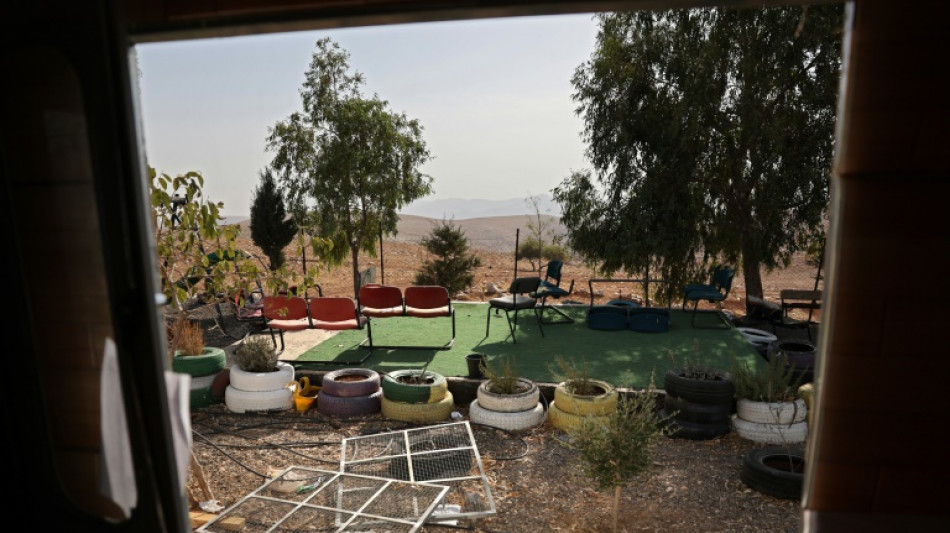
/ Photo: Thomas COEX - AFP

 H5 bird flu detected in Australian seabird for first time
 Myanmar's pro-democracy revolution weakens five years on

 Hundreds flee homes in Taiwan ahead of biggest typhoon in decades

 Asian stocks rally as SK hynix breathes life back into AI trade

 Humanitarians look to put the AI in aid
 Indian haute couture presence 'overdue', says designer Manish Malhotra

 'Everyone' expects Spain to beat us, says Belgium coach
 France's Galthie says 'hot and cold' Australia still a threat

 Mbappe warns 'a long way to go' for France at World Cup after reaching semis

 Deschamps hails Mbappe after superstar fires France into World Cup semis

 OpenAI number two Simo steps down to focus on health

 Iran buries Khamenei after new fighting with US erupts

 Can ageless Messi keep delivering for Argentina at World Cup?

 Chip titan SK hynix to raise $26.5 bn in blockbuster US listing

 Bayeux Tapestry begins epic journey from France to London

 Mbappe, Dembele fire France past Morocco into World Cup semi-finals

 Chip titan SK hynix readies for mega US listing

 Iyer says India in 'transition' after latest thrashing by England
 Iyer says India in 'transition' after latest England thrashing

 Silencing World Cup hotshot Haaland vital, says England's O'Reilly

 Australian sprint sensation Gout Gout set to miss rest of season

 England thrash India by nine wickets for T20 series win

 Wimbledon run came 'out of nowhere', says finalist Noskova

 India captain Kaur hopes Lord's Test can offset World Cup woes

 China factory fire kills at least 28 people

Within an hour, the Bedouin village of Wadi al-Seeq in the occupied West Bank had been completely emptied, its 200 residents fleeing on foot with their sheep and goats.
On October 12, five days after the start of the war between Israel and Gaza's Hamas rulers, residents say dozens of Israelis turned up at the village and gave them an hour to leave their land, among them settlers, soldiers and police.
Residents said some were local settlers dressed in army uniforms who have regularly harassed the village, while others wore civilian clothing, with army and police vehicles also at the scene.
The Israeli army had no immediate comment on the incident, despite several AFP requests.
The Gaza conflict began on October 7 when Hamas militants went on the rampage in southern Israel, killing 1,400 people, and kidnapping 230 others, prompting a massive Israeli retaliation that medics in the Hamas-run territory say has killed more than 8,000 people, half of them children.
On both sides, the vast majority of victims are civilians.
"We are paying for what happened," said Abu Bashar, a leader from Wadi al-Seeq, a village of Palestinian herders that lies some 10 kilometres (six miles) east of the city of Ramallah, who has taken refuge with a dozen other families on private land in Taybeh slightly further north.
The violence in Gaza has sparked widespread unrest in the West Bank, which has been occupied by Israel since the 1967 Six Day War and where more than 110 Palestinians have been killed since the beginning of the war in clashes with soldiers or settlers.
About three million Palestinians live across the West Bank, which is dotted with Jewish settlements that are considered illegal under international law but are home to 490,000 Israelis.
Since the Gaza war broke out, settler attacks against Palestinians have more than doubled, from an average of three to eight incidents a day, according to the UN humanitarian agency OCHA, citing incidents of intimidation, theft and assault.
"We don't sleep anymore, it's a nightmare", said Alia Mlihat, who lives in Muarrajat, another Bedouin village between Ramallah and Jericho.
She's afraid her village will be next in line.
"With the war, we're seeing the settlers have more weapons, it's very difficult," she told AFP.
"We're living through a new Nakba because of settlers and the army," she said, using the Arabic word for "catastrophe" when some 760,000 Palestinians fled or were expelled from their homes during the 1948 war that accompanied Israel's creation.
That year, the Mlihat family, like most Palestinian Bedouins, left Israel's Negev Desert for the West Bank.
Since October 7, OCHA says some 607 people, more than half of them children, have been displaced within the West Bank.
In the previous 18 months, 1,100 people were forced off their land.
- 'Everything was destroyed' -
"I have nowhere else to go", said Abu Bashar who only wants to go back home.
"All of our things are there, the goods we buy in bulk, our tractors, our solar panels."
A week after the expulsion, the army allowed the villagers back to collect their things but when they got back, everything was ruined.
"Everything was destroyed. The bags of food for the animals were dumped out on the ground," he said.
At the site, AFP observed ransacked homes with wardrobes emptied, children's beds broken, curtains torn and papers, sandals and toys scattered across the floor.
In and around the village, civilian vehicles circulated, some displaying Israeli flags, AFP journalists said.
All he wants is to be left alone to live in peace but he can't see that happening.
"There is a long-term plan to drive us out and take our land, and they took this opportunity to do it while everyone is watching Gaza."
- Violence with impunity -
Israeli human rights activist Guy Hirschfeld told AFP the settlers had been stepping up efforts to throw Palestinians off their land since the start of the conflict.
"The settlers taking advantage of the war to finish cleaning area C from non-Jewish people," he told AFP, referring to an administrative area covering 60 percent of the West Bank that is controlled by the Israeli army.
Although the settlers do not enjoy widespread public support within Israeli society, they have strong backing from leading officials in Benjamin Netanyahu's government.
Despite the widespread presence of Israeli troops in the West Bank, the army "does not interfere with the settler violence," says Allegra Pacheco, head of the West Bank Protection Consortium, a group of NGOs coordinating humanitarian aid.
"Their presence generally ends up in more violence."
P.Hernandez--AT