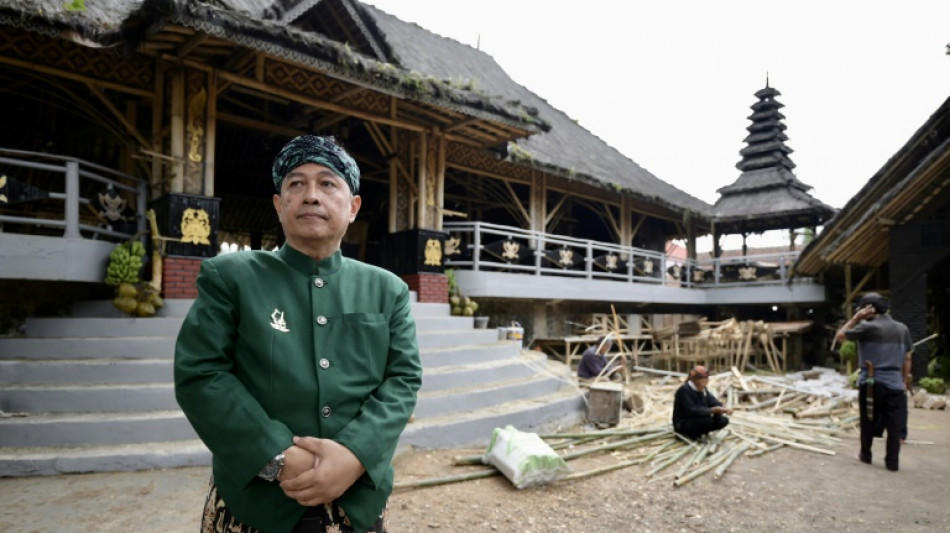
Not 'godless': Indonesian native faith followers fight for recognition / Photo: BAY ISMOYO - AFP

 From obscurity to smashing sixes: Pakistan's Razaullah rises to stardom

 Bezzecchi takes pole for San Marino MotoGP
 China, Russia, Iran leaders gather in India as BRICS nations seek common ground

 Korda finally beaten as Europe grasp slender Solheim lead

 Zelensky says willing to meet Putin at G20 in Miami: interview

 Quebec Brokerage Qubit Insurance Announces New Data on Coverage Shortfalls as Rebuilding Costs Rise

 Trump asks Smithsonian to install George Washington statues, exhibition

 'A legend': Celine Dion poised for emotional comeback in Paris

 Europe eyes battle over 'pervert' AI glasses

 Philippine Muslim enclave trades bullets for election ballots

 Children in flood-hit Nepal grapple with loss, cling to hope

 Bhutan business bets on hazelnuts for farming future

 First bodies of Philippines ferry fire victims land as toll hits 35

 Gaza film, Malkovich drama vie for Venice top prize

 DR Congo school fire stampede death toll rises to 26: UNICEF

 Best Free Gold IRA Kits in 2026 Rankings Released By Experts

 Top seed Zverev holds off Khachanov to reach US Open final

 James McAvoy brings new film 'Faith' to Toronto fest

 Faultless Duplantis, hungry Ingebrigtsen shine at inaugural Ultimate

 Roblox to launch wallet to pay creators faster and will allow off-platform gaming

 Springboks wary of new-look All Blacks in Baltimore test

 Townsend, Siniakova win US Open doubles for career Grand Slam together

 Verstappen unimpressed with new Madrid street track

 Razaullah heroics deny England quickfire win in 3rd Test against Pakistan

 Masks banned at planned UK protests: police

As 81-year-old Subrata listened to a gong echo during a celebration of his ancient Indonesian Indigenous faith, he betrayed little of the trauma of a lifetime of discrimination deriding him as "godless".
He was enjoying a cleansing ritual for younger followers of the Sunda Wiwitan religion in Muslim-majority Indonesia's most-populous province West Java, where they are often derided as infidels, primitive or faithless idolaters.
Sunda Wiwitan believers are pushing for official recognition of their shunned faith -- which has existed longer than Islam and Christianity in Indonesia.
"I hope people will no longer treat God's creatures differently," Subrata, who like many Indonesians has one name, told AFP between rituals in Cigugur village, around 200 kilometres (124 miles) east of Jakarta.
Sunda Wiwitan believers face significant hurdles, including policies that bar them from government jobs and having their marriages officially recognised.
"I am a citizen of this country, yet I am ostracised on my land," said Subrata.
Around him, preparations were under way to celebrate Seren Taun, the annual harvest festival outlawed from 1982 until the end of Suharto's dictatorship in 1998.
Before a ritual known as "Pesta Dadung" to protect crops from ruinous pests, men dressed in black solemnly chanted prayers while lighting a fire, as women in white kebaya sang in a traditional Sundanese language.
Sunda Wiwitan venerates the spirit of followers' ancestors as well as the power of nature, causing misconceptions that they revere dead objects.
Before he retired from the civil service, Subrata said he was repeatedly denied promotions and interrogated because he was deemed "godless" by his then-boss.
"God destined me to be a believer of Sunda Wiwitan, but after I was born, I was treated differently. Of course, it hurts," he said.
Later, the government barred native faith believers from applying for civil service jobs altogether.
- Social stigma -
Despite the religion's centuries-long existence, Sunda Wiwitan followers continue to face barriers to their ability to practice their faith and access other rights.
Before 2017, more than 10 million native-faith followers were required to fill the religion field on their ID cards with a dash.
The move created several bureaucratic roadblocks for believers, including renewing driving licences, applying for certain jobs or undertaking other official administrative tasks.
In 2017, Indonesia's Constitutional Court allowed native-faith followers to fill the religion column with a generic phrase: "the Belief in God Almighty".
But bureaucratic problems remain.
Some are reluctant to renew their ID cards because they cannot state their actual religion.
"We are all different, why do we need to be lumped into one term?" asked Dewi Kanti Setianingsih, an advocate for Sunda Wiwitan rights.
Without a listed religion, people cannot register their marriages legally, forcing some women into unofficial nuptials that carry further stigma in Indonesia.
"Their children's status will not be acknowledged by the law and they will be considered as children born outside of marriages," said Setianingsih.
Followers say they face more obstacles than other religions and local authorities have also moved to shut down their tombs, citing a lack of permits.
"We are still fighting because there are still articles... that are discriminatory," Ira Indrawardana, an anthropologist at Padjadjaran University who practices Sunda Wiwitan, told AFP.
The government, however, denies discriminating against the community.
"The ministry can't provide such service for that many religions so we decided on a universal term," said Sjamsul Hadi, senior official at the Ministry of Education, Culture, Research and Technology.
- In hiding -
Sunda Wiwitan followers numbered as many as 15,000 in the early 1960s, said Setianingsih.
More precise estimates are hard to come by because many hide their faith.
As a child, Restu Buana would call himself a Catholic for fear he would be bullied if his true religion was known.
When his religious studies teacher found out, he condemned Sunda Wiwitan as a culture that "is not a religion", the 20-year-old student said.
He now settles for a dash on his ID card.
"What I want is to not have a religion column on our ID card. Religion is a private matter, whatever people practice is their right and must be respected," he said.
Some Sunda Wiwitan followers believe involving other religions in their sacred harvest rituals could help fix misconceptions.
They are also working with NGOs and religious organisations to clarify misunderstandings about their faith.
Others have lobbied the government through the rights commission, filed court requests to recognise marriages or led protests against tomb closures.
"If Indonesia wants to be seen as the beacon of diversity, it has to embrace differences," Indrawardana said.
N.Mitchell--AT