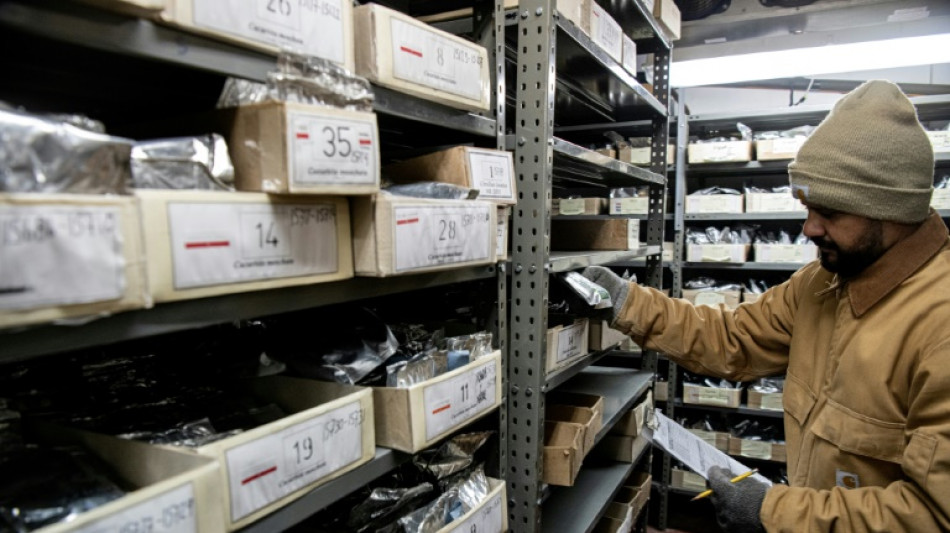
In Costa Rica, saving seeds to feed future generations / Photo: Ezequiel BECERRA - AFP

 North Sitra sewage expansion lifts capacity to 30,000 cubic metres daily

 Bahraini law allows crypto assets to pass to heirs

 Milky Way and Brazilian lagoon form eye-like image in NASA feature

 Review analysis ranks South Africa’s best and worst-rated malls

 Court overturns MK party expulsions of Zuma-Sambudla and Ndhlela

 Khloé Kardashian and Malika Haqq dispute surprises mutual friends

 Fight breaks out among fans during Rams-Packers game at SoFi Stadium

 Laura Brand visits Russell Brand in prison with their children

 U of C Professor and Residential School Survivor Condemns Denialism

 Biography details Johnny Depp’s efforts to leave 21 Jump Street

 Rare yellow-bellied sea snake found on Southern California beach

 Second-generation Mini Cooper SE set for India launch with 402km range

 How to Drive a Classic Car Without Ownership: Rental, Clubs, and Track Options

 South African Bail Fund Launches to Address Remand Detention Crisis

 Qatar Facilities Management Market to Reach $11.15bn by 2032
In the tropical mountains of Costa Rica, scientists guard a treasure trove of seeds collected over decades as a bulwark against food insecurity and climate change.
Some 6,200 samples from 125 species of squash, chilli, tomato and other edible plants are held at the Tropical Agricultural Research and Higher Education Center (CATIE) near the town of Turrialba.
In temperatures as low as minus 20 degrees Celsius, the seeds can be kept for up to 40 years for purposes of research, genetic engineering of plants more resistant to pests, diseases or changing weather, or to replace species that die out.
The bank "is a resource we have for use now or in the future," plant geneticist William Solano told AFP at the facility some 60 km east of the capital San Jose.
It holds seeds from 57 countries, he said, but about 90 percent are from the Central American region, collected from markets and farms or growing wild.
The CATIE stockpile, stacked on shelves in hundreds of small, silver envelopes, includes the second-largest collection of squash family seeds in the world.
Many of the seeds are not present in banks anywhere else in the world, according to the center.
- 'Genetic archive' -
"In response to climate change, we have here important materials for food security that are locally adapted" to a variety of climate conditions, ranging from humidity to extreme drought, Solano told AFP.
As ever-more extreme weather threatens food production, traditional, native seeds are essential to "give sustainability to agri-food systems," he added.
According to seed expert Ester Vargas of the University of Costa Rica, "there is variability in native seeds that gives them the ability to adapt to different conditions" in the areas of their origin.
Seed banks like the one at CATIE serve to guarantee an availability of "crops with high nutritional value" for generations to come, she added.
The UN's Food and Agriculture Organization (FAO) estimates that almost one in ten people in the world suffered hunger in 2022 -- some 735 million in total -- with increases in parts of Africa, western Asia and the Caribbean.
The FAO says seed banks help preserve "the most adapted varieties" for a given region.
"As climate change has a significant impact on agricultural production, growing local varieties, which have a high degree of genetic diversity, is highly important because these varieties have the ability to better withstand and adapt to environmental stresses and changes," a document on the organization's website states.
CATIE agronomist Daniel Fernandez said the bank also served another purpose: as a "genetic archive" of species that were replaced by more modified crops and that one day may need to be brought back.
O.Brown--AT