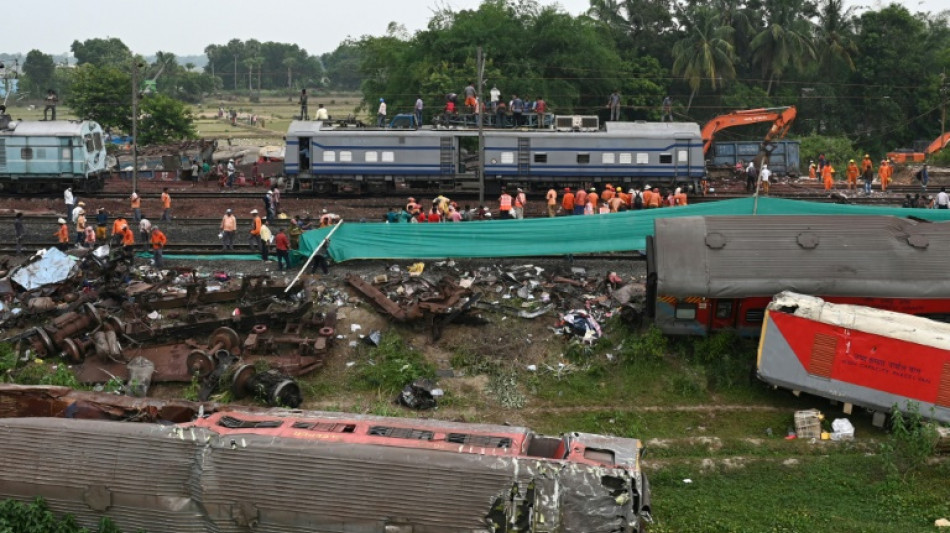
3 Indian rail workers arrested over deadly train crash / Photo: Punit PARANJPE - AFP

 Breytenbach confirms recommending Sibiya for Johannesburg post

 Celebrities mark Thanksgiving in turkey-themed photo gallery

 German fashion model Veruschka dies in Berlin at 87

 Thanksgiving storms disrupt thousands of US flights
 T.J. Lang criticises Aaron Rodgers over comments about Mike McCarthy

 Black Friday beauty offers span skincare, fragrance and wellness devices

 U2 pays tribute to Dolly Parton during Thanksgiving Eve NFL show

 Toyota Innova Hycross and Kia Sorento hybrids compared in top trims

 President Trump to Attend TSMC Groundbreaking in Phoenix Next Week

 Gauteng Health Department Warns of Rising Antibiotic Resistance Threat

 Bishop Museum Races to Save Rare Megamouth Shark Specimen

Indian police said Friday they had arrested three men over a triple-train collision that killed nearly 300 people last month, one of the worst rail accidents in the country's history.
June's train crash in eastern Odisha state occurred when a packed passenger train was mistakenly diverted onto a loop line and slammed into a stationary goods train loaded with iron ore.
The derailed compartments then struck the carriages of another fast train, the Howrah Superfast Express from Bengaluru, which was passing in the opposite direction.
Three railway employees had been charged with culpable homicide and destruction of evidence in a case filed against them on Thursday, a statement from the Central Bureau of Investigation said.
The statement identified the men as two signal engineers and one technician employed with Indian Railways, without giving further details.
The two passenger trains were carrying more than 2,000 passengers between them when the collision occurred.
Carriages had flipped over entirely and rescue workers scrambled to pull out survivors trapped in the mangled wreckage, with scores of bodies laid out under white sheets beside the tracks.
Relatives spent days combing through possessions and looking at post-mortem pictures of those killed in the crash, to identify their loved ones.
At least 850 others were injured in the collision.
Days after the accident, India's railway minister Ashwini Vaishnaw said the crash was the result of an issue with signalling and that the "people responsible for the accident" had been identified.
But he did not give further details at the time, saying he did not wish to pre-empt a government probe into the disaster.
Train services resumed 51 hours after the deadly crash, and Vaishnaw was seen folding his hands in prayer as he saw the first train cross the accident site.
Indian Railways, the world's fourth-largest rail network, runs some 14,000 trains daily with 8,000 locomotives over a vast system of tracks around 64,000 kilometres (40,000 miles) long.
Carrying more than 21 million passengers each day, according to official figures, the network is under enormous pressure in a country which has recently become the world's most populous.
India has invested huge sums of money in recent years to upgrade its rail network, run express trains, build modern railway stations, lay new tracks and install electronic signalling systems.
The June crash ranks as India's third-worst and the deadliest since 1995, when 300 people were killed after two express trains collided near Agra, home of the Taj Mahal.
W.Nelson--AT