Cost, taboo make menstruation a nightmare for Cameroonian refugees

 STARTRADER Launches XAUUSD247, Extending Gold CFD Access Across the Full Week

 Spurs agree deal to sign Man City's Savinho: reports

 US-sanctioned ICC head warns against 'demise of international rule of law'

 Top India court orders new steps to protect threatened elephants

 Djibouti football federation accused of misusing funds

 Australia charges man with trying to pass Ukraine military intel to Russia
 Ex-Pakistan PM Khan taken back to jail after hospital checks: govt

 China, Indonesia hold talks on security, defence
 Train to nowhere? South Korea's lonely push for peace with the North
 Australia's Hussey mulls role with England for Ashes series

 Indian captain 'scapegoat' in Britain's Russia shadow fleet case, wife says
 Rosenior seeks to match Paris FC's capital ambition as Ligue 1 returns

 Inter set for Serie A title defence as Milan get Amorim reboot

 'Greatest' Springboks face All Blacks in clash of juggernauts

 William and Harry: Britain's warring royal brothers

 UN holds second informal poll for next leader
 In US mining hub, black lung rates soar

 Champions Arsenal embrace being 'hunted' as Premier League returns

 World No.2 Rybakina retires from Cincinnati clash with Swiatek
 'I heard you missed me': Melania Trump jokes about month out of spotlight

 IRA-Eligible Gold: Rules, Approved Coins, and Best Gold Dealers (Guide Released)

 Amazon Prime Video to invest $2 bn in Latin America productions

 Panama Canal to reduce shipping over El Nino-fueled drought

 Maradona trial on hold over possible medical evidence mix-up

 'Green dilemma': China's solar boom hurt birds, says study

On the day Geraldine Mbia Enu fled her home with her three children to escape the conflict in southwestern Cameroon, her period began.
Having hastily gathered her belongings when the sound of gunshots inched closer to her village, she'd forgotten to take menstrual pads.
So on their exhausting seven-day trek to neighbouring Nigeria in 2018, the 33-year-old had to make do -- like many women in similar situations.
"We just used pieces (of cloth) to pad ourselves," she said.
Even after reaching safety, the challenges are manifold for menstruating refugee women who have abandoned their homes and lost their livelihoods.
One million people have fled the violence in Cameroon between security forces and rebels fighting for an independent state.
More than 70,000 of them have arrived in Nigeria.
- 'Too expensive' -
Magdalene Ajili lives in one of three camps set up in Ogoja, eastern Nigeria, with her 86-year-old grandmother, her two daughters and their children.
She also sought refuge in 2018 after becoming separated from her husband when they fled their village and has since lost contact with him.
"I’m the head of the family," she said, "I take care of the family for food."
However, when it comes to sanitary pads "it's not possible (to buy them) as it’s too expensive," she added.
A pack of sanitary pads costs about 600 naira (1.2 euros) -- or a fifth of the cash they receive every month from the UN refugee agency (UNHCR).
"Most of the refugees cannot afford the cost of (the) monthly purchase of disposable pads," said UNHCR's gender-based violence protection officer in Ogoja, Mmone Moletsane.
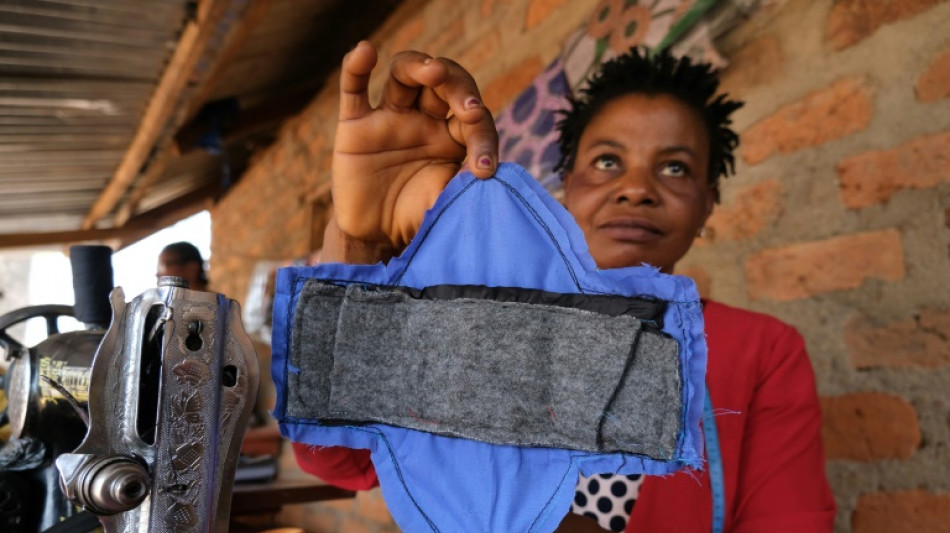
UNHCR and its NGO partner distribute washable and reusable pads.
- Missing school -
"I preferred the ones we were using in Cameroon, disposable ones, but the pads they gave us are ok," said 16-year-old Christabel, another refugee.
For three years, Ajili has been using the same reusable pads provided by the UN.
She says she is happy with them but would like to get new ones. "Sometimes... it gives me rashes," she said.
But the UNHCR says it doesn't have the funds to provide new pads, or to give packs to every single refugee.
Many other women uprooted by the conflict in Cameroon live outside the official camps and have not received any pads at all.
They use what they can find -- pieces of cloth -- despite the risk of infection.
Lack of proper protection means that sometimes girls "miss school when they are menstruating", said Moletsane.
Older women often miss work.
On top of the practical challenges, the subject of periods is taboo in Nigeria, as in many countries around the world, she added.
That makes it difficult, for instance, to dry washable pads outdoors which is important for avoiding bacteria, or when girls have to share the same toilet block as boys at school.
- New buyers -
Some refugees are taught how to make reusable pads to sell.
Mbia Enu has made about a hundred using materials provided by Save the Children.
The charity also bought the pads she made and distributed them to those in need.
But Mbia Enu is now struggling to find new customers among the refugee community.
The pads she makes -- sewed using three layers of different types of cloth including a waterproof one -- are sold for 800 naira for a pack of three.
Determined to find new buyers, Mbia Enu used her meagre savings to travel to a market in Ikom, about 90 kilometres (56 miles) away, where she convinced a shop owner to buy the pads.
"He thinks Nigerian women might be interested in buying them," Mbia Enu said, hopefully.
Period poverty doesn't just affect refugees but also millions of poor Nigerian women.
Inflation has hit Nigeria hard this year, and the price of sanitary products has gone up like everything else.
According to the government, 37 million women in the country cannot afford menstrual pads.
D.Johnson--AT