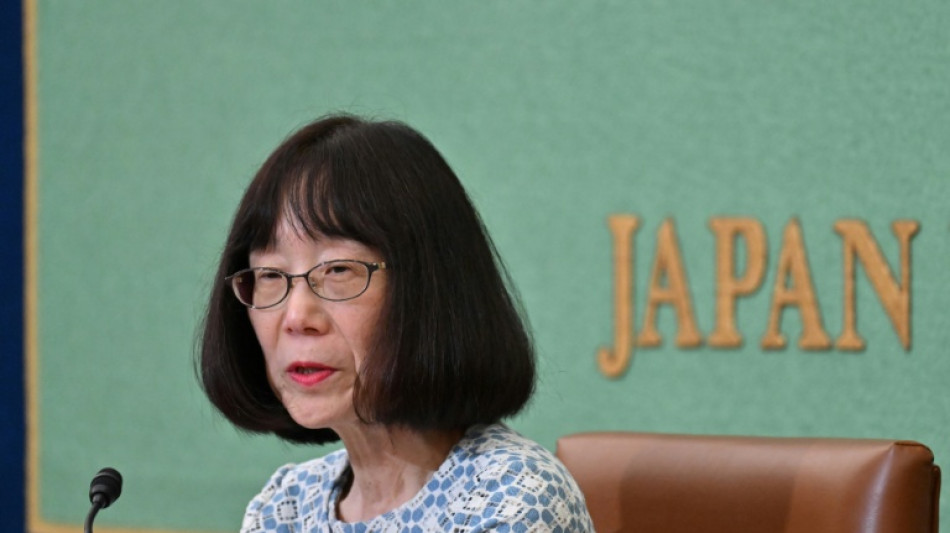
US-sanctioned ICC head warns against 'demise of international rule of law' / Photo: Kazuhiro NOGI - AFP/File

 Zach Hickerson Recounts Hayden Panettiere's Final Moments in New Interview

 Luxembourg Housing Petition Passes Threshold for Parliamentary Consideration

 Raheem Sterling Receives Suspended Sentence After Lamborghini Crash

 Audience to Choose the Set List at Luxembourg's First FAMIL Jukebox Night

 Luxembourg Pay Rise Delayed as Regional and World Headlines Develop

 Chennai Urbanist Sashna Develops 'Anniki' Card Game to Gamify Tamil Nadu History

 Transport Minister Defends Land Seizure Powers for Toronto-Quebec City High-Speed Rail

 UAE Weather Forecast: Scattered Showers and Fog Expected as Temperatures Drop
International Criminal Court President Tomoko Akane of Japan warned on Friday against "the demise of international rule of law" after the United States targeted her with sanctions.
Washington sanctioned Akane and trial lawyer Abdoulaye Seye of Senegal on Tuesday as part of the Trump administration's campaign against what it calls a "corrupt and fatally politicised" body.
"The sanction against me this time was something I had anticipated to an extent, so I'm not surprised," Akane said in a statement released on X by her publisher Bungei Shunju.
"The important thing is not to let this be the beginning of the demise of international rule of law."
The measures bar Akane and Seye from entering the United States and from carrying out transactions in the US financial system.
Akane's statement -- her first public comments since the sanctions -- comes after the ICC on Wednesday called the US measures a "flagrant attack" on the court's independence.
The United Nations rights chief Volker Turk and top EU officials threw their support behind Akane and her institution.
Washington's latest move follows sanctions it imposed on several ICC officials, seen as largely in response to the court's investigations involving Israel, a US ally.
Japan has also objected to the sanctions on Akane, with the foreign ministry saying it "consistently supported the ICC... in its efforts to prosecute and punish the most serious crimes of concern to the international community and to uphold the rule of law".
Japan is the biggest funder of the ICC and a close US ally.
Established in 2002, the ICC prosecutes individuals accused of the gravest atrocities and acts as a last resort when countries do not have adequate legal systems to ensure accountability.
US Secretary of State Marco Rubio earlier said in a statement, without providing examples, that the sanctioned "individuals have directly engaged in efforts by the ICC to investigate, arrest, detain, or prosecute officials whose government has not consented to ICC jurisdiction".
The United States signed the Rome Statute establishing the ICC but never ratified the treaty. Israel, Russia and China are not ICC members either.
In 2023, the ICC issued an arrest warrant for Russian President Vladimir Putin over the war in Ukraine, prompting Moscow to issue its own arrest warrants for senior court officials.
These included Akane, 70, an ICC judge since 2018 who was elected as the court's president in March 2024.
"Even if one judge were to die, we are easily replaceable, so there is really no value in targeting us," she said after the Russian announcement.
Ch.Campbell--AT


