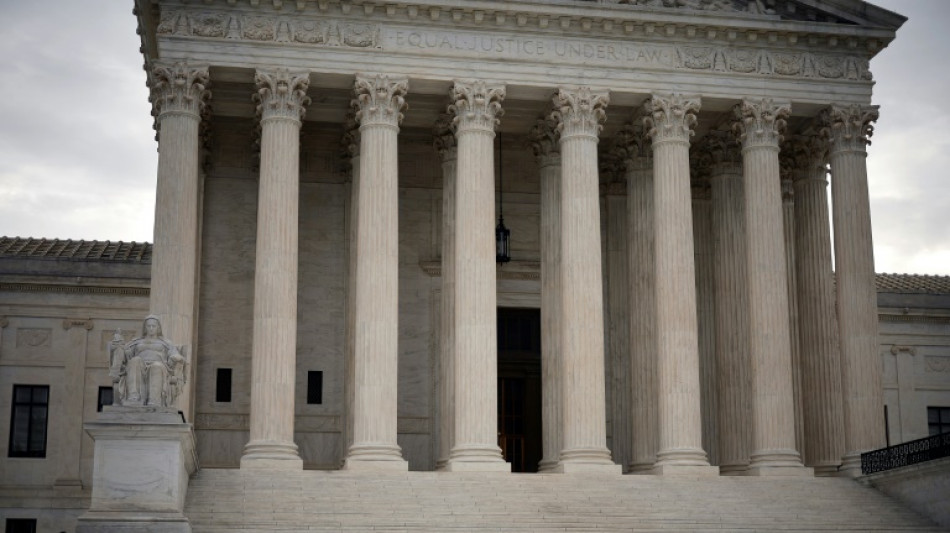
US Supreme Court upholds Native American adoption rights / Photo: CHIP SOMODEVILLA - GETTY IMAGES/AFP

 Breytenbach confirms recommending Sibiya for Johannesburg post

 Celebrities mark Thanksgiving in turkey-themed photo gallery

 German fashion model Veruschka dies in Berlin at 87

 Thanksgiving storms disrupt thousands of US flights

 T.J. Lang criticises Aaron Rodgers over comments about Mike McCarthy

 Black Friday beauty offers span skincare, fragrance and wellness devices

 U2 pays tribute to Dolly Parton during Thanksgiving Eve NFL show

 Toyota Innova Hycross and Kia Sorento hybrids compared in top trims

 President Trump to Attend TSMC Groundbreaking in Phoenix Next Week

 Gauteng Health Department Warns of Rising Antibiotic Resistance Threat

 Bishop Museum Races to Save Rare Megamouth Shark Specimen

The US Supreme Court on Thursday upheld a law that gives Native American families priority in adoptions and foster care placements of tribal children.
In a 7-2 vote, the nation's highest court rejected challenges to the Indian Child Welfare Act (ICWA) brought by a non-Native American couple seeking to adopt an Indian child and the state of Texas.
They had argued that the ICWA, passed by Congress in 1978, was unconstitutional and discriminates on the basis of race.
"The issues are complicated," said Justice Amy Coney Barrett, who authored the majority opinion.
"But the bottom line is that we reject all of petitioners' challenges to the statute, some on the merits and others for lack of standing," said Barrett, who is herself the mother of two adopted children of Haitian origin.
Like in Canada, Native American children in the United States were for decades removed from their biological parents and placed in boarding schools or with non-Indigenous families as part of a policy of forced assimilation.
Congress sought to bring an end to the practice with the passage of the ICWA, which set strict standards for removing Native American children from their parents and required tribal families to receive priority for foster care placements and adoptions.
Republican-led Texas, as well as families restricted by the ICWA from adopting Native American children, filed a legal challenge under the US Constitution's 14th Amendment, which limits the differentiation between citizens on the basis of race.
Several Native American tribes, backed by the administration of President Joe Biden and the powerful ACLU civil rights organization, countered that the law was not based on race but on Indigenous groups' sovereign rights.
Under US law, Native American tribes have a special status with their own legal jurisdictions and court systems.
The Supreme Court decided to intervene in the case after lower courts issued divergent opinions.
Biden welcomed the court ruling.
"Our Nation's painful history looms large over today's decision," the president said in a statement. "In the not-so-distant past, Native children were stolen from the arms of the people who loved them.
"The Indian Child Welfare Act was passed to protect the future of Tribal Nations and promote the best interests of Native children, and it does just that."
H.Thompson--AT