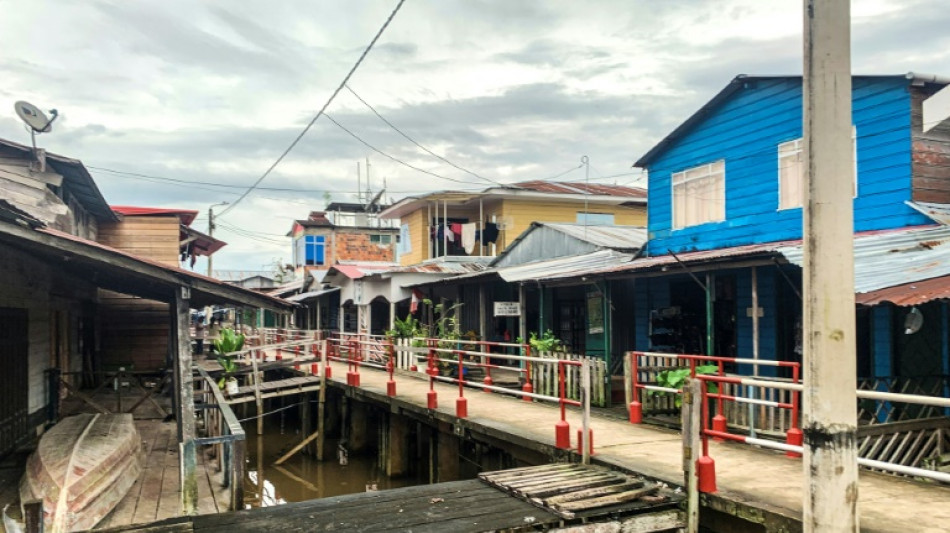
In Peru's Amazon, evangelical cult awaits Inca second coming / Photo: Hervé BAR - AFP

 Arteta blasts 'unacceptable' Sunderland penalty despite Arsenal win

 Mbappe at the double as Real Madrid sink Rayo

 Arsenal extend perfect Premier League start as Chelsea, Liverpool held

 US survive Spain scare to book World Cup final clash with France

 Celine Dion makes long-awaited return to stage in Paris

 Werro crowned Ultimate queen, US sweep 100m races

 Venezuelans outside Caracas say capital not sharing blackout burden

 Danish WWII drama wins top prize at Venice festival
 Chelsea boss Alonso yearns for 'boring game' after Hull make their point

 Werro outguns Hodgkinson to win women's 800m at Ultimate

 Moreira leads AC Milan fightback in Lazio draw

 Chelsea boss Alonso for yearns for 'boring game' after Hull make their point

 'Tired' Liverpool must adapt to schedule, says Iraola

 Stunning US fightback sets up Solheim Cup singles showdown

 Monaco's perfect Ligue 1 start ends with Strasbourg draw

 Ukraine's economy hobbled by Russian strikes

 France sink Germany to reach first women's basketball World Cup final

 Hull hold Chelsea, Liverpool fail to beat Fulham in Premier League

 Nmecha and Silva keep Dortmund perfect in Bundesliga

 Norris snatches thrilling Spanish GP pole from Antonelli

 'Great to have a race at home': Fans celebrate F1's Madrid return

 French IT giant Capgemini sells subsidiary after row over ICE links

 Thousands rally in Kosovo ahead of ex-leader's war crimes verdict

 Zelensky ready to meet Putin at G20 in Miami
 Gaza film, 'irreverent' Malkovich drama vie for Venice top prize

In the heart of the Amazon, where Peru, Brazil and Colombia meet, members of a quirky religious mashup of evangelical Protestantism and Incan rites await the end times in their remote "Promised Land."
Members of the Israelites of the New Universal Pact -- a religion that has nothing to do with Judaism -- farm and sell their wares to townsfolk and occasional tourists while they await a post-Judgment Day return of the Inca empire and a new world order.
Considered a sect by some, the Israelites have their own bible and commandments and of course a prophet in the form of Ezequiel Ataucusi Gamonal, who died in 2000 and was replaced by his son Jonas.
"God commands us to grow our beards and hair," sixty-something Israelite Gustavo, who sells vegetables and sweets in the Peruvian town of Islandia, told AFP.
Members of the community greet each other with a fraternal: "Peace of God, brother" and are loathe to give their full names.
"All those who bind themselves to God must conform to his principles," including renouncing alcohol, said Gustavo, waving the bible he carries with him everywhere.
Gamonal -- a former Catholic and later Seventh-day Adventist -- created the Israelite religion in the 1970s among inhabitants of the Peruvian Andes.
The movement later moved to the Amazon rainforest which adherents view as the "Promised Land" and the only place that will survive the end of the world, according to Lionel Rossini, a cinematographer who specializes in the tri-border region.
The movement recruited followers mainly among Indigenous landless people, but also former guerrillas of the now defunct Shining Path insurgency, and in poor neighborhoods of Amazonian cities.
By 2000, the Israelite religion counted nearly 200,000 members -- though many left that same year after self-proclaimed prophet Gamonal's promised resurrection three days after his death never happened.
Many settled in villages along the Javari and Amazon rivers, including in the town of Islandia, which resembles a jungle Venice with its wooden houses on stilts in the Javari River.
There is not a car or motorbike in the town of 3,000 souls, about a third of them Israelites.
- 'Nest of traffickers' –
Men in the group wear their hair and beards long, and many dress in multicolored cassocks similar to those associated with Jesus. Women dress demurely, with long sleeves, and cover their hair.
Every Saturday, the faithful gather to make burnt offerings of cows, goats and chickens.
They live a mostly farming lifestyle, producing rice and vegetables, some of which they sell.
"People live on fishing, trade, a little of everything... There are also officials" in the local government, city secretary Linda Pimentel Santa Cruz, not an Israelite, told AFP on a recent visit.
Rossini added that the Israelites "are reputed to be hard workers because for them, their work is part of God's work."
Islandia is a gateway to the mysterious Javari Valley -- the second-largest Indigenous territory of Brazil and home to the last uncontacted tribes in the world.
Santa Cruz and others are working to turn Islandia with its sole restaurant and a fresh produce market under construction, into a tourism attraction.
But they are having to contend with an ominous presence of countless criminals in this part of the dense jungle: drug traffickers, illegal gold miners and loggers, poachers, and unlicensed fishermen.
Despite the presence of Peruvian army boats, the city "is a nest of traffickers of all kinds," said a frequent visitor who did not want to be named for fear of reprisal.
Islandia today produces a large part of the vegetables consumed in the region, playing an increasingly important role in the local economy and trade.
- Political force –
The Israelites have also created their own political party -- the People's Agricultural Front of Peru -- which has several municipal, even mayoral seats in Peru, and surprised many by obtaining more than eight percent of the vote in parliamentary elections in 2020.
The party advocates the adoption of divine law and agriculture as the best means of combating poverty.
"Even if they are isolated, by their number and by their work, the Israelites have succeeded in establishing themselves as decisive actors in this Peruvian Far East... a pioneering front that is advancing," said Rossini.
E.Rodriguez--AT