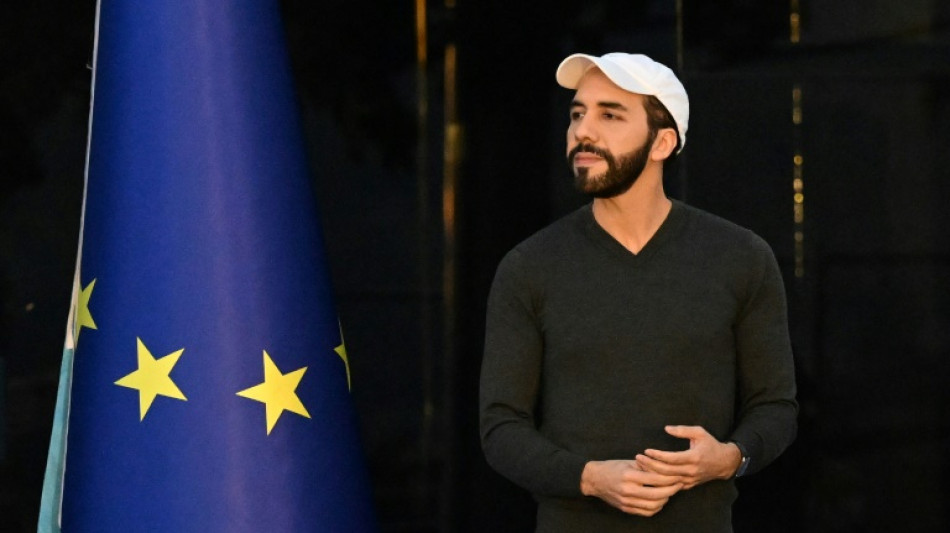
Four years on, Salvadoran 'dictator' Bukele basks in gang war glory / Photo: Marvin RECINOS - AFP

 Arteta blasts 'unacceptable' Sunderland penalty despite Arsenal win

 Mbappe at the double as Real Madrid sink Rayo

 Arsenal extend perfect Premier League start as Chelsea, Liverpool held

 US survive Spain scare to book World Cup final clash with France

 Celine Dion makes long-awaited return to stage in Paris

 Werro crowned Ultimate queen, US sweep 100m races
 Venezuelans outside Caracas say capital not sharing blackout burden

 Danish WWII drama wins top prize at Venice festival
 Chelsea boss Alonso yearns for 'boring game' after Hull make their point
 Werro outguns Hodgkinson to win women's 800m at Ultimate

 Moreira leads AC Milan fightback in Lazio draw
 Chelsea boss Alonso for yearns for 'boring game' after Hull make their point
 'Tired' Liverpool must adapt to schedule, says Iraola
 Stunning US fightback sets up Solheim Cup singles showdown

 Monaco's perfect Ligue 1 start ends with Strasbourg draw
 Ukraine's economy hobbled by Russian strikes
 France sink Germany to reach first women's basketball World Cup final
 Hull hold Chelsea, Liverpool fail to beat Fulham in Premier League

 Nmecha and Silva keep Dortmund perfect in Bundesliga

 Norris snatches thrilling Spanish GP pole from Antonelli

 'Great to have a race at home': Fans celebrate F1's Madrid return
 French IT giant Capgemini sells subsidiary after row over ICE links
 Thousands rally in Kosovo ahead of ex-leader's war crimes verdict
 Zelensky ready to meet Putin at G20 in Miami
 Gaza film, 'irreverent' Malkovich drama vie for Venice top prize
In his four years as president, Nayib Bukele has shaken up El Salvador: consolidating power, making Bitcoin legal tender and waging a "war" on gangs that's earned him opprobrium from rights groups but adoration from a crime-fatigued nation.
As he gears up to contest a second term in February 2024, the 41-year-old president, who adopted the label "Dictator of El Salvador" in an ironic nod to critics, is basking in sky-high approval ratings.
Brushing aside two establishment parties to sweep to victory in 2019 elections, Bukele, who assumed office on June 1 of that year, stuck to his promise to tackle one of the world's highest murder rates, jailing tens of thousands of suspected gang members along the way.
To house them, he had the largest prison in the Americas built in a matter of months, a 40,000-person complex that more than doubled the country's penitentiary capacity.
The murder rate plummeted.
Bukele's first year in office, the poverty-stricken Central American country had 38 murders per 100,000 inhabitants.
In 2020, that number was less than eight.
Bukele's main achievement has been "security, the dismantling of gangs," economist Carlos Acevedo, a former central bank president, told AFP.
This, in turn, "has really generated a new climate where we begin to see a revitalization of the productive fabric of microenterprises."
Small business owners, street vendors and residents alike celebrate their new-found freedom from drug-dealing gangs that demanded protection money and fought bloody turf battles.
Among them is Cristina Arevalo, 71, who was forced to close her small shop on the outskirts of the capital San Salvador several years ago due to nonstop gang activity in her neighborhood.
"With the security we are experiencing, I will soon reopen, because I will no longer be extorted," she told AFP.
Polls indicate that nine out of ten Salvadorans support Bukele's assault on gangs which formerly controlled 80 percent of the country, according to the government.
- Alarm -
On the other hand, rights groups, the United States and the United Nations have all expressed alarm about arbitrary arrests, inhumane prison conditions and growing authoritarianism in the country.
Shortly after taking office, Bukele ordered heavily armed police and soldiers to storm a then opposition-led parliament to intimidate MPs into approving a loan to finance an anti-crime plan.
Bukele's New Ideas party and its allies subsequently won a majority in the legislative assembly.
Parliament then replaced the five judges of the Supreme Court's highest body, the Constitutional Chamber, and the attorney general -- two institutions with which Bukele had clashed -- as well as a third of all the country's judges.
The refreshed Supreme Court later allowed Bukele to seek reelection despite the constitution's single-term limit.
"The government and the president have everything they need for reelection, not only because of popular support, but also because they control the majority of the institutions," public opinion studies expert Omar Serrano of Central American University told AFP.
Then in 2022, parliament approved Bukele's request for a state of emergency that expanded police powers and restricted civil rights.
This came after a particularly bloody weekend in March 2022 left 87 civilians dead at the hands of gang members, who Bukele has said must face "prison or death."
In the 14 months since, police have rounded up some 69,000 presumed gangsters, though about 5,000 were later released for a lack of evidence.
The mission of curtailing the gangs "has been achieved," said Carlos Carcach, a researcher at the El Salvador's Higher School of Economics and Business.
But it came at the cost of "implementing an emergency regime that implies the disappearance of the rule of law and supremacy of the constitution," he told AFP.
- Bitcoin gamble -
Another bold Bukele move was to make Bitcoin legal tender in El Salvador's dollarized economy -- the first country in the world to do so.
He insisted it would help revitalize a struggling economy despite warnings from experts and regulators about the cryptocurrency's volatility, potential impact on inflation and lack of consumer protection.
The currency plummeted in value and uptake was low in a population heavily reliant on remittances from some 3 million Salvadorans living abroad.
The adoption of Bitcoin "has been the most unpopular measure" of the Bukele government, said Serrano.
El Salvador's economy, according to the central bank, closed 2022 with growth of 2.6 percent and a projection of 2-3 percent growth for 2023.
S.Jackson--AT